

This is the map of homophobia in the world: advances and setbacks
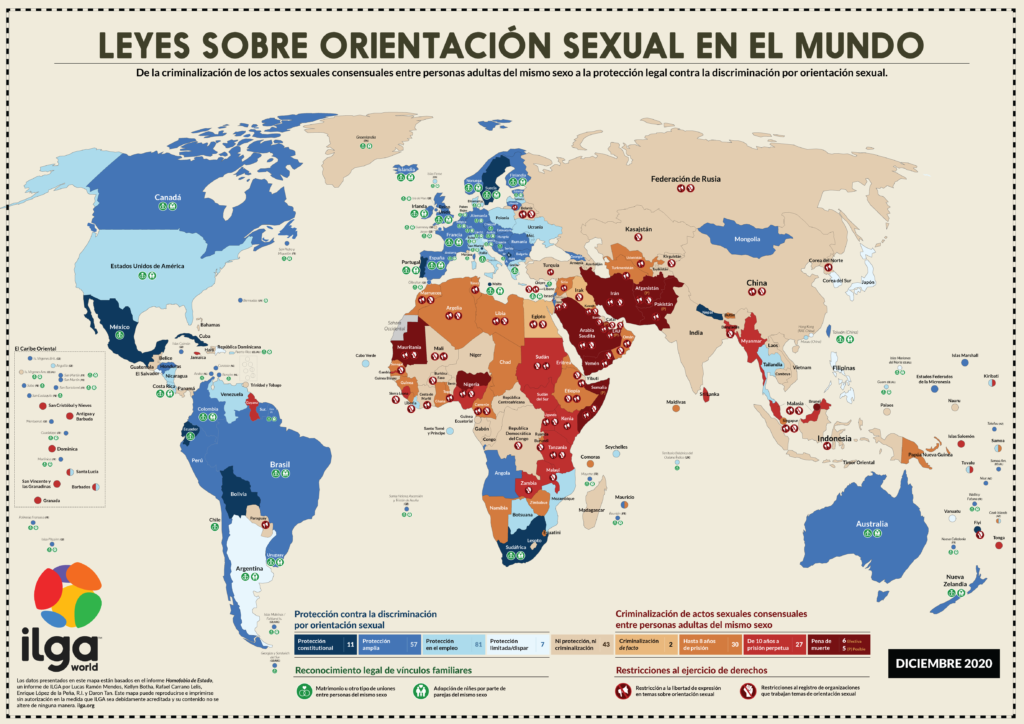
According to the State-sponsored Homophobia report by ILGA World, 69 UN member states continue to criminalize sexual orientation.


Share

By Rosario Marina
Infographics: Ilga World Report
According to the State-Sponsored Homophobia report , published by ILGA World and updated on December 15, 2020 , 69 UN member states continue to criminalize consensual same-sex sexual acts. This represents 36% of the 193 UN member states.

Since 2006, every year, the organization ILGA World (International Lesbian, Gay, Bisexual, Trans and Intersex Association) – a global federation created in 1978 that brings together more than 1,600 organizations – publishes its State-Sponsored Homophobia report, a global survey that maps what is happening with sexual orientation laws around the world.

Advances in the world in the last year
According to ILGA World, against all odds, positive progress has been made even during the last 12 months: the updated State-Sponsored Homophobia report documents how legislation protecting lesbian, gay and bisexual people from discrimination and violence has continued to expand around the world.

Same-sex marriage is now a reality in 28 UN member states. – In May of this year, Costa Rica was the last to join the list, thus becoming the first Central American country to do so.
-In the rest of the world, there were other important advances.
-In July 2020, Sudan abolished the death penalty for consensual same-sex sexual acts.
Germany has now become one of the four UN member states to ban so-called 'conversion therapies' at the national level, with more jurisdictions in Australia, Canada, Mexico, and the United States following suit.

2020 Review: Criminalization Did Not Fall Behind
The report's message, according to its lead author, Lucas Ramón Mendos, is twofold. First, "On the negative side, the idea that laws criminalizing gay people are historical remnants is false. We've focused on uncovering cases of incarceration: out of 69 countries, 34 are actively prosecuting and imprisoning people based on consensual sexual acts. This completely refutes the argument that these are merely outdated norms," he told Presentes.
First same-sex civil union in Bolivia
But on a positive note, the report's lead author highlights what happened in Bolivia on December 10. In July 2020, the Second Constitutional Chamber of the La Paz Court of Justice overturned a resolution issued by the National Civil Registry that had denied registration to a same-sex couple in 2019. It is important to remember that Article 63 of the Bolivian Constitution limits marriages and "free unions" to those between a man and a woman. However, the local United Nations office in Bolivia welcomed the decision and urged the Civil Registry to comply.
On December 10, 2020, the Bolivian Civil Registry adopted Resolution 374/2020: this means that David Aruquipa and Guido Montaño are the first same-sex civil union recognized by the State of Bolivia.
Latin America: More protection for LGBT+ people from the States
The blue color on the map indicates that the country has laws protecting same-sex couples from discrimination, among other things. “In Latin America, the map looks quite blue these days. This is thanks to the organizations that have succeeded in getting the State to protect LGBT people ,” Mendos pointed out.
Setbacks in the region
But she also emphasized that there have been setbacks in the region. “We have seen the rise of organized religious groups. While there has always been resistance, what we see today is a constructed discourse around this concept of ‘gender ideology .’ In Brazil, regarding restrictions on freedom of expression, we have found state-level regulations that prohibit the ‘dissemination of gender ideology.’ In Paraguay, there is a resolution from the Ministry of Education that prohibits material on ‘gender ideology,’” she noted, among other examples. She also mentioned the hate bus in Chile and the legislators in Peru who attempted to repeal a legislative decree that prohibits discrimination against LGBT people.
Nine Latin American countries criminalize sexual orientation
In Latin America, same-sex relationships are not criminalized in 73% of countries. However, in nine Latin American countries, same-sex relationships are still illegal : Antigua and Barbuda, Barbados, Dominica, Guyana, Grenada, Jamaica, Saint Vincent and the Grenadines, Saint Lucia, and Saint Kitts and Nevis.
Furthermore, homosexual relations are still prohibited in the police force of the Dominican Republic and within the army of Venezuela.
On the map, the only countries in Latin America painted red are Jamaica and Guyana. What's the situation there? “Both are former British colonies and retain the laws that spread throughout the British Empire. In the 1980s, some repealed these laws, but there are many religious groups that don't want to repeal them,” Lucas Ramón Mendos Presentes
Paraguay restricts freedom of expression on gender issues
In the region, there are no legal barriers to the registration or operation of organizations working on issues of sexual and gender diversity. However, Paraguay has a law that restricts freedom of expression on matters related to sexual diversity. In 2017, the then Minister of Education and Science, through Resolution 29.664 , prohibited the dissemination and use of educational materials that referred to “gender theory and/or ideology in educational institutions under the Ministry of Education and Science.”
The Inter-American Commission on Human Rights indicated that this measure "represents a setback for the rights of women, people with diverse sexual orientations and gender identities, and children to receive an education free of stereotypes based on ideas of inferiority or subordination."

Brazil: struggle for educational materials
In Brazil, the Supreme Court struck down laws in seven municipalities this year that prohibited educational materials containing “gender ideology.” According to this article by Human Rights Watch , “On April 24, the Supreme Court unanimously struck down a 2015 law in Novo Gama, Goiás state, that prohibited learning materials containing information about ‘gender ideology’ in municipal schools. On May 8, the court struck down a similar portion of a 2018 law in Foz do Iguaçu, Paraná state, that prohibited educational policies and school activities ‘likely to apply “gender ideology” or the terms “gender” or “sexual orientation.”’”
Jamaica and Haiti: among the most criminalizing
In Jamaica, the Film Authority still has to authorize films. In 2013, a film in which two lesbians were murdered by their boyfriends was banned without explanation.
Finally, in Haiti, in 2017, the Senate voted to prohibit “any public demonstration of support for homosexuality and proselytizing in favor of such acts.”
Constitutional protection against discrimination based on sexual orientation
As of December 2020, 81 UN member states have laws protecting against discrimination at work based on sexual orientation: twenty years ago, there were only 15.

However, Mendos cautions: “The law is one thing, but how it’s implemented in practice is another. This is a barometer that takes on a certain aspect.” The report is based on legislation, but in countries that appear to have good protection laws, this is sometimes not reflected in everyday practice.
There are only four countries in Latin America where protection against discrimination based on sexual orientation is guaranteed in the Constitution. These are: Bolivia, Cuba, Ecuador, and Mexico.

However, in 26 countries in the region, there is broad protection against discrimination even if it is not enshrined in the national constitution. In Argentina, for example, the report notes that at the federal level there is no law against discrimination based on sexual orientation in general terms, although the cities of Buenos Aires (Law against Discrimination – Law No. 5.261/2015) and Rosario (Law No. 6.321/1996) have enacted local laws that provide varying levels of protection.
“Furthermore, several provinces have enacted laws granting this protection. These local laws provide varying levels of protection,” the report states, explaining the case of Chaco, which has Article 60 bis of the Code of Misdemeanors (Law No. 4,209) prohibiting discrimination based on sexual orientation in general terms, and that of Río Negro, which, through Law No. B 3,055, recognizes sexual orientation as an “inherent right” of every person and, by virtue of Article 2, establishes that sexual orientation will be included in the application of all anti-discrimination legislation.
In the region, only Brazil, Ecuador, and Puerto Rico have laws prohibiting so-called "conversion therapies." However, Argentina, Chile, Mexico, and Uruguay also have "indirect" laws, mostly within mental health legislation.
Death penalty for sexual orientation
ILGA Mundo has been able to verify that at least 34 UN member states have actively implemented criminalization laws over the past five years, but the number is likely much higher. “Where these provisions are still in force,” explains Mendos, “people can be reported and arrested at any time, even on the mere suspicion of having engaged in consensual same-sex sexual acts. The courts actively prosecute them and sentence them to prison, public flogging, or even death.”

None of the states that punish consensual same-sex sexual acts with the death penalty are in Latin America.
This occurs in Brunei, Iran, Mauritania, Nigeria (only in 12 northern states), Saudi Arabia, and Yemen. In five other countries (Afghanistan, Pakistan, Qatar, Somalia (including Somaliland), and the United Arab Emirates), although there is no legal certainty, certain sources in the report warn that the death penalty could be imposed in those cases.
Share
We are present
We are committed to journalism that delves into the territories and conducts thorough investigations, combined with new technologies and narrative formats. We want the protagonists, their stories, and their struggles to be present.
SUPPORT US

FOLLOW US
Related notes


We are present
This and other stories are not usually on the media agenda. Together we can bring them to light.