

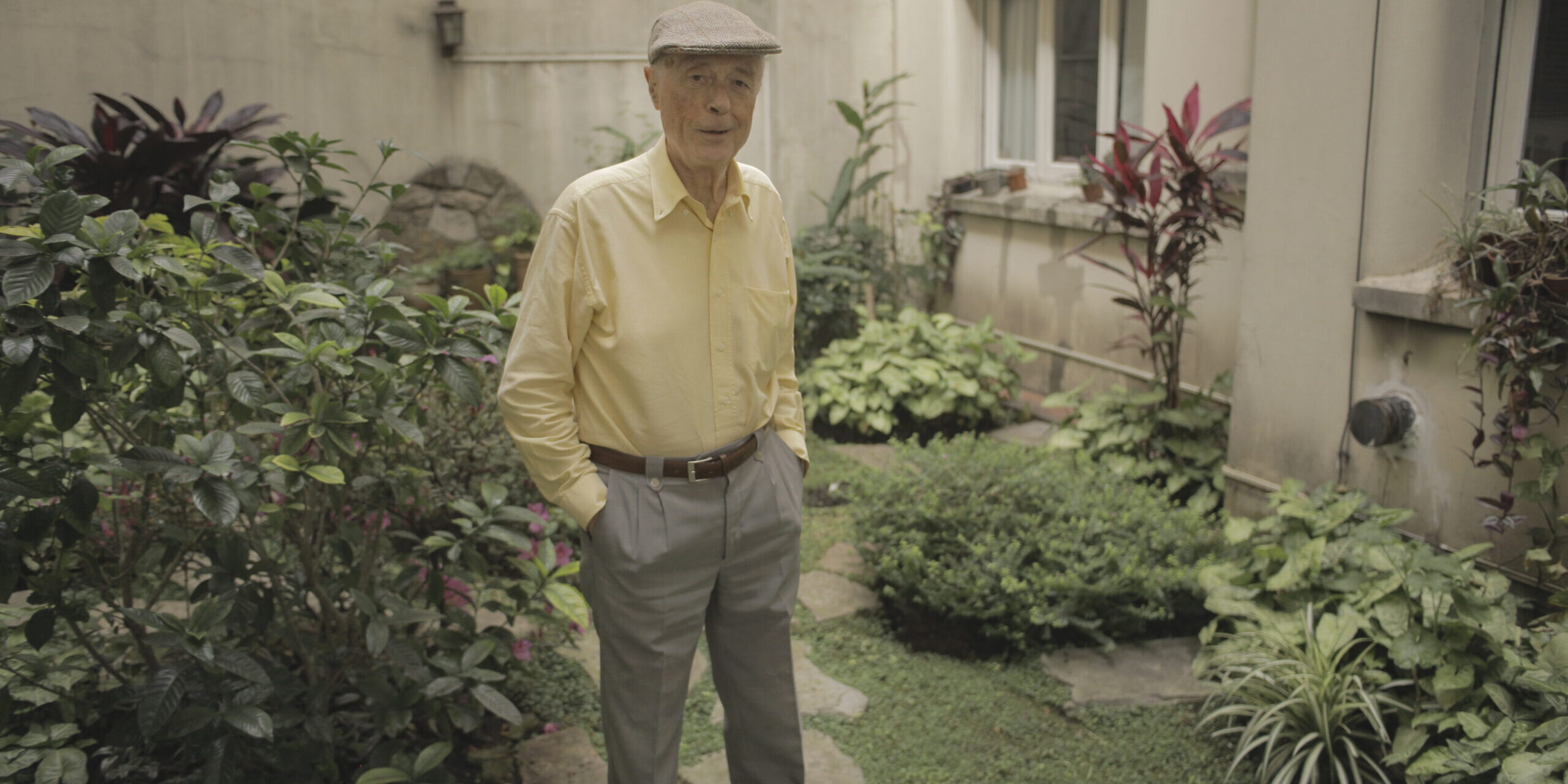
Blas Matamoro: “One writes from freedom, legislating for oneself”
He is one of the founders of the Homosexual Liberation Front of Argentina and an exquisite writer from exile, who today finds new readers in his country.


Share

The founding of the FLH ( Homosexual Liberation Front ) marked a milestone in the organization of sexual dissidence as a cultural and political phenomenon in Argentina. In 1971, a young Blas Matamoro (essayist, critic, and novelist) witnessed and played a leading role in this initial movement, alongside figures such as Manuel Puig and Nestor Perlongher.
Almost four decades later, Matamoro's literature (he currently lives in Spain) has resurfaced in Argentina thanks to the efforts of De Parado Publishing House . In 2019 *Las tres carabelas* (The Three Caravels) , a story born in the context of the State Terrorism of the last civic-military dictatorship, was published, and a few months ago, * La canción del pobre Juan* (The Song of Poor Juan), written in 1988, was released. This novel tells the story of Juan S. Aguilar, a writer who returns to Argentina after exile and meets a young dance star with whom he begins a romantic relationship.
We spoke with Matamoro on the occasion of the publication of *La canción del pobre Juan* (The Song of Poor Juan ). From Madrid (where he first emigrated in 1976 due to the censorship of his book *Olimpo *), Blas reminisced with us about the emergence of the FLH (Honduran Liberation Front), and discussed the relationship between the literary and the political in his work and life; his first encounters with the world of letters and the current rediscovery of his work, as extensive as it is diverse and exquisite.
– What are your earliest memories linked to reading and writing? What motivated you to publish and share your work?
My first attempts at writing stories date back to my childhood. I must have been about nine or ten years old. It was a pirate novel with illustrations. I only remember that there was a ship's captain traveling through the Caribbean with his daughter. I still haven't finished it. As for reading, I found the reading books silly and ugly. I have a special admiration for The Prisoner of Zenda* (a man who is two, himself and his doppelganger, fuel for my schizoid tendencies) and *The Mysterious Island * (a submarine and an island inhabited only by men, some mature and wise, others young, robust, obedient, and rather ignorant). I have no memory of when I first tried to publish. In 1967, my annotated translations of Mallarmé came out, thanks to a publisher named Cicero, who was frantically scouring the bookstores of Buenos Aires looking for someone translating Mallarmé. I did it sporadically, to distract myself from my law studies.
– To what extent
*Las tres carabelas*, reissued in 2019, an autobiographical book? What was it like writing about these themes in a context where it wasn't as "normalized" as it is now? – Every book is autobiographical because it's a written episode from the writer's life, the act of writing itself. It's not an autobiography but a work of fiction, and like all fiction, it incorporates personal experiences and memories that, when fictionalized, become fictional. As for normalization, I was never at all interested in working with the idea of what would be normal for any other writer in mind. You write from a place of freedom, making your own rules.
– The demand for sexual freedom became a political slogan with the rise of the FLH (Honduran Liberation Front). What can you tell us about its origins?
– The FLH was founded in my house on La Rioja Street in Buenos Aires in 1971. It was an initiative of the postal workers' union leader Héctor Anabitarte, and I, Juan José Sebreli, Juan José Hernández, and Manuel Puig attended. Juan Pablo Queiroz has compiled most of the documentation.
–What was it like to deal with homophobia in political spaces where one sought to integrate, such as certain sectors of Peronist activism?
The FLH allowed the issue to be brought to the media, albeit under pseudonyms or anonymously. Political parties ignored the topic. Some comrades tried to participate in a Peronist demonstration but were expelled after being greeted with these verses: “We are not faggots nor are we drug addicts/ we are brothers of the FAR and Montoneros.” In my work as a school teacher, lawyer, and journalist, I was never persecuted or inhibited by homophobia.
“The emergence of young readers surprises me”
The rediscovery and reappraisal of his narratives, amidst exile and the passage of time, is a remarkable achievement from the perspective of literary exegesis and cultural archaeology, undertaken by his editors. His work, largely forgotten until a few years ago, has gained new momentum thanks to the meticulous work of Francisco Visconti and Mariano Blatt, his editors.
However, let's clarify: a contemporary author like Ioshua acknowledged his influence more than once, citing him in both interviews and poems some years ago: “Rereading Jonathan by Blas Matamoro. Getting cigarettes. Dirtying my sneakers. Smiling at a kid on the soccer field,” he writes in the remarkable poem “No, Kid, No,” collected in * Todas las obras acabadas* (Nulú Bonsai, 2015 ). Coincidence?
“The appearance of young readers surprises me because I don't really know what culture they belong to, what their reading interests and demands are, or if they want to know something about the country that existed before the dictatorship. Perhaps you could better explain why you've been interested in reading my books. It would be interesting to survey a few more,” he remarks with a mixture of humility and contentment . No coincidence: one only needs to peruse his pages and immerse oneself in a unique, meticulous, elegant, and beautifully written prose. His historical relevance, yes; but his literary power as well.
– As an author, what was your stance regarding the relationship between literature and the struggle for sexual liberation during the FLH era?
– A writer can be an activist wherever they want, but they shouldn't subject their work to any obligation prior to the writing itself. Personally, activism doesn't appeal to me. It's a category of a military nature.
– Many of your works were published in the collections of the Centro Editor de América Latina (CEAL). What was your connection to that publishing project?
– I dealt regularly with Boris Spivakov, who was the director. My contacts were with the collection editors, Luis Gregorich and Beatriz Sarlo. I also worked on my book Olimpo , which was the first book banned by the Videla dictatorship, with its dedication to Osvaldo Luaces, who was murdered by the repression. The book was finally published by Corregidor. I learned from a documentary by Mempo Giardinelli that the military burned 54 tons of CEAL books, including five of mine. It was a publishing house considered left-leaning, but we were never censored or subjected to any ideological suggestions.
– What was life like for sexual dissidents in Spain? Did you have contact with people who created like-minded spaces for fighting for the rights of gays, lesbians, and bisexuals?
– I had to leave because of the text of the prohibition decree and because my partner at the time disappeared for a week. We decided to emigrate before it was too late. In Madrid, I went to the first Gay Pride parade and returned with my current spouse when the law legalizing same-sex marriage was passed.
– What does it mean to you to rediscover your work among new generations of readers through De Parado, or through younger authors
like the poet Ioshua, who quotes you in one of his poems?
-Personally, it's very gratifying for me because I've been away from the country for 44 years, and much of what I've written in Spain isn't known there. My books stood on their own two feet, since I couldn't attend to them beyond writing them.
– Having written literary and music criticism, essays, novels, and remaining active, publishing for so many years to this day, do you feel you have any unfinished business, any pending writing projects you'd like to pursue?
I enjoy writing and do so regularly in articles. I don't like to talk about unpublished material. I prefer to be read by others.
We are present
We are committed to journalism that delves into the territories and conducts thorough investigations, combined with new technologies and narrative formats. We want the protagonists, their stories, and their struggles to be present.
SUPPORT US

FOLLOW US
Related notes
We are present
This and other stories are not usually on the media agenda. Together we can bring them to light.