

She was arrested on a 33-year-old warrant: all the lives of trans activist Ivanna Aguilera
The trans activist and survivor of the dictatorship was “detained” days ago in Córdoba by an arrest warrant from 1988, based on a contravention code that has not existed since 2016 and an article repealed in 1994.


Share

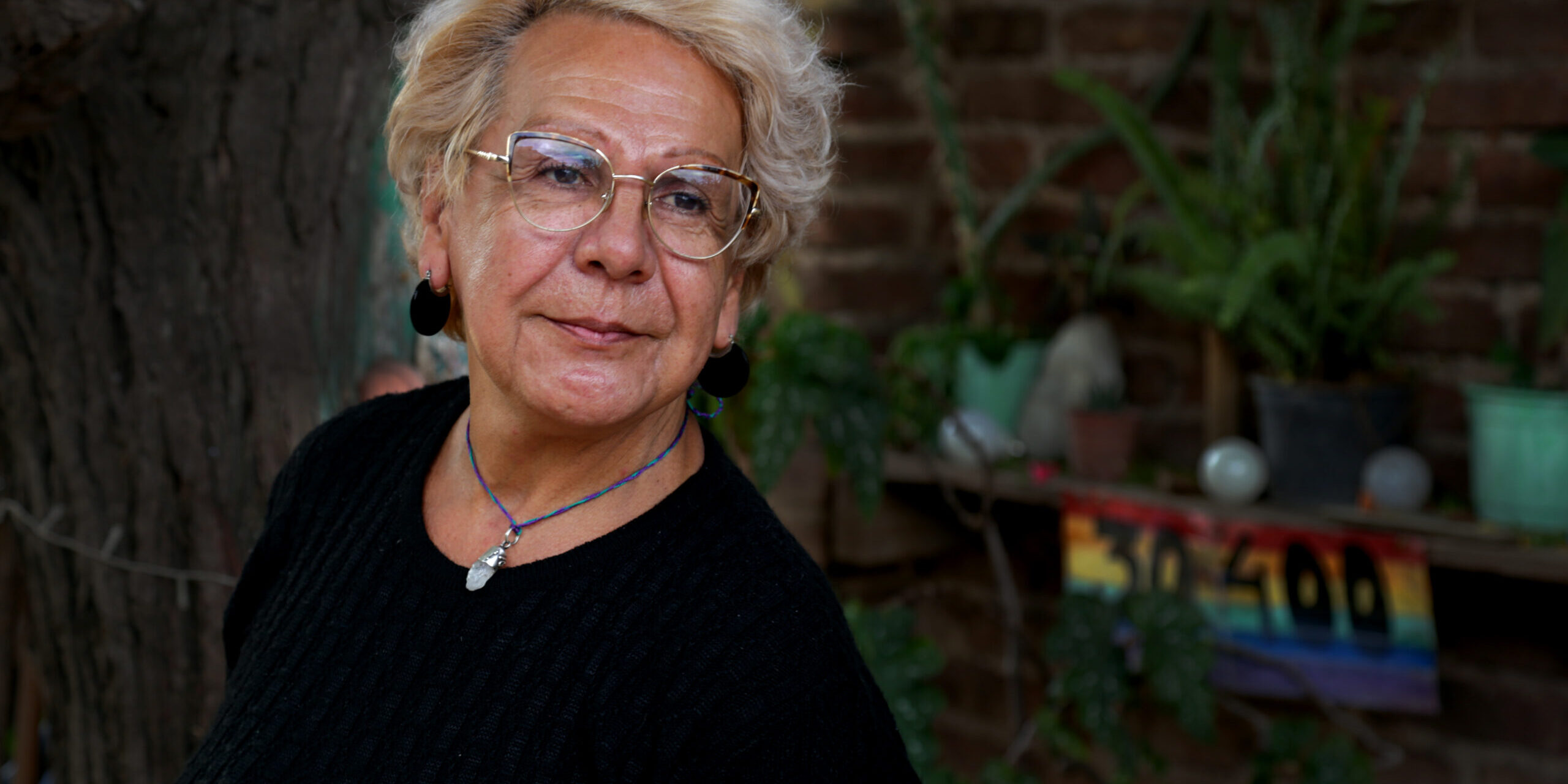
At 12:45 a.m. on Monday, March 29, the taxi in which Ivanna Aguilera was returning home was stopped at the police checkpoint on the Maipú Avenue bridge over the Suquía River, which runs through the city of Córdoba. The long-time trans activist handed her ID to the officer for a check that lasted more than twenty minutes. Aguilera paid the taxi, got out, and asked what was happening. A police officer pointed to the gazebo: “Wait there.” Three hours later, she was taken in a patrol car to Judicial Unit 1, where an official informed her that the “delay” was due to an arrest warrant issued thirty-three years earlier.
—It was much more than a déjà vu— Ivanna says with a bitter expression.
The now adopted daughter of Córdoba and one of the national leaders of the trans community was born in Rosario in 1963. Like Fito Páez, she was also a student at the Manuel Belgrano primary school, from which Ivanna was expelled at the age of nine because her emerging diverse identity was considered “immoral.” Orphaned at the age of four, she grew up in “a family of siblings.” “We raised each other, and my sisters and brothers always respected my freedom,” she recalls in an interview with Presentes .
“To the Army we were just sex objects”
Ivanna was 13 years old in 1976 when she and a friend of the same age used to visit Poropá, who embodied everything they wanted to be and was the godmother who initiated their transvestite identity. As night fell, Poropá would see them off before standing on the corner by the Rosario Automobile Club. One cold August night, they lingered too long and were surprised by an army patrol.
— A truck pulled up, followed by two jeeps. They jumped out, grabbed the oldest girl by the arms, and started insulting her, saying all sorts of things. They threw us all on top. Imagine, we were just kids. They also took another girl who happened to be there, still hurling insults at us about our sexuality. I'd never heard those words before: faggot, degenerate, pervert… all that. We were driven around in that truck for a while, went into a place, were taken to a kind of office, and separated. I was in a large bathroom with showers and urinals, the kind with marble walls. Then we were subjected to gang rapes. My first sexual experience was a gang rape, followed by beatings and electric shocks. There we were abused for 72 hours, until they put us back in a truck and left us lying naked, hurt and broken – in our bones, me in a leg and wrist, but also morally – in an open field behind the Swift refrigerator.
With the care of her siblings, it took her three months to recover and even longer to work up the courage to return to the center to look for her friend Poropá: “I could never find her again, nor did we ever hear from her again. From then on, I was a woman who had a vision for myself. Like any other woman at that time, I lived at night and took many risks, because we had to work and bring food home.”
During that time, the Rosario police arrested them and took them to the former police station—where they were housed in the PH (Homosexual Pavilion)—and to the headquarters of the Rosario Police Intelligence Service , which also functioned as a clandestine center for detention, torture, and extermination. “But also, every now and then the Army would kidnap us to use us as sex slaves and then dump us somewhere,” Ivanna adds.
Trans girls “under the flag”
In 1981, at the age of 18 and still under the dictatorship, she drew an unusually high number in the lottery for mandatory military service. With the notification slip, she and a friend in the same situation went to the 121st Communications Battalion of the II Army Corps , where the medical examination prior to joining the military was being conducted.
“At the entrance, there was a table with officers receiving citizens,” Aguilera recounts. “We waited until everyone had gone in, presented our letter, and they called two military police officers to escort us. They made us walk around the entire park, with the officers lined up on either side. We were two trans women, so they skipped the security check and took us straight to the medical board. But before that, I asked to use the restroom, and that's when I became aware of the place and a certain smell. I also remembered that when I was arrested for the first time, they took us out early in the morning, and the truck had metal sheets with holes in the sides, through which I could see that same park. Then I knew that this was the place where I had been five years before.”
From Battalion 121 they were sent to the military office in downtown Rosario, where they were then referred to the Military Hospital in Paraná, Entre Ríos. There, a clinical diagnosis had to be prepared to justify the exception. “They kept us hospitalized for a month. We went to the psychologist in the morning and to the psychiatrist in the afternoon,” she recalls.
—Did they want to cure them?
“I don’t know what they were trying to do, because they weren’t telling us anything. We were two trans women under the flag (laughs). After a month, they discharged us, and back in Rosario, they told us we were exempt from military service and gave us back our IDs. We looked at them, and it said by law this and that… You know how there was a legend that said homosexuals were marked in red? But the exemption was a law that applied to everyone: the one who was missing an eye, the one who was lame, the one who was overweight, the one who was very tall, the one who had flat feet…”
—Was it what they called FAD (physical fitness deficiency)?
-That.
—They equated trans identity with a medical problem…
—Of course, we were sick! The thing is, we went back to civilian life; that is, to police and military persecution.
Public and private punishment
“I suffered very marked harassment. The police didn’t arrest me: they grabbed me, beat me senseless, and left me lying there. Like that, over and over again. Until a more ‘cool’ cop, in quotes, told me: ‘Do you know what your problem is, Gata? You have two brothers who are police officers and they don’t want anything to do with you, because you embarrass them, because their colleagues gossip about them and tell them they have a brother who’s a thug,’” Ivanna recounts.
Her older sister confirmed that her father had children from a previous marriage, one of whom was the head of the Robbery and Theft Division and the other a member of the Rosario Police Radio Patrol. The repression in the streets was mirrored in her private life: “My partner was also violent. That's why I left Rosario, fleeing all that violence. When I left, I became uprooted from my city, my friends, and my family, with whom I lost contact for more than thirty years. Here in Córdoba, it was no different. There was systematic persecution, and we lived hiding from the Army and the Police, but without the personalized beatings by my partner and the police. The truth is, what happened to me the other night wasn't pleasant. It stirred up a lot of things, and it saddened me greatly that institutional violence is still present.”
The past that returns
The arrest warrant for Aguilera dates back to 1988 and was based on the old, dictatorial Code of Misdemeanors of the Province of Córdoba , in force since April 23, 1980, modified in 1994 and replaced on March 28, 2016, by the current Code of Coexistence . The article invoked was Article 19, precisely one of those eliminated in the 1994 reform: “Persons of either sex who exhibit themselves in public in clothing contrary to public decency, according to the place, will be sanctioned with a fine equivalent to up to one time the minimum wage, or arrest for up to ten days.” Combined with Article 22 (“Those who, while practicing prostitution, publicly offer or incite others or do so by bothering people or causing a scandal, will be punished with arrest for up to thirty (30) days”) – later converted to Article 45 and reduced to 20 days of arrest but in force until 2016 –, they constituted the legal combo that enabled the repression of the trans-travesti community.
The police officers who detained her and the court official who explained the reason are likely unaware that the woman in question was one of the driving forces behind the repeal of the article that justified that long-ago arrest warrant. They even advised her to request the cancellation of the warrant, because she "might be arrested again." The process involved a bureaucratic ordeal between the courts and the police station.
The support of the National University of Córdoba
Currently, Ivanna coordinates the Trans, Travesti, and Non-Binary area of the Faculty of Philosophy and Humanities (FFyH) at the National University of Córdoba (UNC), which, along with other organizations, condemned the incident . Furthermore, this group is considering requesting meetings with the Chief of Police of Córdoba, Liliana Zárate Belletti, and the Attorney General of the Province, Juan Manuel Delgado, to demand respect for the Gender Identity Law 26.743 by the police force and the elimination of all arrest warrants or charges against trans and travesti people related to outdated regulations.
In turn, the Higher Council of the UNC expressed its concern yesterday and urged that “the exercise of public force, both in Córdoba and in the country, be strictly subject to a human rights perspective that avoids its arbitrary and harmful exercise of basic guarantees and freedoms of people, warning that in this context of pandemic authoritarian practices have deepened in the conduct of the police forces.”

The raid that spawned militancy
Shortly after arriving in Córdoba in 1983, Ivanna formed a relationship with a man whom she thanks for saving her life, because “I would have been just another statistic in the number of trans women murdered on a street corner or in a vacant lot. This partner took me out of the prostitution scene, which for trans women is not a choice and is synonymous with death, because we have a life expectancy of 38 years. Where are we murdered? In the context of prostitution.”
In this new life, she had a spacious house where she sheltered her fellow trans women in conflict, a greengrocer's shop to earn a living, and time for pioneering LGBTQI+ activism in Córdoba. In 1990, during a police raid on the Planta Baja nightclub—one of the few spaces open to sexual diversity in general and trans people in particular in Córdoba at that time—Ivanna was arrested along with more than forty other people, including Eugenio Cesano, the owner of the establishment. Together with him, they spearheaded the defense of those arrested, and in the heat of that mobilization, they created the Association Against Homosexual Discrimination (ACODOH), the first LGBTQI+ organization in Córdoba: “We started working, making ourselves visible, and together with social and human rights organizations, we demanded the repeal of this infamous Article 19 and Article 22. These were demands for which the Province and the Police were unprepared, but in '94 we managed to repeal Article 19.”
Later, she founded Flores Diversas, joined the United Transvestites Association of Córdoba (ATUC), represented Córdoba on the national board of the Association of Transvestites, Transsexuals and Transgender People of Argentina (ATTTA), and was an authority at Devenir Diverse, serving as vice president in 2014 and 2015 and president until 2019 when she assumed her current position. Through these organizations, she advocated for labor inclusion and the right to health for the trans and travesti community, campaigned for equal marriage and gender identity laws, denounced transfemicides, promoted the National Campaign for Trans and Travesti Labor Inclusion, and—with the student center of the Faculty of Philosophy and Humanities—created the Trans and Travesti Labor Inclusion Canteen at the National University of Córdoba (UNC).
Lost toys
—You're often described as a survivor, and that doesn't seem like an exaggeration…
"It's no exaggeration, not for me or my comrades. A twenty-year-old girl is also a survivor. Every day she has to wake up, if she wakes up at all, and figure out how to survive that day. I'm a survivor because I'm older and I'm still fighting. There aren't many of us older women who are activists. That's why they call me 'auntie' or 'grandma,' but we're all survivors ."
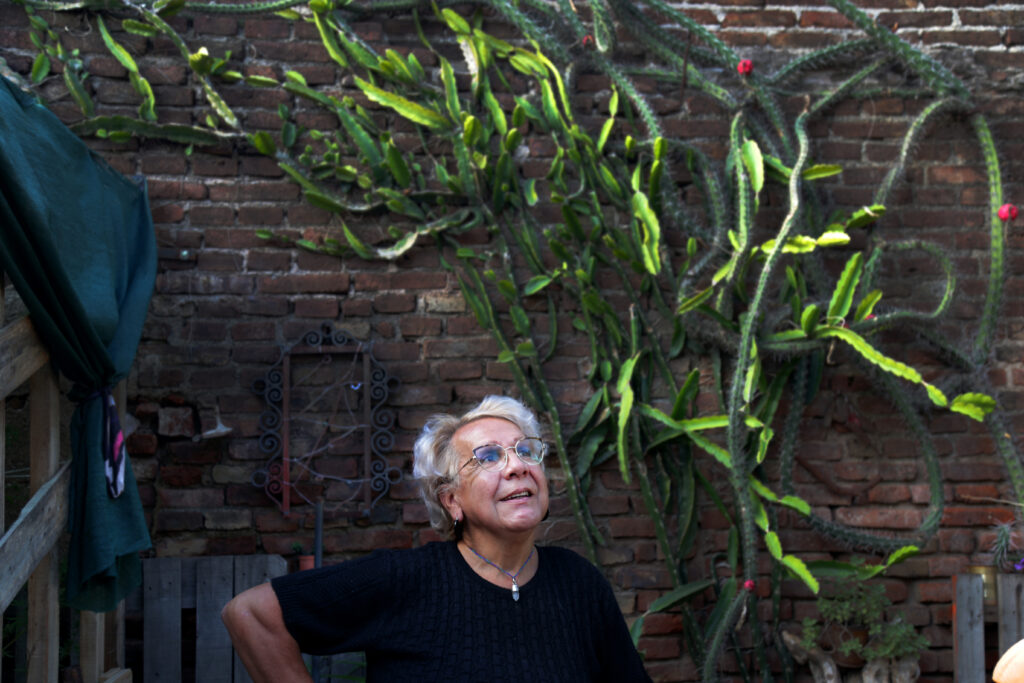
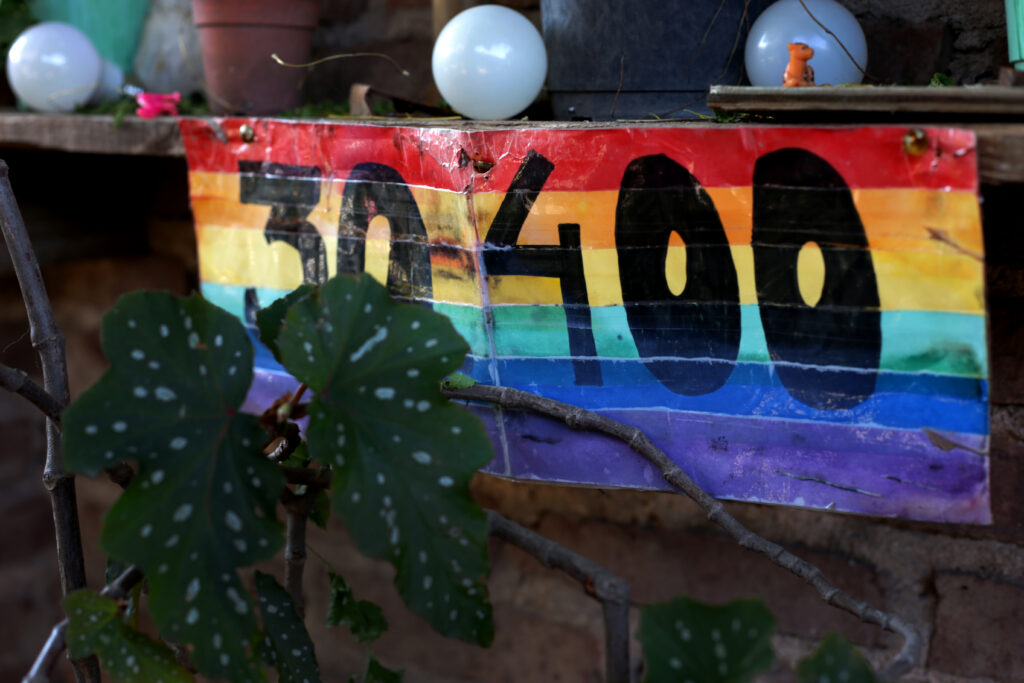
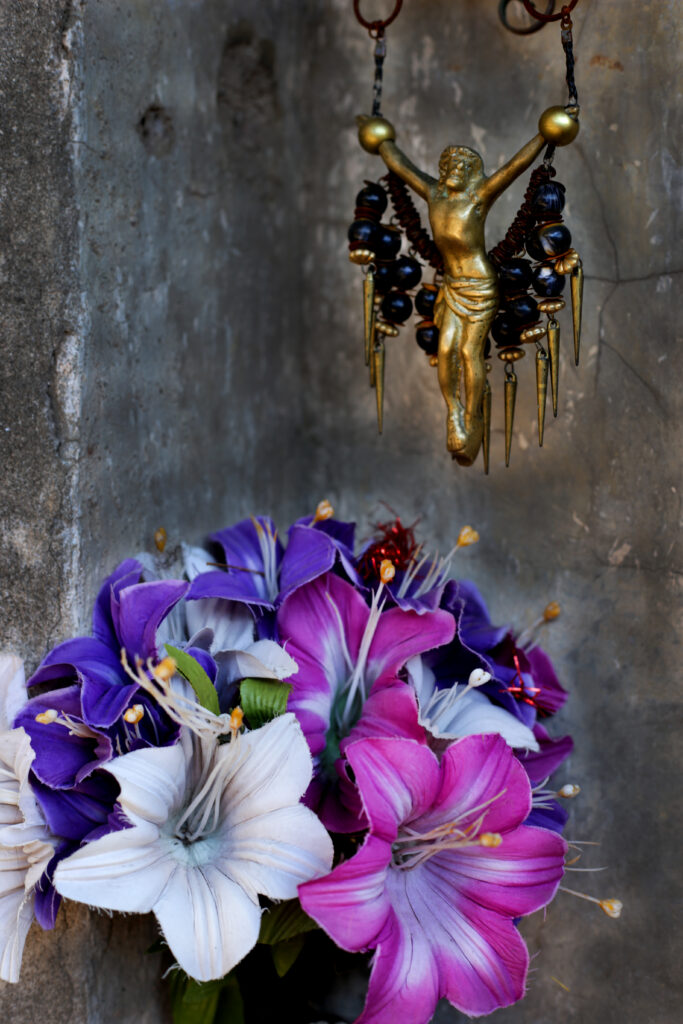
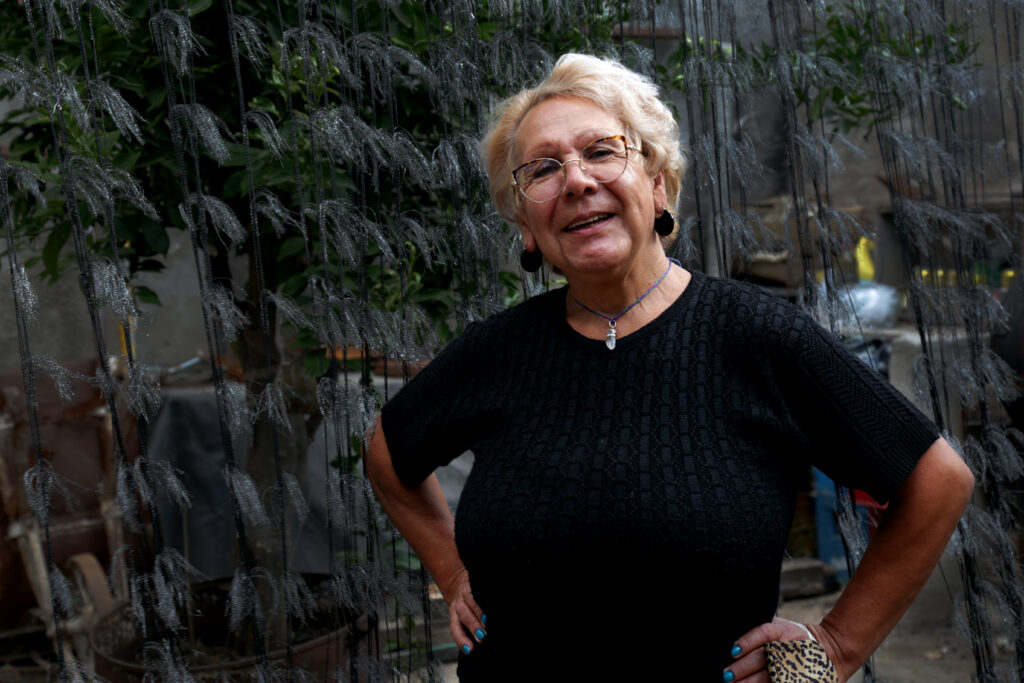
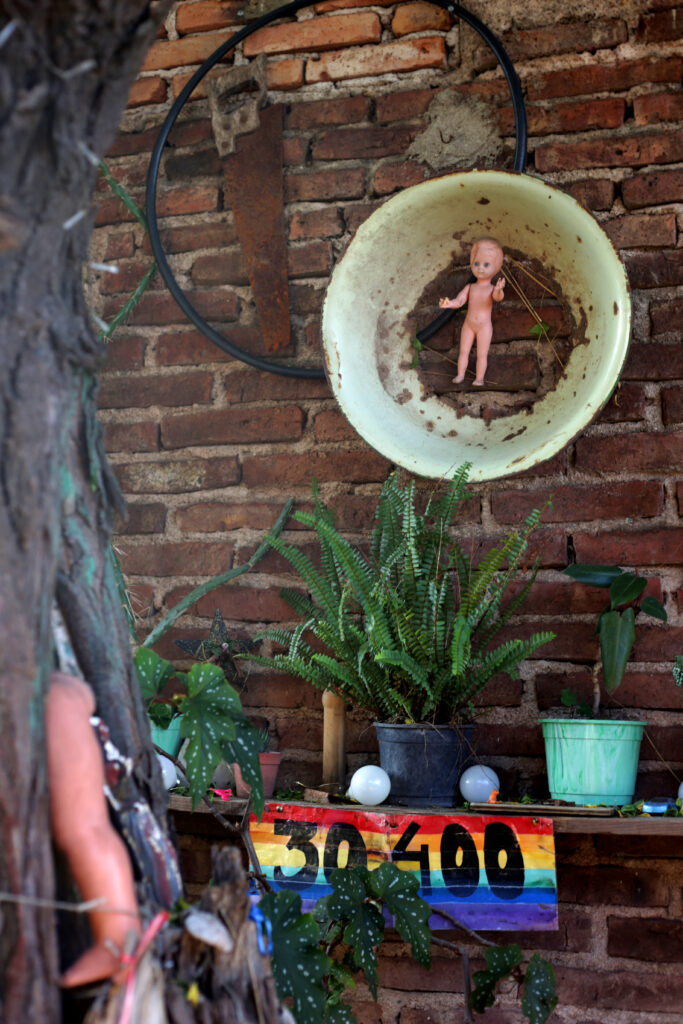
On the bare brick walls of the patio, the bricks are adorned with mementos and objects found in the street, integrated into the everyday landscape like small, secular shrines. “I’m a bit of a hoarder, and I almost always find toys, I don’t know why…” she says with a mysterious tone and a touch of nostalgia in her eyes. As if they had been hers, from that childhood marked by loss, discrimination, and violence. Or perhaps they are symbols of her hope for a future where the children who lost them can find the freedom to which she offers herself every day of her life: “To exercise the right to be who I am.”

“As much as possible, I try not to dwell on negative things,” she says. “The past is always there because I have a very good memory, but I don’t dwell on it. When I go to Rosario, I get off at the bus terminal and walk, because it was a city I couldn’t walk in. So, I explore it. I try to find places that remind me of when I was young or some nice memory, and I really do walk a lot.”

We are present
We are committed to journalism that delves into the territories and conducts thorough investigations, combined with new technologies and narrative formats. We want the protagonists, their stories, and their struggles to be present.
SUPPORT US

FOLLOW US
Related notes
We are present
This and other stories are not usually on the media agenda. Together we can bring them to light.