

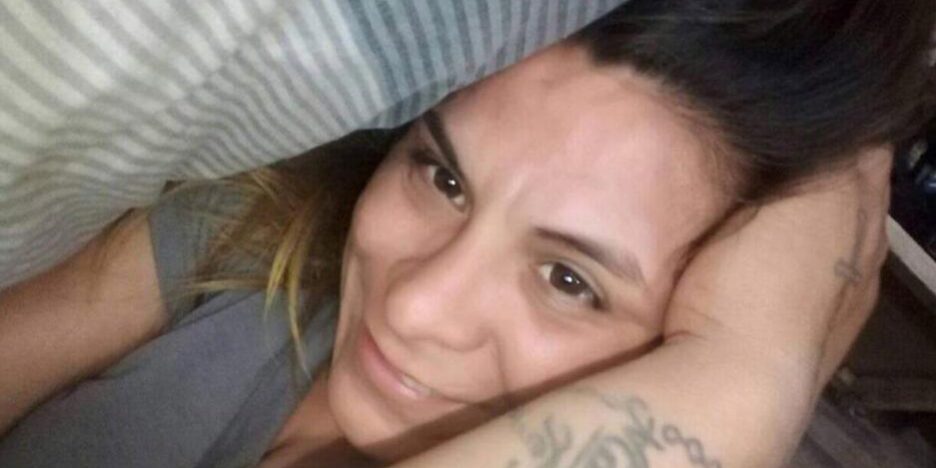
They denounce the transfemicide of Micaela Catán, a young trans activist from Santiago del Estero
Micaela Catán was 27 years old and lived in Santiago del Estero. She died after eight days in the hospital with burns covering half her body. Her family and organizations denounce her death as a transfemicide. They demand justice with a gender perspective.

Share

By Ernesto Picco, from Santiago del Estero. Photos: Facebook
Four years ago, at 23, Micaela Catán started elementary school again. She became the flag bearer at the school in the Primera Junta neighborhood of Santiago del Estero. She participated in meetings of the DIVAS association , where she was one of the most active young trans women. In 2021, at 27, she was in a relationship and had begun building her house in the Santa Rosa de Lima neighborhood. On the night of Saturday, April 3, her sister Marina found her sitting on the bed, her legs and arms spread wide. She was trying unsuccessfully to rub toothpaste on her body to soothe the burns: “Look at me,” Mica said to her sister when she saw her come in. They were both trembling.
It was the last time they saw each other. Marina later recounted: “She had no face. And the skin on her arms was peeling off.” Mica was hospitalized and died eight days later at the Regional Hospital. Now, while the family and organizations maintain that it was a transfemicide, the justice system is investigating the case with extreme discretion. The prosecutor in charge of the investigation is Celia Mussi , from the common crimes division.

Of abuse and violence
At midday on Thursday, April 15, Margarita Rodríguez, Mica's mother, welcomed Agencia Presentes to the same dirt patio where, three days earlier, her daughter's remains had been laid to rest. Also present were Marina, two brothers, and several grandchildren. The house is located in the Libertad neighborhood, a humble settlement on the far west side of the city, just meters from the century-old San Martín canal, which diverts water from the Dulce River across the entire city. The front of the house where Mica grew up is painted blue and red, the colors of the Güemes club, like many others in the neighborhood. Her mother, Margarita, lived there almost her entire life, working selling used clothing. Also living there was O, a neighbor with whom Mica had been in a relationship since she was 18.
"She suffered a lot of abuse," the mother recounts. "She had brought her partner here to my house, and he beat her. He grabbed her by the hair, he cut her. I ended up kicking him out of the house, and she followed him."
Mica and her partner ended up moving 5 kilometers from her mother's house, to a small house in the Santa Rosa de Lima neighborhood, along the road to Catamarca. She was building it with the money she received from the Hacemos Futuro program—designed to promote educational attainment—and the Social Emergency program. He had intermittent jobs. He had worked in a butcher shop and a motorcycle repair shop. Marina, her sister, had also started building her house in the same neighborhood, a hundred meters from Mica's. The family recounts that on the night of Saturday, April 3, he desperately knocked on Marina's door, telling her that his sister had burned down.
She ran to see what was happening and found Mica burned in bed. Dazed, she ran out to the sidewalk looking for help. Neighbors had begun to gather. After a while, an ambulance arrived. He was gone.
“If you have nothing to hide, you don’t run away,” Marina says. “When I killed the man who tried to assault me, I waited for the police to come. They raided the house, and I took responsibility. Because I was defending myself.”
Marina, Mica's sister, recounts her own horrific story in the dirt yard. In 2005, a neighbor tried to rape her, and she stabbed him in the chest with a knife. She was 16 years old and spent eighteen months in prison until she could prove she had acted in self-defense and be released.
Soon after, she met a man with whom she was in a relationship for ten years. They moved into a house, and every time they saw her mother, Margarita would find a bruise or a bump on her. Marina would tell her that she had fallen or hit her head on the window.
"I covered for him. I didn't want to report him," Marina says.
Until 2016, when Margarita reported him and the man ended up in jail for a few months. Upon his release, he returned to loitering around the family home. Marina was in a relationship again.
“My husband is a truck driver now, and he told her, ‘The day you go near the Navy, I’ll run you over with my truck,’” she recounts. She explains how that threat gave her the security that the law couldn’t: “He doesn’t bother me anymore, and neither do I.”
“I rescued her,” the mother says. “Because I’ve lived through violence too. My children’s father used to hit and abuse me. He didn’t like me going out to sell clothes. I finally had him removed by the police when my children were little. I also told Mica to report what was happening to her. But she didn’t want to. I couldn’t do it with her anymore.”
April: a violent fortnight for transvestite and trans people
The death of Micaela Catán adds to the episodes of violence against transgender people that reached a historic peak in the first half of April 2021. In Jujuy, Yeni Méndez barely survived a machete attack. And in Tierra del Fuego, Gilda escaped an attempted murder. On the same Monday, April 12, Josefina Cruceño was found dead in Mendoza ; her death is under investigation.
Santiago del Estero already has two previous cases of transfemicide: Cecilia Montenegro was killed in 2013 and Pamela Moreno in 2014. DIVAS covered both investigations.
On Sunday morning, the 4th, Mica's colleagues from the organization approached her family. Their president, Julieta Paz, told Presentes that they were very surprised. “We saw on social media that she had been in a relationship for over ten years, that she had a solid bond. But we never imagined that there were situations of violence going on behind closed doors. She participated in workshops and heard about violence, but she never spoke about any of her own experiences. This makes us think about how trans people normalize violence and can't recognize when the person next to us doesn't love us, but rather abuses us.”
They demand justice with a gender perspective
DIVAS connected the family with a lawyer from the local Access to Justice Center. On Thursday, April 8, family members and members of the organization met with the Public Prosecutor's Office , where they asked the authorities to clarify the case. That same day, a large crowd marched through the streets of Santiago demanding O's arrest. Mica was still fighting for her life in intensive care, with half her body burned. O was missing.
Marina remembers the last contact:
"It was around four in the morning. I kept calling him because Mica was in the hospital, but we needed the paperwork to admit her. And he had it. Then he saw me and gave the fanny pack with the documents to a neighbor, and the neighbor brought it to me."
A week after Mica's death, her family still doesn't know what happened. Some say the burns were from boiling water, others from alcohol and fire. The results of the autopsy, performed in the middle of last week, are still pending to determine the cause of death. Margarita, Marina, and their siblings have already given statements. Her partner, according to family members, was seen in the neighborhood, but his whereabouts are unknown.
“He’s not a fugitive, because there’s no arrest warrant,” Julieta Paz clarifies. “He even went to the police station to give a statement. Some neighbors have testified about a suicide attempt, but for us, this is a transfemicide. We don’t know the official charges, but we want the investigation to continue and for the justice system to act with a gender perspective.”
We are present
We are committed to journalism that delves into the territories and conducts thorough investigations, combined with new technologies and narrative formats. We want the protagonists, their stories, and their struggles to be present.
SUPPORT US

FOLLOW US
Related notes



We are present
This and other stories are not usually on the media agenda. Together we can bring them to light.