

How Indigenous translators work during the pandemic
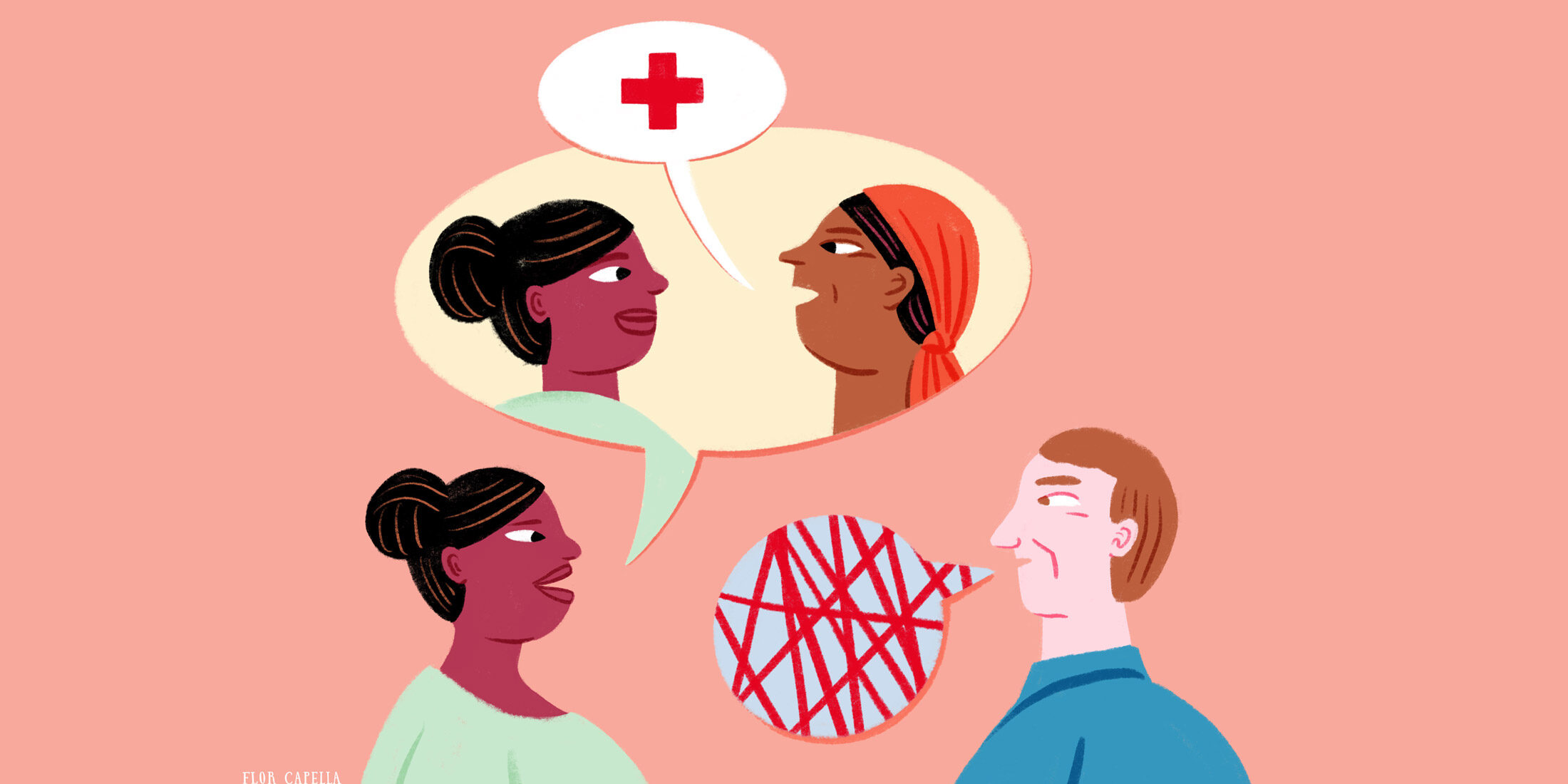
If the healthcare system is organized in the language inherited from the conquerors, how can Covid-19 be prevented in Indigenous territories? What is the role of Indigenous translators in this pandemic?

Share

By Luciana Mignoli . Illustrations: Florencia Capella
“Look, sister, Covid us, hunger is,” Orfilia Susy Martínez, a Wichí woman from Sauzalito, Chaco, was told in an Indigenous community. Susy was traveling through the territories, distributing what she could obtain through informal channels. It wasn’t just that phrase that resonated with her. “It’s very sad to see how people live. There’s a huge need. They live in plastic sheeting; it’s heartbreaking. We have a health center here. There’s a man who works inside the hospital. But there should be an Indigenous woman there helping the people who don’t understand Spanish.”
Susy knows the situation is critical for Indigenous populations in our country: the Covid-19 pandemic exacerbated and exposed historical inequalities. This is according to the report “ Socioeconomic and Cultural Effects of the Covid-19 Pandemic and Mandatory Preventive Social Isolation (ASPO) on Indigenous Peoples in Argentina ,” a collaborative work by research teams from universities across the country. “This situation worsens socioeconomic inequality, irregular land tenure, and the historical invisibility, stigmatization, and, at times, criminalization associated with their sociocultural condition,” the report states.
In public health emergencies, information is the primary resource that allows people to make informed decisions about protecting themselves. How do those who don't speak Spanish learn about COVID-19 precautions? According to the map "Indigenous Languages Today, " developed by a team from the University Language Center (CUI) at the University of Buenos Aires, there are at least 36 indigenous languages in Argentina. Of these, 15 have active speakers, and 9 are undergoing revitalization.
Can you translate for me?
In Sauzalito, Susy has been working for ten years as a volunteer translator for community members who need to communicate with the police station, the courthouse, the hospital, or the bank. Her services, essential for those who don't speak Spanish, are provided without pay or financial support. As a child, Susy worked in the homes of white people, where she learned Spanish. Today, she runs a small shop and lives across the street from the police station, on the corner by the bank. As a result, she is frequently called upon to interpret in various situations.
“‘Can you translate for me? This woman wants to file a report because her daughter was raped. I don’t understand her,’ the police officer told me. So I went over and asked her in Wichí, ‘What do you want to tell me? What do you want to say?’ She spoke to me in her language, I translated into Spanish, and they typed it up on the computer. The perpetrator was non-Indigenous, but sometimes women are raped by their own partners. We don’t have justice here. These things happen all the time,” she says.
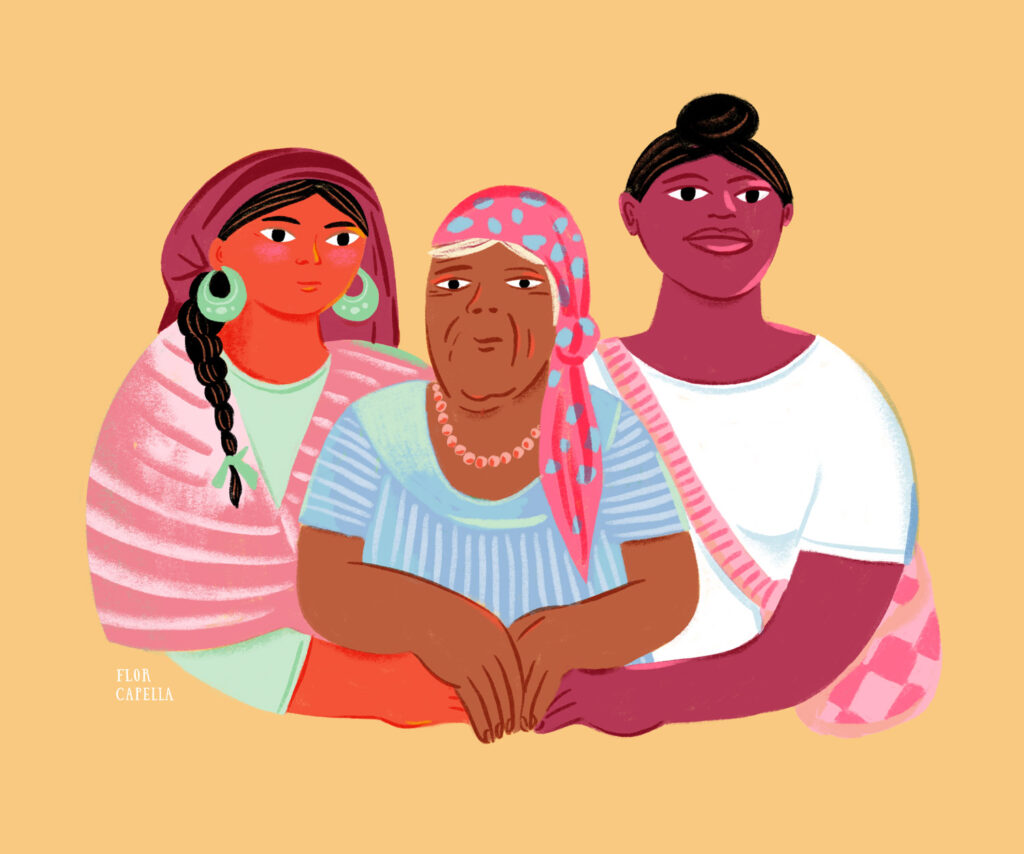
Laura Méndez is a Coya communicator and a member of the Board of Directors of the Cueva del Inca Community in Tilcara, Jujuy. For her, many Indigenous people act as interpreters “from the heart, in a humanitarian sense” because “they speak Spanish well. They help prevent more people from dying in their territories. Now, in addition to malnutrition, there is the pandemic.”
The health emergency brought the centrality of individual and collective care to the forefront . In a country inhabited by a diversity of Indigenous nations, with diverse worldviews on health and a wide variety of languages, what are the challenges of public health communication? Is it possible to speak to the entire population of a country without homogenizing them? Are differentiated strategies necessary to promote access to health for the entire population?
“What’s disseminated in media campaigns stems from a worldview that has nothing to do with our communities. They tell you ‘ wash your hands ’ and there’s no water. It’s taken out of context; it has nothing to do with community contexts. The person acting as interpreter doesn’t do a literal translation but rather a cultural and social one, issues that the campaigns don’t consider ,” adds the Coya communicator.
In Argentina, nearly 1 million people belong to an Indigenous group according to the 2010 census, representing 2.4 percent of the population. The National Registry of Indigenous Communities recognizes at least 36 Indigenous groups. However, organizations warn that their presence is underrepresented in both the census and the registry . This is due, on the one hand, to the erasure of their identity, a legacy of the persecution and terror instilled by the genocide of Indigenous peoples upon which our country was founded. On the other hand, it is due to criticisms of the census and registration techniques themselves, both regarding the statistical methodology and the bureaucracy required to register a community.
Ethnic identification in tests
Health statistics in our country still do not inquire about or record ethnic affiliation. But for the first time, the notification form for suspected or confirmed cases of Covid-19 asks whether the person declares themselves as belonging to an “indigenous community” and their “ethnicity.”
“Ethnic identification was incorporated into some tests, but without any prior dissemination. So we must insist on affirming the right to identity so that every person tested knows they can state their affiliation ,” explains Verónica Azpiroz Cleñan, a Mapuche political scientist who lives in the rural community of Epu Lafken, near the city of Los Toldos, Buenos Aires province.
A doctoral candidate in public health (UNLA), she is a member of the Indigenous Professionals Network, an organization that spearheaded the campaign “Don’t Let the Plague Erase You,” aimed at the Mapuche population during Covid detection operations. “We are Mapuche in the countryside and in the city,” she states in the bilingual video available on Instagram . Regarding access to healthcare, she is emphatic: “ If the public health system continues to be exclusively Spanish-speaking, it creates the first barrier to accessing the system, which is linguistic .”
Stigmatization and mistreatment in hospitals
At the start of the pandemic, Chaco was the third hardest-hit district in the country, after the City of Buenos Aires and the Province of Buenos Aires. The epicenter of the Coronavirus outbreak was the Toba neighborhood, inhabited by the Qom people on the outskirts of Resistencia. Some national media outlets quickly stigmatized the area as “dangerous” and “difficult to enter” because its residents “do not comply with isolation measures.” At that time, various voices rose up to emphasize that government policies should include the Indigenous women of the Toba neighborhood, who play a fundamental role in the transmission of community care practices.
The Napalpí Foundation also warned that “due to the situation of indigenous peoples, the quarantine measure is not experienced in the same way: indigenous families cannot cover the basic needs to combat the coronavirus, a clear example is that the vast majority of communities do not have access to safe water, that is, they do not have access to water on a normal day, not to mention the electricity service, added to the lack of economic solvency that prevents the acquisition of food and medicine for many days, among other things essential for hygiene.
The historical mistreatment by the healthcare system has intensified during the pandemic. Aureliana González , a Qom leader from Pampa del Indio, Chaco, told Presentes that during the pandemic, “ many Qom women don't want to go to the hospital because of the mistreatment. There are mothers who don't understand Spanish. So it's difficult to express ourselves. My mother was an Indigenous midwife, and at that time, all mothers could have given birth at home. We're not against doctors. But we also have our own knowledge. roqshé (non-Indigenous people in Qomlaqtac) will have to understand us
Qomlashepi group , "Mothers Caring for Qom Culture," a network that works to recover the culture of this Indigenous people. During the pandemic, limited internet access and severe storms hampered their work: "We held virtual workshops about our worldview, training other women from Roca, Fortín Lavalle, Espinillo, and Miraflores. We gave them activities and started to remember what we heard from our mothers and grandmothers because of the pandemic ."
Tensions and proposals
On one hand, the hegemonic medical model; on the other, Indigenous knowledge. In between, diverse health paradigms exist in tension, generating questions and proposals. “What would the referral and counter-referral process look like between an obstetrician and a püñeñülchefe (a traditional Mapuche midwife)? Is there only one valid way to support a pregnancy? Why do we give the criterion of truth to ultrasound and not to pellontun (a technique for visualizing or diagnosing an ailment)?” asks Verónica Azpiroz Cleñan from Los Toldos. From Sauzalito, Susy Martines emphasizes: “Here, we need someone to talk to girls and boys about comprehensive sex education in the Wichí language.”
Griselda Villalba, does some of this work . She has worked at the Ministry of Public Health for seven years, is in charge of the intercultural health office at SAMIC (the local health center), where she also works as a translator. She lives in the village where she conducts checkups and workshops on Comprehensive Sexuality Education and contraceptive methods.
“Here, most of the girls are using contraception. The most common methods are the injectable and the implant. We hold talks in Guarani and Spanish. Doctors and gynecologists come, with the support of the chiefs. And I do the translation. There’s no stopping us,” she says, smiling.
Griselda loves her work and is “very proud to be Guarani.” In her village, most people don't understand Spanish and very few can read. Her work reflects the tensions between the biomedical model and other ancestral knowledge: “I have a pact with the elders. Wherever they see me, they ask me questions, sometimes they talk to me about my work, they give me strength, they empower me. And we exchange knowledge with the shamans. Here we heal ourselves with indigenous medicine, but we can't overuse home remedies, especially with children. Guarani medicine also has its limits. It's a very big and very beautiful challenge.”
Various ethnographic studies indicate that the “civilizing” campaigns relegated Indigenous women to a secondary role, a marginalization that allowed them to preserve their language and much of their culture to a greater extent. For this reason, they now play key roles, both formal and often informal, in supporting and sharing messages of health prevention and promotion.
Communicating the health risks of Covid-19 in a country like Argentina—inhabited by diverse Indigenous peoples with varying conceptions of health—is undoubtedly a challenge. And developing policies that support the growth of healthier communities requires acknowledging the oppressions that arise from intersectionality: class, ethnicity, and gender.
It is not about "translating" the hegemonic medical model, but about finding dialogues between different knowledge systems, generating channels of trust, and recognizing the strategies that people have to collectively confront their problems.

We are present
We are committed to journalism that delves into the territories and conducts thorough investigations, combined with new technologies and narrative formats. We want the protagonists, their stories, and their struggles to be present.
SUPPORT US

FOLLOW US
Related notes


We are present
This and other stories are not usually on the media agenda. Together we can bring them to light.