

LGBT+ people who are victims of the armed conflict in Colombia are asking the State to listen to them
LGBT+ organizations delivered to the Special Jurisdiction for Peace the first report that compiles the victimizations suffered during the armed conflict.

Share

By Esteban Tavera/ We Remember*
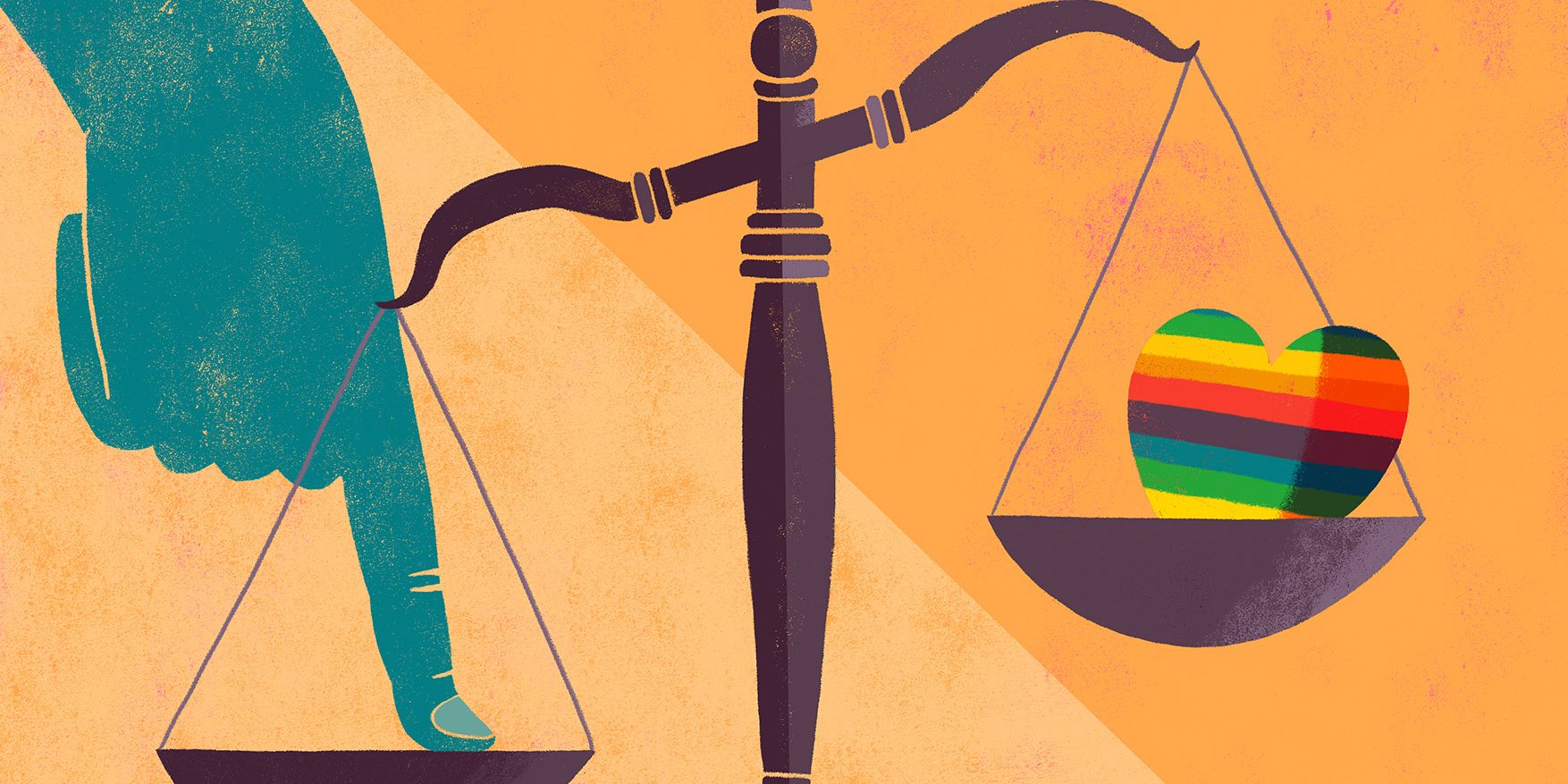
Illustration: Florencia Capella
“My story is very closely linked to the organization I belong to because it has given meaning to my life project since I joined at 16.” This is what Andrés Gutiérrez, leader of the Casa Diversa collective in Comuna 8 of Medellín, said. Casa Diversa is one of the LGBT+ organizations that has been recognized as a subject of collective reparations, and in September 2020 submitted to the Special Jurisdiction for Peace the first report that compiles victimizations suffered by organizations that advocate for the rights of this population.
Andrés Gutiérrez is 31 years old and lives in the Villatina neighborhood, in eastern Medellín. He recalled that when he arrived at Casa Diversa, “the streets of the neighborhood still looked like those of a rural area. They were dusty and unpaved. There were few houses and many wooded areas.” He explained that Villatina is a neighborhood that developed with the arrival of families from many parts of the country, where inequality and the dynamics of the armed conflict forced them to seek refuge in the big cities.
In his case, his family came from Andes, a municipality in southwestern Antioquia whose economy has historically been driven by coffee farming. There, his father, Jhon Jairo, worked planting and harvesting coffee, and his mother, Miriam, was in charge of feeding the workers and managing the household. “My parents brought me here when I was four years old because the conditions in which we lived were very precarious and because it was very difficult for my sister, July Andrea, and me to go to school. When we arrived here, the neighborhood was practically a farm that was being subdivided. My father started by paying rent, then, with an inheritance from my mother and with what he earned as a construction worker, we bought a small wooden shack with a dirt floor, which little by little my father converted into a brick house,” Andrés recalls.
In the 1990s, when Andrés and his family arrived in the neighborhood, links were already being established between these violent demonstrations and the dynamics of the armed conflict unfolding in the rest of the country. This occurred through the arrival of the National Liberation Army (ELN) militias, which supported the formation of the November 6 and 7 Urban Command in La Sierra. By the 2000s, the La Sierra militias had been absorbed by paramilitary groups, and from that moment on, the Metro Bloc and Cacique Nutibara Bloc structures, belonging to the United Self-Defense Forces of Colombia (AUC), began to dominate.
In this decade, the peace process initiated by the government of Álvaro Uribe with the United Self-Defense Forces of Colombia (AUC) took place, culminating in the Justice and Peace Law, Law 975 of 2005, which allowed for the demobilization of the two fronts operating in Comuna 8 and the extradition of several paramilitary leaders. This, however, did not signify a break in the territorial control exercised by these armed groups. “I remember that in 2005, when I worked at the Medellín Ombudsman's Office, figures like Don Berna, Memín, Julio Perdomo, alias Job, and other leaders went so far as to claim that Comuna 8 was the most important urban paramilitary project they had in the entire country,” noted Max Yuri Gil.
Bomb threats against a diversity march
During those years, Andrés was a teenager interested in social issues and was already starting to get involved with the youth groups in Villatina. One of these was the group that would later become the LGBT Roundtable of Commune 8, now known as Casa Diversa. “At first, we were a youth organization that carried out recreational activities in the neighborhood, just as these activities had historically been done in the Commune. Years later, in 2007, due to the diverse gender identities and expressions of most of our members, we decided, within the framework of a city-wide strategy and a community agreement, to form the city's first LGBT Roundtable with a local focus,” Andrés recalled.
By then, the Comuna was divided into two conflicting factions. After the demobilization of the Metro and Cacique Nutibara blocs, Medellín experienced a period of fracturing among the criminal organizations operating in the city, which are grouped under the umbrella of the Oficina de Envigado. “Amid this fracturing, in Comuna 8, the gangs took sides with one of the two most powerful kingpins: some sided with alias 'Sebastián' and others with 'Valenciano',” explained Max Yuri Gil.
The connection between the attacks and the group's activism was undeniable. As Andrés recounted: “In 2009, we decided to hold the first march for life and sexual diversity in Comuna 8. Immediately after announcing it, we received a threat telling us that if we held the demonstration, there would be blood and tears because they were going to throw a grenade at us.”
Despite the intimidation, the group held the march in 2009, but from that moment on, the attacks escalated. A year later, in 2010, they organized the second march, and things were even worse. “Fifteen days before the march, we were in the planning stage. It was five or six in the afternoon, I don't remember the exact time, it was late evening. At that time, three or four members of the armed group came in and beat two of the guys, and then we all got involved. It turned into a full-blown fight, and we finally managed to get them out of the headquarters. We locked ourselves inside, and out of fear, we stayed until very late, when we didn't see anyone else around,” Andrés recounted.
Systematic violence
Expressions of violence associated with LGBT+ activism were a common factor throughout almost the entire country. This was documented by the National Center for Historical Memory in the report " Annihilating Difference: Lesbians, Gays, Bisexuals, and Transgender People in the Context of the Colombian Armed Conflict" (2015), which states: “The Colombian armed conflict has left the mark of the rupture of love in multiple dimensions. For those who live outside of heterosexuality, it has damaged the possibility of establishing loving relationships, because doing so has meant torture and death for some people, but the scars of war on the possibility of love also extend to society and all its members” (p. 17).
For her part, Vivian Cuello, an activist with the Caribe Afirmativo collective, one of the driving forces behind the report submitted to the JEP on September 15, said: “One of the things we have identified is that armed actors have sought to gain an advantage over their enemies through social legitimacy, and one of the ways they do this is by promising society that they will protect certain characteristics considered socially important. We live in societies that are based on gender roles and stereotypes, as well as prejudices against LGBT people, and the armed actors end up reproducing these stigmas . We have identified that in these territories, people knew what was happening and said nothing, but they also even communicated with the armed actors so that they would threaten and displace LGBT+ people from the territory.”
"They told me I had 24 hours to leave the neighborhood."
Specifically in Comuna 8, the greatest level of violence against Andrés occurred in 2013, when he was threatened and forced to leave the neighborhood. “They started intimidating me with phone calls, but I ignored them and continued with my activities, trying not to take public action. Instead, I met with the collective in closed spaces, so as not to let the process fall apart. However, the armed group was still watching, and finally they approached me as I was leaving one of the meetings and told me I had 24 hours to leave the neighborhood. That's when I got scared and left,” he recounted.
His first reaction was to seek help from the state. He visited the office for victims of displacement, where he was told that because he was male and of working age, they couldn't offer him any assistance. Later, with the help of an official he met through his activism, he managed to get the state to provide him with a place in a temporary shelter, where he only lasted a week.
Andrés says : “At that time I was about 18 years old, almost a child, and it was very hard for me to have to separate from my family and friends to protect my safety and theirs. I fell into a terrible depression; I would cry and ask myself, 'Why was I part of that group?' I would say to myself, 'Why was I there? Why did I do this and that?' I even questioned what I loved and the fact that the institutions didn't protect me; this was a very hard blow.”
Although Andrés says he has recovered some of what was stolen from him by armed groups, he still maintains that the State owes him, as well as his fellow activists who suffered the same persecution, attacks, and assaults, an enormous debt. Part of that debt could begin to be repaid if the Special Jurisdiction for Peace recognizes their cases as priorities, if it provides them with spaces to speak out, and if it does everything possible to stop the violence in a context that remains highly hostile to the population.
*This article was written as part of an information alliance for the Journalism and Memory Network, between Hacemos Memoria of the University of Antioquia and Agencia Presentes.
We are present
We are committed to journalism that delves into the territories and conducts thorough investigations, combined with new technologies and narrative formats. We want the protagonists, their stories, and their struggles to be present.
SUPPORT US

FOLLOW US
Related notes


We are present
This and other stories are not usually on the media agenda. Together we can bring them to light.