

A year in a Buenos Aires prison during the pandemic: "The prison system is designed for cis men"
One year after the spread of Covid-19 in the country, what have been its effects on LGBTI people deprived of their liberty?

Share

By Ivana Romero
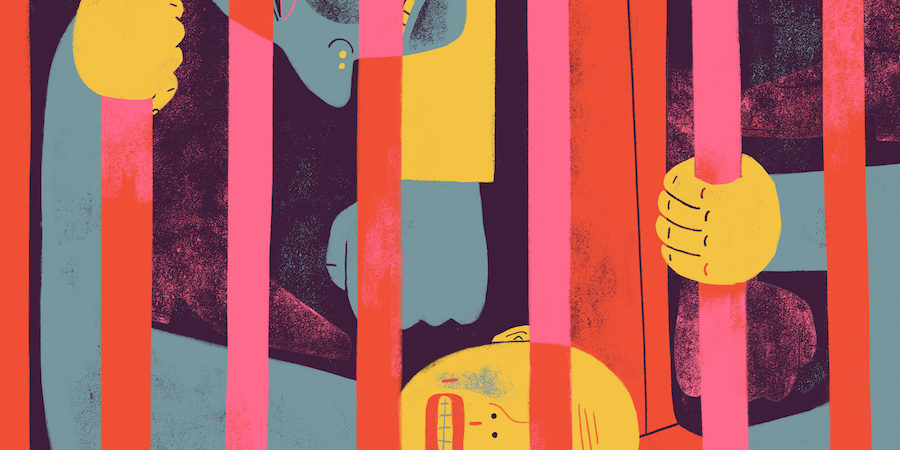
Illustration: Florencia Capella
Wendy Espinoza is a 42-year-old Peruvian immigrant. She is one of 13 trans women who have been held at the Ezeiza Penitentiary Complex IV since the start of the mandatory lockdown due to the pandemic in March 2020. Although the Federal Penitentiary Service provides them with face masks, bleach, and soap, Wendy and her companions say that the hygiene conditions, which they themselves ensure, are far from adequate. They add that many have had to discontinue hormone therapy or treatments for chronic infections such as HIV. Medical checkups have slowed down “and still don't take into account the specific needs of our community, which are different from those of cisgender women,” they explain. The same has happened with the progress of the legal cases of those deprived of their liberty, which are already proceeding at a snail's pace.
One year after the spread of Covid-19 in the country, what have been its effects on incarcerated LGBTQ+ people? “Prison is a hegemonic model of administering punishment. Therefore, it is an expression of a heteronormative cisnormative cultural model,” states Josefina Alfonsín, a member of the Gender and Sexual Diversity Team of the Argentine Penitentiary Ombudsman's Office. This team, along with various organizations, is part of Corpora en Libertad, an international network of incarcerated LGBTQ+ people. Currently, Corpora is preparing a report to expand the information available and assess the conditions of confinement for this population at a regional level within the context of the pandemic.
“ The pandemic brought pre-existing conditions to light. The trans and travesti population faces high rates of discrimination, and their time in prison is part of a chain of marginalization that includes deficiencies in basic rights such as health, food, and education, as well as the validation of identity issues. It also includes the historically outstanding debt of a non-stigmatizing judicial system,” Alfonsín explains.
Most without a criminal record and migrants
Claudia Vázquez Haro is the president of Otrans, which conducted a study of transvestites and transgender people in prison between 2018 and 2019 in the province of Buenos Aires, following the deaths of four activists from that organization in 2017: three had been arrested in La Plata and another died as a result of a violent police raid on her home. Otrans conducted 87 interviews in all provincial prisons housing transvestite and transgender people. These included prisons under the jurisdiction of the Buenos Aires Penitentiary System (SPB)—Unit No. 44 in Batán, Unit No. 2 in Sierra Chica, and Unit No. 32 in Florencio Varela—and the Ezeiza Women's Prison (Unit IV), which is under the jurisdiction of the Federal Penitentiary System (SPF).
Eighty-two percent of the transvestite and transgender people interviewed had no prior criminal record; that is, they were entering a detention facility for the first time. Among those who had been incarcerated, less than half had received a sentence. This situation, which was observed in the province of Buenos Aires, was also replicated at the federal level. The report also identified an increase in the number of incarcerated migrant women: “The majority of transvestite and transgender women deprived of their liberty are migrants. A large percentage of them are awaiting trial, either a final sentence or release,” it states.
The situation has not changed. The LGTBI+ news agency Sudaka, also coordinated by Vázquez Haro, has published a series of complaints from December 2020 to the present, filed by 11 trans women and transvestites detained at the Roberto Pettinato jail in La Plata. The complaints refer to mistreatment, discrimination (the word “faggot” is just the tip of the iceberg of a series of systematic and daily discriminations by the staff), lack of hygiene supplies and medication, confinement in cells measuring two meters by two meters alongside cisgender men (known as “refugees” since they are separated from other prisoners due to the complexity of the crimes they are charged with, including sexual assault), and the impossibility of having recreational outings to the courtyards due to aggression from other inmates. This jail was originally designed to house only men.
Of the 11 trans women detained there, ten are migrants. This situation extends beyond the local jail and affects all prisons in Buenos Aires province: “ In addition to the persecution for our gender identity, we also face the persecution of being migrants, Indigenous, or Afro-descendant . Consulates rarely deal with us, our families of origin are unaware that the women are detained, and in some cases, they don't even want to know about them. Added to this is poverty and prostitution as their only option. And illiteracy, because many cannot complete their education; they can neither read nor write. So, they suddenly find themselves facing a legal system they know nothing about,” explains Vázquez Haro.
The court rejected the report of the Committee against Torture.
The Committee Against Torture, created by the Provincial Commission for Memory (CMP) in 2002, conducted an official inspection and interviewed the transvestites and transgender people held at the Pettinato jail in recent months. It then filed a habeas corpus petition with the La Plata Court of Guarantees No. 4, which rejected it. The committee opened an appeal process that has not yet been resolved.
Antonella Mirenghi heads the committee. She draws a preliminary map and says, “The transvestite and trans population represents 0.2 percent of the entire prison population. We're talking about some 80 people deprived of their liberty.” These are people for whom there are no specific policies in a system that has collapsed for all those deprived of their freedom.
“ In addition to the lack of basic rights, there is the pervasive hatred within the prison system ,” says Mirenghi. During their visit to the Pettinato detention center, the commission witnessed firsthand the violence detainees suffered at the hands of staff, as recounted by the detainees themselves. For example, they are searched by men when they request to be searched by female personnel. “During these searches, they are subjected to violence, insults, and humiliation. And they arrive in transport trucks with other men; that is, in enclosed spaces where no one listens to them and where they are also subjected to violence, including sexual violence,” she explains.
Mirenghi also points out: “We are almost nine years away from the enactment of the gender identity law. While it has made diverse identities visible, there is still no public policy planning that aligns with this legislation.”
Good news came with the decision by the Ministry of Justice to appoint Ángeles Maribel Helguera as coordinator in the Gender Policies Sub-Directorate of the SPB (Buenos Aires Penitentiary Service). She is the first transgender officer in that prison system.
This is what Lucía Portos, Undersecretary of Equality and Sexual Diversity of the Ministry of Women, Gender and Diversity in the province of Buenos Aires, points out.
“The Covid outbreaks in prisons weren't terrible. "During the first months of the pandemic, we worked with the judiciary, and they granted reduced sentences and house arrest to prevent infections," says Portos. However, this decision revealed a new problem: that the trans and travesti population, especially migrants, often don't have a home where they can serve their sentence and therefore end up being returned to prison.
The prison population tripled
Furthermore, many transgender people are incarcerated “due to the punitive policies of the Macri administration,” which focused on street-level drug dealing rather than alleged drug cartels. “This is why the prison population has tripled,” explains Portos, who also states that these policies have been under review since the end of 2019 through a coordination committee with members of the Ministry of Justice, the Secretariat of Human Rights, the Ombudsman's Office, and civil society organizations working in prisons. The official notes that the provincial ministry is also addressing “the alarming number” of transgender people without national identity documents, lost in searches, raids, or court proceedings, if they even managed to obtain them.
While the official acknowledges the outstanding debts in terms of building infrastructure, access to basic rights, and training of legal personnel skilled in gender issues, she also points out that the pandemic accelerated the dialogue processes between the State and organizations "and to jointly propose measures to reverse long-standing structural problems."
Vázquez Haro has a different perspective: “The Covid pandemic exacerbated the lack of policies that specifically address the needs of transvestite and transgender people. The prison system is designed for cisgender men, and any other identity is not only unrecognized but also stigmatized .”
“And when we say that a comprehensive policy is needed, we're talking, for example, about trans and travesti women being held in police stations, which are merely transit points, like the case of Brunella Faccini in City Bell last year, in the context of Covid,” the activist continues. She also lists the number of women imprisoned without formal charges and even those “who are offered a plea bargain to keep the case moving, even if it means admitting guilt they don't always have in cases that are often fabricated.”
“We have the experience of persecution and death tattooed on our bodies. That’s why we take care of each other. We know each other and build networks when we know someone has a problem. But alone we can’t face so much hatred before and during the pandemic and probably even after,” she summarizes.

We are present
We are committed to journalism that delves into the territories and conducts thorough investigations, combined with new technologies and narrative formats. We want the protagonists, their stories, and their struggles to be present.
SUPPORT US

FOLLOW US
Related notes
We are present
This and other stories are not usually on the media agenda. Together we can bring them to light.