

Qom women in Paraguay defend their communities during the pandemic against the advance of monoculture
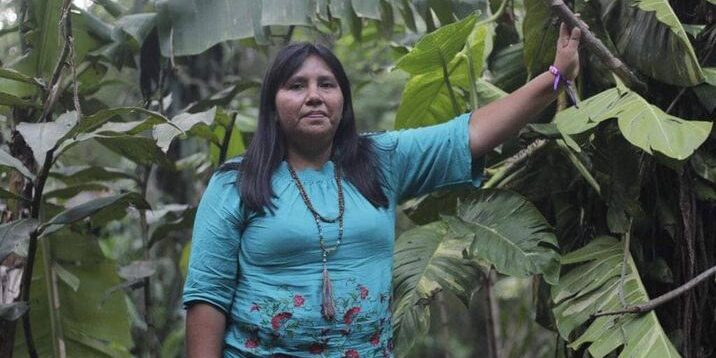
The environmental defenders and artisans of Santa Rosa, indigenous women of the Qom people, have been organizing for months in defense of their territory.

Share

By Concepción Oviedo
Photos: Courtesy of Conamuri
The environmental defenders and artisans of Santa Rosa, Indigenous women of the Qom people located in the Benjamín Aceval district of the Paraguayan Chaco, have been organizing for months to defend their territory alongside four other communities of the same people. Their goal is to halt the advance of an extractive eucalyptus monoculture project promoted by the NGO Fundación Paraguaya.
The Qom people, organized into eight communities, have lived for 36 years on a 1,117-hectare territory with collective title. This means that any action must be agreed upon by all the communities, and the land must be used for the benefit of the community.
The Paraguayan NGO Fundación Paraguaya carries out social projects with communities in several cities across the country. According to its website, its vision is “a world without poverty where everyone wants to live.” It is directed by businessman and politician Martín Burt, former Mayor of Asunción for the Liberal Party (1996-2001) and former Chief of Staff in the de facto government of Federico Franco, installed after the coup d'état (some call it a parliamentary coup) against former President Fernando Lugo.
Progress on a monoculture project during a pandemic
The Chaco region is characterized by its arid land, and deforestation exacerbates the problems of soil and water access. The eucalyptus monoculture project is seen as a threat to the environment. “Three years ago, their project was established. In August, they came in full force to the community, erecting fences, clearing native trees and destroying natural medicines—they have completely destroyed everything,” explained Bernarda Pesoa, a leader in the Santa Rosa community.
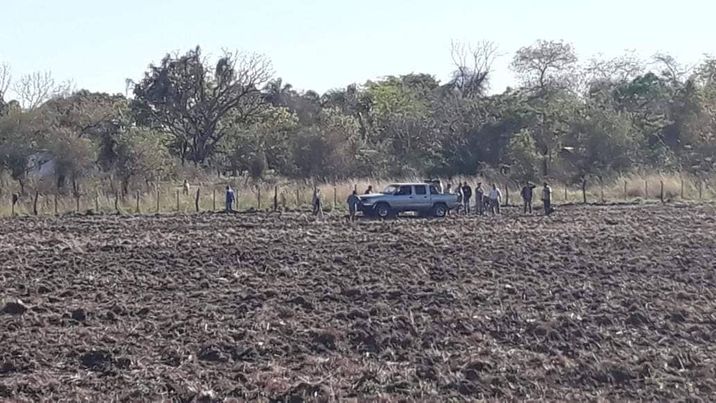
In addition, the work progressed near the cemetery, where the remains of the ancestors of those who live in the community are located.
On July 31, a complaint was filed with the Environmental Prosecutor's Office and the Ministry of Environment and Sustainable Development (MADES), requesting support to stop the clearing of native trees.
Another key point for understanding the situation is that the project, which seeks to cultivate 20 hectares of land, has not consulted with all the communities. They have disregarded the "Protocol for the Process of Free, Prior and Informed Consultation and Consent with the Indigenous Peoples of Paraguay ," a mechanism established by Decree 1039 on December 28, 2018, for Indigenous communities and which must be overseen by the National Indigenous Institute (INDI).
Road closures and protests
Community leader Bernarda, along with her sisters and brothers from the communities, knew they couldn't just sit idly by and wait for a response from the government. Therefore, on August 4th and 5th, they held road blockades and demonstrations at kilometer 49 on the "Dr. Carlos A. López" highway, commonly known as the TransChaco.
For two days they publicly expressed their discontent with the project, which was moving forward without prior, free, and informed consultation with all the Qom communities. After two days of mobilization, they achieved a temporary suspension and a dialogue.
The Qom leader and environmental advocate stated emphatically: “Covid won’t kill us, transnational corporations will. The countryside needs water, people need water, not eucalyptus,” according to CONAMURI’s Twitter account.
The leader highlighted the national and international support received through social media, while also requesting, via Conamuri's accounts, continued support for the process until the agreement signed between the Paraguayan Foundation and two Qom communities is revoked. Nationwide, civil society organizations are also leading a campaign: “Not on our land, Qom people.”

Violence in the communities
Despite all the actions and agreements to halt the deforestation, these were not respected. And the violence escalated in the communities. On October 27, Bernarda Pesoa was beaten by Indigenous people from the communities that support the project. This occurred after the women of Santa Rosa had stood up to defend their territory. not the only time; on other occasions, the women had received threats, which were recorded on a cell phone by one of the young Indigenous women. The Paraguayan Foundation, in a public statement , disclaimed responsibility for the acts of violence and stated that it was an internal problem between the communities.
On November 2nd, a virtual meeting was convened due to the seriousness of the situation and the widespread condemnation from national and international social leaders and the media. It was decided that the project could not proceed without the consultation and consent of the eight communities. “The authorities and the National Indigenous Institute (INDI) do nothing, only make promises they don't keep, and neither does the Ministry of the Environment (MADES). The Senate's Indigenous Peoples Commission said that cultivation should be halted after the violence that occurred when I was attacked. It only stopped for 15 days, and then they came back. They mock our struggle and tell us that no one will believe us because we are not involved in the project and the Paraguayan Foundation does whatever it wants in the community,” Bernarda stated.
On December 8, work resumed on clearing the land, preparing the soil with chemical fertilizer, and planting eucalyptus seedlings. The leader and her community fear that this will lead to renewed conflict between Indigenous people from the now-divided communities.
Environmental Impact
Rosa Toledo, an agro-ecology technician at IALA Guaraní and a peasant leader with Conamuri, explained that the water problem will worsen when asked about the environmental consequences of eucalyptus monoculture. She noted that the Chaco region's climate and soil type create a very fragile ecosystem, and that an intervention like the one proposed could cause an imbalance. "Eucalyptus is an allelopathic plant; it doesn't allow anything else to grow around it. Important microorganisms for biodiversity are lost, it absorbs the area's water resources, and it slowly deteriorates the soil, preventing other crops from being grown for a long time," she pointed out.

What does the Qom people need?
Currently, five communities are opposing the expansion of monoculture. Their resistance, motivated by respect for the environment, biodiversity, and the future of the families who live on the collective land, is driven by the common good, because a monoculture is not a forest. They seek long-term community benefits. Bernarda said that they must consider how to provide food for the communities and explore the possibility of developing productive projects for community gardens and planting native trees.
Having raw materials within the Indigenous territory and finding a secure market . Currently, the women artisans of Santa Rosa must leave their community, travel kilometers to obtain their raw materials, and once again depend on the will of the landowners; sometimes they are not even allowed to pass, which means returning empty-handed. In the podcast miniseries Kuña Remiandu , they tell their story of their work in the Qom, Guarani, and Spanish languages.
“What is lacking is that the decisions of the people are respected, not just the decisions of a few leaders,” Bernarda stated, with the tranquility and serenity that characterizes her as a leader.

We are present
We are committed to journalism that delves into the territories and conducts thorough investigations, combined with new technologies and narrative formats. We want the protagonists, their stories, and their struggles to be present.
SUPPORT US

FOLLOW US
Related notes


We are present
This and other stories are not usually on the media agenda. Together we can bring them to light.