

Indigenous women march from northern and southern Argentina in defense of Mother Earth
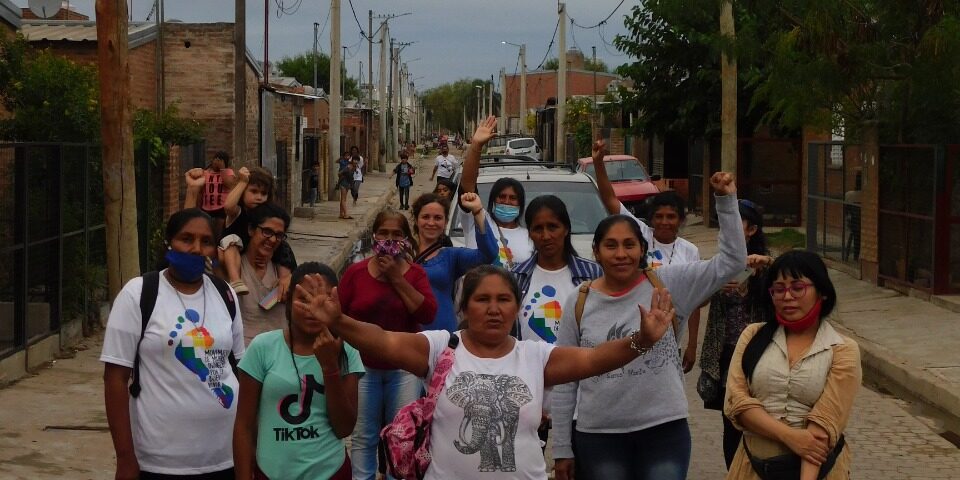
The "Stop Terricide" march has departures from various points across the country, based on two columns that set out from Chubut and Chaco. It will end in Buenos Aires on May 25th.

Share

By Elena Corvalán
Photos: Indigenous Women's Movement for Good Living and Timbó News Agency
The harassment and constant pressure on their territories, the extractive activities—all of which impact communities by denying them access to essential human rights, such as food and water. And now, in addition, the intentional fires in southern Argentina . These are some of the reasons why members of the Indigenous Women's Movement for Good Living began a march to draw attention to the environmental damage caused by extractive activities and the fact that the consequences disproportionately affect people with fewer economic resources.
“Here in the south, there’s a lot of talk about mega-mining, hydroelectric projects, and now, with the fires, they’re burning the whole territory under the pretext of fighting the fires, but no, it’s to get rid of the people and take over the land. And the same thing is happening in the north,” listed Karumanta Escalada, a Quechua and Ava Guaraní woman living in General Pico, La Pampa, who plans to join the march in Rosario, Santa Fe.
The "Stop Terricide" march has departures from different points across the country, organized along two main columns. The southern column began its march on March 17th, following a press conference in the city of Esquel, Chubut province, and then proceeded to El Bolsón, Río Negro province (Puel Willimapu). The northern column departed from the city of Presidencia Roque Sáenz Peña, Chaco province.
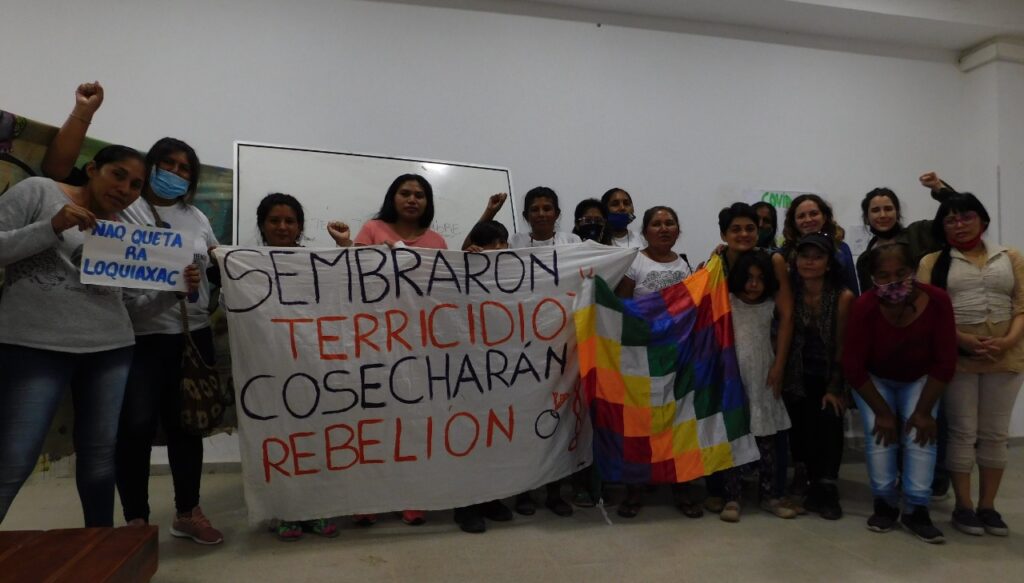
"We have no water, we have no work, and they are taking our land away."
“The sisters of Chaco have no drinking water, they have been without water for weeks, so all of these are serious problems and as women who met, we hugged each other, we identified with the problems, we decided to say enough is enough, we decided to raise our voices and start this Walk,” Karumanta stated from the south in response to a question from Presentes.
Target: City of Buenos Aires
The marchers are expected to join as the columns advance, which have set themselves the goal of reaching the Autonomous City of Buenos Aires to participate in “a large mobilization” on May 25, “To demand that #TERRICIDE be considered a crime against nature and against humanity and that the perpetrators of terricide be tried and convicted.”
The coincidence with the national holiday seeks to highlight the pre-existence of the native peoples, and to denounce the policies of extraction of the resources that nature provides in the territory that today comprises the Argentine Republic.
With the slogan "As long as we do not have justice, there will be no peace for them," the members of the Indigenous Women's Movement for Good Living ask for the support "of native brothers and sisters and of Argentinians who want to join this march to say #StopTerricide ."
Although the possibility of doing something to make visible the constant aggression suffered by the land had been discussed for some time before, there was greater urgency with the recent fires in Patagonia, explained Karumanta Escalada to Presentes, a woman born in the Estación neighborhood of the city of San Ramón de la Nueva Orán in Salta province, who has lived in General Pico, La Pampa, for about twenty years, and who is part of the Indigenous Women's Movement.
The Movement's statement emphasizes that "To date, all attacks against the life of our Mother Earth have gone unpunished" and denounces "the indifference of governments (which) fuels the avarice, the lethal greed of extractivism ." This is also why they intend to mobilize on the anniversary of Argentina's independence, to remember that while the cry for freedom was being raised against the Spanish invaders, "the State began to establish itself as an invading force in Indigenous territories."

He also recalls that there was genocide, the extermination of native peoples; ecocide, with ecosystems torn from the face of the earth; indigenous epistemicide, with the elimination of other ways of thinking about life, and that “repression and persecution has led to the clandestine nature of our spiritual and medicinal practices and the impossibility of living according to our culture which is in absolute harmony with nature.”
The Indigenous Women's Movement for Good Living called upon that "plurinationality that inhabits the confines of all the territories called today Argentina" to "unite in a cry for life, building together with the Argentine people and the peoples of the world a new civilizational matrix" because up to now "The colonial republics have taken Terricide to its maximum expression of pain and death."

Silent evictions
The two women who gave their testimony for this article specifically corroborate what the Movement affirms in general.
Karumanta Escalada was born in the humble Estación neighborhood, where her community settled when the activities of the immense San Martín del Tabacal sugar mill confined them to a tiny strip of land—a form of silent eviction that often occurs. With nowhere to live and no means of support, and with two young children to care for, Karumanta migrated south, where she had a relative.
There, too, she suffered extreme hardship: “I stayed here because I didn’t have a penny to go back and I didn’t understand how this society worked.” “I stayed here and struggled, making bread, empanadas, all those things made with flour, to sell. We had a hard time those first few years.”
She joined the Indigenous Women's Movement for Good Living and organized a community, bringing together migrants from different Indigenous groups across the country who move through Argentina as seasonal workers. “Here in Pico, I managed to build a community, because there's a mix of people here: Ramuches, Mapuches, other Guarani, and some Charrúa sisters. There are many families from Salta here, at least 70 families. Not all of them identify with the movement, but if you play a pin pin (Guarani dance), they'll immediately start tapping their feet.”
"Little by little we started to encourage each other."
In the Ajayu Pahwa (Free Spirit) Pluricultural Community, “We also came together to raise awareness, because here in La Pampa, it’s a very difficult province when it comes to Indigenous issues.” Since the main economic activity is agriculture, “they’re all landowners and don’t pay much attention” to the issue of Indigenous peoples. “And we’ve been building ourselves up as a community for years now, and thanks to that, we’ve achieved small things, but for us, they’re huge achievements.”
Karumanta explained that the Walk was conceived as a process, “and little by little we encouraged each other.” She indicated that assemblies will be held in each town they visit. “To explain the purpose of the Walk, so people can hear from the sisters who are already walking about their experiences, and also to ask for support.” The walkers will need support in the places they visit, to provide them with water and food, and also to replace their shoes.

The spokesperson said they plan to walk between 14 and 20 kilometers per day, stopping to rest, holding a meeting, and then continuing the walk. “It’s a huge effort. Some sisters have decided to leave their children in the care of other people, their parents, or family members who also support this walk.”
“Behind each sister there is a whole family supporting her; otherwise, they couldn’t do this. And it also takes courage, because we don’t know how we’ll be received, we don’t know if the state, through the police, will repress the march. While we have the right to hold this march, I know that many won’t like it” that they are going with “the truth from the territories,” she said.
In that same vein, she noted that they might face attacks through the media, as happened with the fires. “But we stand firm and with a clear conscience, knowing that what we are doing is not just for ourselves, it is for everyone in general, because Pachamama, the Mapu, shelters us all. Pachamama doesn't make distinctions, saying 'you are my community,' or 'you are Indigenous,' or 'you are not.' No. Here we all breathe the same air, we all eat from the same land; it's just that some are conscious of caring for it, of loving it, while others, with their ambitious selfishness, don't care about destroying it.”
Unanswered requests
The community of Fabiola Rodas, in Tartagal, has also historically suffered forms of silent eviction. There was no violent operation, but the city itself was founded on Indigenous territory and gradually expanded, growing over ancestral lands and confining its inhabitants to small spaces that the municipality now intends to call neighborhoods.
“Last time, when I also did the walk here with the people, the brothers from Santa Victoria, we went from Tartagal to Salta and we didn’t get any kind of response,” it’s “like the government, everyone, turns a deaf ear,” Fabiola said when asked about her motivations for walking with the Movement.
In November of last year, indigenous inhabitants grouped in the Autonomous Union of Indigenous Communities of the Pilcomayo (UACOP) marched from the town of Santa Victoria Este, on the tri-border area of Argentina with Bolivia and Paraguay, to the city of Salta, demanding public policies that would allow them access to decent housing, water and land.
“Now I’m going to do this march because we don’t have water, we don’t have jobs, they’re already taking all our land, we don’t have anywhere to plant,” the spokesperson added. She added that in Tartagal they feel discriminated against; as an example, she said the municipality is paving the streets in the neighborhoods around Misión Tapiete, “except for the part where we live; we still have dirt roads, we still don’t have water.”

"Those who sleep will run out of water. Those who don't sleep will get up at 3 or 4 in the morning to collect it."
Regarding access to water, he explained that it comes through a very old hose system, with minimal pressure, and only at night. “Those who go to sleep run out of water. Those who don't sleep have to get up at 3 or 4 in the morning to collect it.”
Fabiola also includes in her accounts the historical claim of losing her territory, which was “enormous. I remember we had fences where we could plant crops, but not anymore. Here, in each house, two or three families live together, all crammed together.” About 300 families reside in Misión Tapiete.
During the November march, the community requested access to sewing jobs and funding for the purchase of carpentry equipment, "but we never received a response." And, in the emergency, they asked for a community kitchen: "They don't even give us that help," she lamented.
"The conditions are not right for living."
“There will be those who say: 'Indigenous sisters, the conditions are not right to go out and fight.' To which we respond: the conditions are not right to live, that is why we go out to fight,” states the communiqué from the Indigenous Women's Movement for Good Living.
The Women invited everyone to support and participate in the march, saying, “We will walk alongside all those who, like us, feel outraged and powerless, and who refuse to be mere spectators in the face of tragedy, nor silent accomplices to the destruction of life.” Those wishing to volunteer should write to
bastadeterricidio@gmail.com
We are present
We are committed to journalism that delves into the territories and conducts thorough investigations, combined with new technologies and narrative formats. We want the protagonists, their stories, and their struggles to be present.
SUPPORT US

FOLLOW US
Related notes

We are present
This and other stories are not usually on the media agenda. Together we can bring them to light.