

Elizabeth Duval: "Trans people are only asked about our identity"
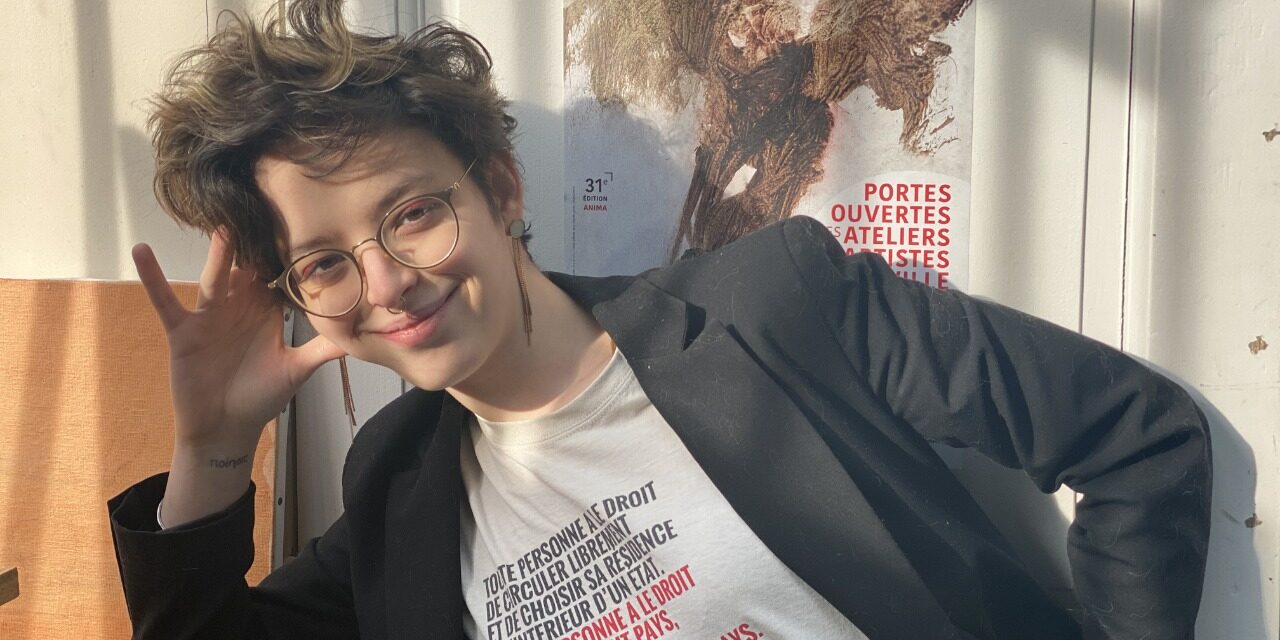
Spanish writer Elizabeth Duval is 20 years old and has just published her third book.

Share

By Franco Torchia
Journalist Franco Torchia interviewed Spanish writer Elizabeth Duval for his radio program "You Can't Live on Love," broadcast on Buenos Aires Public Radio. Duval is 20 years old and has published three books, including poems, a novel, and now an essay, "After the Trans," not yet published in Argentina but available as an ebook . We reproduce part of the radio conversation.
F: In your written production, in your poetry collection Exception, in your autofiction called Queen and now in this essay called After the Trans , there is a kind of sequence, at least from the titles, linked to the following: your transition from exception to reign and from there to this time later, to this later that how would you characterize it?
E: Yes, there is a progression, but I think that in the case of * After Trans* , what stands out, even though it's not at all an intimate or autobiographical essay, is being fed up with the trans issue. Basically because even when I was promoting my other books, which had little to do with trans issues, there was a kind of media frenzy. So I kind of said to myself: I'm going to write this essay so I can almost turn the page. To say: Ask me about it in 2021, but if they ask me about trans issues again in 2022, I'll be doing other things and I can say, "I don't know, I have no answer."
F : One of the questions at the beginning of * After Trans * is: Am I an activist simply by virtue of existing? This runs throughout your latest work and resonates in a very special way in Argentina right now, and I would venture to say in certain countries in the region. Generally speaking, no one in Argentina has managed to break free from that dynamic. In this regard, I'd like to cite an example. You read and quote Camila Sosa Villada , who has been on this program so many times, who is so important to this program and now, fortunately, to literature, to the writing of a good part of the world. But perhaps Camila is a kind of example of that possibility. However, it's not a truly strengthened possibility, or—if I may be redundant—it's not a very viable possibility. Why?

E: I think there are many trans people who can't give up, who can't stop being constantly labeled as activists simply for existing. Because basically, if you're in a society where your identity is questioned, if you're in a position where you're a visible trans person, it's very difficult for the mere fact that you exist to stop being something that breaks people's molds. But it's something that's very tiring, very emotionally draining.
Now in Spain we're witnessing debates over the draft of the trans law, something you in Argentina are much further along in; you've already made significant progress. But here in Spain we're dealing with it, and I do notice that this debate is quite tiresome here, simply because trans people, who don't necessarily have an activist vocation, are forced to defend something as basic, as fundamental, as their very existence. But I do think there's something enlightening about Camila's case, and that is that, thanks to the success of * Las Malas* 's no longer seen solely as a trans activist or role model, but her literature is valued as literature itself. I find that enriching.
Identities and privileges
F: At another point in After the Trans , “in any case, I am the annulment of categories, of forms, of gendering.” Now, do you feel that this annulment is accessible to everyone, or is it only accessible to those who can, for example, today, call themselves non-binary?
E: I discuss this later in the essay in relation to Paul B. Preciado's position. This idea is that many times the seemingly most transgressive positions, like non-binary, are also made possible by living in a certain cultural environment, with avant-garde artistic practices, that views that transgression more favorably. But when, in more everyday aspects of life, if you consciously and consistently try to transgress that norm—which is what I'm talking about later when I discuss corrective violence—you often become a much clearer target of violence and punishment, because those behaviors that fall outside that norm, those categorizations, are repressed, attempts are made to silence them, they are seen as dangerous. And I think that both the avoidance of it, or the attempt to erase those categories, to make trans people seem less important, and the adoption of seemingly more radical positions, require certain structures behind them, which are sometimes structures of privilege. Clearly, a trans person who can live without being constantly reminded by society of their trans identity is likely someone who doesn't face certain problems of economic or class insecurity, or perhaps they aren't a trans person of color; perhaps they are a trans person who has certain structural privileges that allow them to assume that position. So I think that, certainly, it's not within everyone's reach, and in fact, it's something that, for example, in Spain, we have to keep in mind: not all trans people suffer similar levels of violence. Elsewhere in the essay, I talk about La Veneno, about older trans women who, due to historical circumstances, have been closely linked to the world of prostitution, precariousness, and cabaret, and I think their suffering isn't comparable to that of trans minors who begin their transition at age 12 and who can live lives more easily assimilated within the system. I believe that Spain, for example, has a great historical debt to those older trans people whom the State has practically not even allowed to exist.
F: So there's a kind of system—spelled with an 's' or a 'c'—between the impossibility for trans people in general of doing anything other than telling their own stories, that is, being—as you say in the book—the best and worst possible narrators to explain what happens to them. The fact that the public sphere constantly condemns trans people to recount their past, to recount their existence, to use a neologism, and the fact that, on the other hand, activists are always kicking and screaming with the same slogans, does this create a kind of dead end?
E: I think it does, in part. But surely because these narratives of intimacy, of constantly explaining or justifying one's own life, lead, just as some statistics do, to constructing a very specific social role for trans people: the role of victim. When I believe that the role of victim, or the role of someone recounting their intimacy in order to be recognized, isn't so necessary. I think we can go further and assume that there can perfectly well be, whether we like it or not, trans lives that are almost conservative or almost fully assimilated into the system. Because I think that pretending all trans lives are necessarily those of victims or revolutionaries means we fail to recognize the lives of older trans women—to use your term, the older, sex-crazy trans women who have had it much worse than younger generations. And this kind of tabula rasa also hides the violence or suffering endured by those in the worst situations, and pretends we're all the same. That seems to me, and I say this in the context of La Veneno, a way of blurring the lines of violence, of shifting the focus of that violence, which is quite counterproductive.
"Trans people have only been given a media platform to talk about ourselves."
F: It's always said that trans people should talk about trans people. You discuss this, and you discuss it at length in the essay—we're not going to reveal the entire contents of your book, of course—but it's an idea that has a problematic scope here, and in my opinion, a very welcome one. Should the field of interlocutors on trans issues be limited to trans people or not?
E: I would say that this issue has a problematic reach not only in Argentina, but even in Spain. And I think this idea is so ingrained because it's an indirect consequence, or a bit of a cause-and-effect, of what I was saying earlier: how trans people have only been given media space or a platform in public opinion to talk about themselves or about the problems or things that happen to them because they are trans. I quote these words from Pier Paolo Pasolini at one point in the essay, when he criticizes the notion of tolerance. He says that true tolerance, real tolerance, never exists because, in the eyes of the majority—he uses the example of a Black man—the majority is incapable of forgetting the difference that separates them, their minority existence. And one consequence of that is that if trans people exist in the public sphere, they are expected to be constantly talking about being trans. I think it's a potentially controversial thesis, because as long as, for example, the left is stuck in this position of saying only trans people can talk about trans issues, or only trans people are valid interlocutors, as long as we're stuck in that mindset, this reduction to that specific aspect of identity will continue to be demanded, when they can address so many more topics.
Essentialisms and biology
F: On the other hand, you insist a great deal on criticizing the materialist arguments of trans people, or of transsexuality or transgender identity—to put it very simply—a materialism that you say borders on the religious. Only the faithful can end up talking about the trans experience, and it's by virtue of a kind of essence understood as the materiality of the body. This, I imagine, is still quite alarming and provocative in Spain today, and here as well.
E: Of course. And not only in relation to the trans issue. Let's remember when the fight for same-sex marriage began in Spain; often, one argument used was this "born this way" thing—you're born this way, it's something you're born with, something you are due to your biological makeup, it can't be changed, and that's why you deserve rights. Even from the social sciences—and this is by no means a way of invalidating sexual orientation or identity—there are theories that say, for example, that if we were to place someone who in ancient Greece we would have considered homosexual today, they wouldn't necessarily be homosexual right now, and vice versa. Identities are also circumscribed by their historical moment, by a whole host of socio-cultural considerations and circumstances that, for example, mean that trans women today might feel dysphoria or discomfort with having hair on their legs . But it's not that women feel some kind of biological discomfort with having hair on their legs; rather, there's an entire society behind it that instills the message that they have to be immaculate, pristine. I think these analyses need to incorporate the historical perspective, the sociocultural perspective, and of course, science can certainly make use of biological factors, but biology is in no way destiny.
F: You dedicate a lot of time to the series Veneno. As we've mentioned more than once on this program, the series hasn't officially premiered in Latin America yet, but it has the distinction of already being a very popular series, widely consumed by its potential audience. The audience it has in this part of the world is one that the series has already attracted even before its official release, so we understand the kind of phenomenon we're talking about: the series Veneno, about the lives of Cristina Ortiz and Valeria Vegas.
E: I think what's happened is that the reaction has been quite positive. The series came out just a few months after the new draft of the trans law, a step forward for the human rights of trans people, began to be debated, and that triggered a very strong, very powerful conservative reaction in Spain, which, of course, the series alone isn't able to mitigate. But the effects of the series, even if I try to offer cultural criticism, to critique it a bit as a discursive artifact, I think are mostly positive, and that it's mostly a work to be praised.
F: Of course. To truly understand this situation you just mentioned, Elizabeth, what does it mean that all the discourses on trans issues in Spain right now insist on that being that is not becoming, on that being that is not a process of becoming, on the order of identity in the most restricted sense possible?
E: It leads to a kind of debate that I think can be very toxic, about whether some people are trans enough or not, or who is truly trans. If suddenly, to be trans, you have to have a certain type of brain, a certain type of characteristics, and you have to have shown it since you were four years old because otherwise you're not authentically trans. I think that's problematic at a time when the goal is to expand rights for the majority.

Returning to psychoanalysis
F: There's another important chapter in * After Trans* , the one where you describe your exchange with the Spanish philosopher Paul B. Preciado. These days, in this part of the world, a kind of discussion has arisen around Paul B. Preciado's participation in a Gucci campaign. This is what happens in Latin America, in this part of the world where Gucci doesn't exist, and certainly not in Central Europe, or if it does, it exists in total exceptionality. This is what makes an impact. This is what generates a lot of discussion here. What are your thoughts on this?
E: Wow, it was really curious, because the Gucci thing came up right in the middle of revising the essay, and I slipped in a little coda to mention it. And that's generated a lot of debate in France, and in Spain too, about how part of that queer, subversive, revolutionary aesthetic is seen within the context of a takeover by luxury or hyper-capitalist companies in the fashion industry. There was an article that I thought was very insightful on this topic, published by a French online magazine called Trou Noir, or Black Hole, and that article addressed Preciado's involvement with Gucci, asking the question of what world we tie ourselves to in our struggles. It also talked about how a fundamental issue for confronting not only cisheteropatriarchy but also, for example, capitalist domination, was ensuring that these struggles didn't harm each other. Or perhaps we should consider the benefit of giving that subversive, revolutionary message—the revolution of desire—the same cosmetic or aesthetic purpose as the rest of the products, clothing, gorgeous actors, and luxury apparel in that advertisement for a brand. A fundamental principle for articulating LGBTQ+ struggles, as well as feminist, anti-racist, and anti-capitalist struggles, is to recognize their equal importance and, above all, to ensure that these struggles do not harm one another, but rather fight for a shared world from which we are excluded .
F: Elizabeth, you return to psychoanalysis a lot in * After the Trans*. In fact, one of the book's epigraphs is a beautiful one by Lacan. You quote Lacan, you quote a whole host of other psychoanalysts from all over the world, many even from North America. This also marks a kind of shift, because as you well know, to a large extent, approaches to issues related to what we understand as gender in the social circulation of discourses in recent decades have largely sidelined psychology. Is that also a kind of gamble? Have you thought about it? Is it partly strategic—like you say trans identity is, strategic trans identity—is it partly strategic of you, Elizabeth, to return to psychology?
E: I believe it also serves as an explanatory tool to overcome those radical distinctions between the biological, the natural, and the cultural or constructed. Psychoanalysis also starts from some biological or natural considerations in order to question them, as well as from constructions. I don't necessarily share Preciado's view. I think it's a tool that can be very useful, and I'm not the only one who uses it. For example, Judith Butler, in her essays and books, shows a strong Lacanian and post-Lacanian influence, constantly referring to these concepts, which I believe are very useful, especially for issues related to identity, the other, and the gaze of the other. Fundamentally, some of the concepts I incorporate into the essay are very French, such as Lacanian psychoanalysis and firmenology.
F: In that quote from Lacan, he speaks of a poem. And throughout the essay, you also insist on identity fiction, something that interests me greatly, given your profession as a writer, and after * After the Trans* , I understand that your project is to continue writing, both fiction and autofiction. But at some point, I also think that's what remains to be absorbed: the idea that all identity is ultimately a modifiable, erasable, disposable fiction.
E: Yes, absolutely. And that quote from Lacan encapsulates it very well: They tell me I am a poet, but I am not a poet, I am a poem that is being written. I think it's very important to understand how malleable identities are.
Share
We are present
We are committed to journalism that delves into the territories and conducts thorough investigations, combined with new technologies and narrative formats. We want the protagonists, their stories, and their struggles to be present.
SUPPORT US

FOLLOW US
Related notes

We are present
This and other stories are not usually on the media agenda. Together we can bring them to light.