

Same-sex marriage in Yucatán will be decided in the Supreme Court
Mexico's Supreme Court of Justice (SCJN) will decide whether the Yucatán Congress is in contempt for not guaranteeing same-sex marriage and whether it should approve it.

Share

By Georgina González
Photos: Courtesy of It Gets Better Mexico
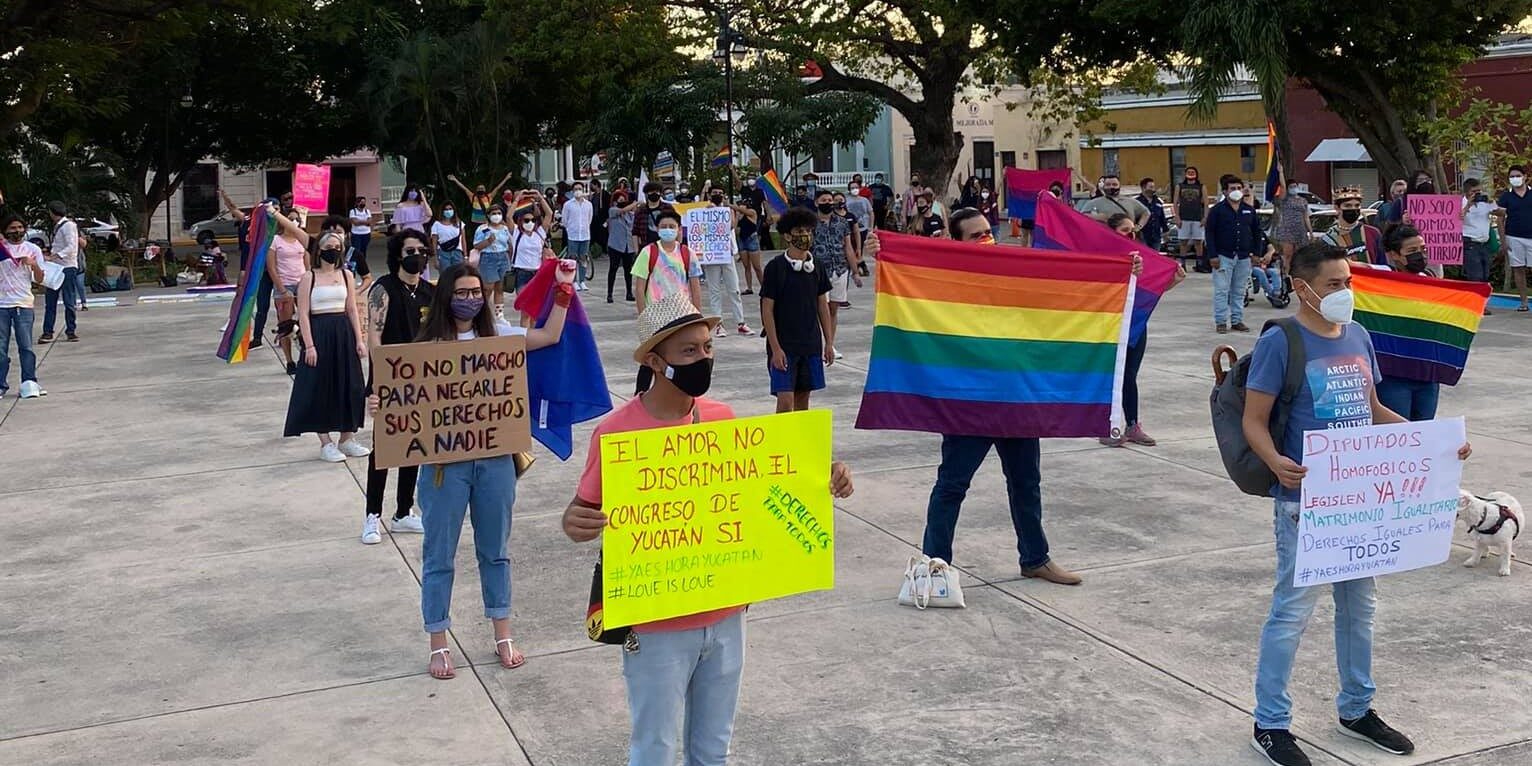
Mexico's Supreme Court of Justice (SCJN) will decide whether the Yucatán Congress is in contempt of court for failing to guarantee marriage equality and whether it should approve it. The ruling stems from an injunction filed by the Collective for the Protection of All Families in Yucatán ( Colectivo PTFY ) against the legislature after it voted against this right twice in secret in 2019.
On Wednesday, March 17, the ministers of the First Chamber of the SCJN were going to discuss the amparo, however, they decided to send it to the Plenary of the highest court so that the 11 ministers would decide on the matter.
Illegal votes
Alex Orué, a member of the PTFY Collective, commented in an interview with Presentes that there is a lot of confusion regarding the injunction and the Supreme Court's decision, clarifying that "what is being discussed is how the legislators acted. There were illegal, undemocratic, and secret votes, and the vote was not in accordance with the Constitution. Same-sex marriage is not up for debate."
This last point is supported by the fact that since 2015 the SCJN declared under jurisprudence 43/2015 that the laws of any state in the country that consider marriage as "procreation and/or that define it as that which is celebrated between a man and a woman, is unconstitutional" because it goes against the principle of equality and non-discrimination.
And although there is still no date for the Plenary to discuss the injunction and grant a deliberation, the activists remain positive about the decision to send it to the Plenary of the Court because of the significance and weight that it may have, since the resolution may define the scope it has in the protection of rights and the actions of Congresses in relation to the principles of equality and non-discrimination.
“We trust that the ministers of the Plenary will resolve and issue the sentence in the plenary session as soon as possible so that the current LXII Legislature of Yucatán can remedy the grievance before the end of its functions in the last ordinary session,” the PTFY Collective stated in a press release .

More than ten years of struggle
In Yucatán, LGBT+ activists have been advocating for the right to marriage equality for over a decade. Bringing this issue to the forefront has been thanks to the efforts of various organizations, collectives, and individuals who have raised their voices, such as Indignación, the Oasis shelter, the Center for Higher Studies in Sexuality (Cessex), the Collective for the Protection of All Families of Yucatán (Colectivo PTFY), and others.
In ten years at least three initiatives have been presented seeking to guarantee marriage equality and all have been rejected; activism has strengthened but so have anti-rights groups.
In July 2009, the Congress of Yucatán approved by majority vote reforms to articles of the Civil and Family Code to establish that marriage is "an institution through which the voluntary and legal union of a man and a woman is established (...) with the possibility of generating human reproduction in a free, responsible and informed manner."
This legal safeguard was the result of a citizen-led proposal spearheaded by the Pro Yucatán Network, an allied arm of the National Front for the Family. It was presented to Congress by the PRI and PAN caucuses—two conservative parties—and also supported by the state's archdiocese.
According to Orué, the State Human Rights Commission has also been part of the opposition to the recognition of same-sex marriage. “The ombudsmen have refused to file a constitutional challenge even though it is within their power to do so,” he says.

Majority of the population in favor
In 2017, 63.2% of adults in Yucatán who responded to the National Survey on Discrimination said they agreed with the approval of same-sex marriage.
In 2018, the PTFY Collective presented an initiative to Congress that was part of a package of reforms sent to Congress by the then governor Rolando Zapata Bello, who finished his term that year.
In April 2019, Congress put same-sex marriage to a public referendum. While activists protested that “human rights are not subject to a vote,” the plebiscite took place, resulting in over 14,000 messages from people demanding that legislators “move forward” with the initiative.
This journey highlights 2019 as the year in which the Collective for the Protection of All Families of Yucatán decided to take the lead in defending this right, which is now being taken up by the highest court of justice in the country.
Appeals brought before the Supreme Court
In April and July of 2019, the Congress secretly voted on initiatives seeking to reform the local Constitution and the Family Code to guarantee marriage equality. For these reasons, the lawyers of the PTFY Collective decided to take action, filing injunctions against the Yucatán legislature, which were subsequently taken up by the Supreme Court of Justice.
Alex Orué explains that an injunction is in favor of the secret ballot because "it is illegal, it violates the freedom of expression of the citizens because it limits the information that should be public and it violates our political rights because without that information we cannot make informed decisions in the next elections."
And another is the injunction that claims the decision of Congress as unconstitutional and a violation of human rights by contradicting the jurisprudence of the Supreme Court of Justice was taken up by the First Chamber of the highest court.
On February 24, 2021, the ministers postponed the vote on the draft ruling, and on March 17, 2021, they referred the discussion of the amparo to the Plenary of the SCJN.
Looking back, Orué maintains that the fight for marriage equality “will undoubtedly be the first of many victories.” She cautions, “The fact that it’s taking us more than ten years doesn’t mean everything else will take that long, but this is what it’s costing us. We’ve reached the Supreme Court because of the negligence, disinterest, and anti-rights stances of our leaders and representatives. And this isn’t the only outstanding issue the State has in human rights.”
A precedent
Since 2015, same-sex marriage has been constitutionally protected by the Supreme Court of Justice of the Nation (SCJN). Despite this, there are still 11 state legislatures with laws that do not guarantee this right, and consequently, some couples must file costly and time-consuming legal challenges to get married.
The Supreme Court's review and ruling on the appeal filed by the PTFY Collective is a milestone, and a favorable ruling could be relevant not only for Yucatán, but also for the rest of the country.
“If six of the 11 justices on the Supreme Court vote in favor, the case would be won. The Yucatán Congress would be ordered to amend its internal legislation, and a precedent would be set, which would carry significant weight in future cases. But if the case is approved by eight or more votes, the ruling immediately establishes jurisprudence. This means that in future cases, there would be no loss. Courts in similar cases would have to grant the injunction,” Kalycho Escoffie, legal advisor for the PTFY Collective, explained
What's next?
Awaiting the Supreme Court's decision on the injunction filed against the Yucatán Congress for its legislative omission in failing to guarantee marriage equality, and on the injunctions related to the secret ballot.
While the issue of same-sex marriage is currently attracting more media attention, Alex Orué explains that the agenda for defending the human rights of LGBT+ people in Yucatán is broad.
“While part of the team is focused on marriage equality, others of us are looking after homeless youth, hate crimes, pseudo-conversion therapies, hate speech, and the recognition of the gender identity of trans and non-binary people. We want to break the myth that 'nothing happens in Yucatán' because it does. But the state isn't interested in seeing, analyzing, or addressing cases of discrimination, which isn't exclusive to LGBT people. The Yucatán state government isn't interested in that, in understanding it, or in seeing it; for them, if they don't see it, it doesn't exist.”
We are present
We are committed to journalism that delves into the territories and conducts thorough investigations, combined with new technologies and narrative formats. We want the protagonists, their stories, and their struggles to be present.
SUPPORT US

FOLLOW US
Related notes


We are present
This and other stories are not usually on the media agenda. Together we can bring them to light.