

"Girls, become lesbians"
Interview with Alice Coffin, lesbian activist, councilor of the City of Paris (France) and author of 'Le génie lesbien'.

Share

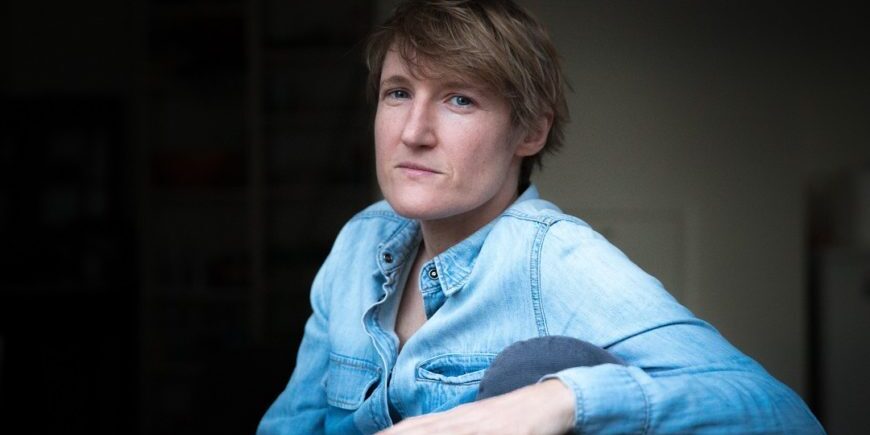
Alice Coffin is a lesbian activist and a councilor for the City of Paris (France). She has just published the book 'Le génie lesbien' (Lesbian Genius), a reflection on lesbian and feminist political practices, which has resulted in death threats and cyberbullying.
By Guillermo Rivas Pacheco / Pikara Magazine *

We helped Alice Coffin (1978) move furniture, shift sofas, and reposition her living room coffee table so that the interview photos wouldn't show her windows and reveal her address. When we interviewed her in mid-December, the French activist had been without police protection for a few weeks, but her security instincts remained sharp.
Coffin's activist career is long: from the anti-sexist football team Les Dégommeuses to La Barbe, a collective of women who denounce male dominance in decision-making bodies with fake beards, to the AJL (French Association of LGBTI Journalists) and the European Lesbian Confederation (EL*C), which she helped found. Until now, she has never had to live with a police escort.
Since being elected to the Paris City Council in the June 2020 municipal elections, activist Alice Coffin has found herself straddling the line between street activism and institutional power. Her first act upon assuming office was to secure the resignation of the city's Culture Councillor, Christophe Girard, due to his complicity with the writer and self-confessed pedophile Gabriel Matzneff, to whom the City Council was paying child support. Having become a public figure in the media, Coffin began receiving death threats and, for the first time in her life, found herself under police protection.
Something I found really interesting in your book is when you mention that at any lesbian meeting or gathering, the first thing they do is rearrange the space, change the furniture layout. That's kind of what we just did, isn't it?
Oh là, là [laughs], it's something I see in every country, whenever I'm with a group of lesbians. I think it has to do with a desire for comfort, with wanting the space to reflect your worldview . What we're doing now is more for safety, although luckily the cyberbullying and threats I was receiving have decreased significantly.
Your book
, *Le génie lesbien * (something like "The Lesbian Genius" in English; the book hasn't been translated), seeks to highlight the often fundamental contribution of lesbian feminists to numerous protest movements, from French feminism in the 1970s to Black Lives Matter . Why do you think their role has been made invisible? It's a largely unknown story, even for a lesbian. Within feminism, there have been debates about whether to exclude lesbians from the struggle. These debates took place in the National Organization for Women, the major feminist organization in the United States, and in the French feminist movement, because political lesbianism is a powerful force capable of dismantling the very foundations of society, from patriarchy to capitalism, including the colonial structure . Simply stating that you are a lesbian is, in itself, a complete transgression against the established order. Lesbians are the element that must not be shown because they directly threaten the patriarchy , from the father as head of the family to the "father of the nation." This allows us to monitor more closely and deconstruct certain systems more easily. It's no coincidence that there are lesbian figures in resistance movements like in Hong Kong, with Denise Ho , or that the Black Lives Matter queer women . So, yes, some feminists weren't wrong to think that lesbians were going to terrorize society (smiles).

Fortunately, the last two years seem to have marked the resurgence of the feminist movement in France.
Yes, and two years of increased lesbian visibility, too! Current events show us how, in film, journalism, and literature, when lesbians manage to break through the barriers surrounding lesbian themes, they cause a social upheaval. The release of a film like Portrait of a Lady on Fire , and the fact that its director, Céline Sciamma (a lesbian), used the promotional campaign to deliver a militant critique of the French film industry, was a seismic event. Just a few weeks after its release, one of the protagonists, Adèle Haenel (also a lesbian), denounced the sexual abuse she suffered at the hands of a film director when she was a teenager. And a few months later, during the César Awards ceremony, a lesbian body—Haenel's—in the midst of that patriarchal world, stood up and left the auditorium shouting "shame" when the award for best director was announced for Roman Polanski , accused of pedophilia. It was a magical ceremony if you analyze it from a lesbian perspective because, as soon as we have the floor, the explosion is incredible, an earthquake.
It seems there are two spheres: the corporate world and the world of institutions, which have perfectly understood that they can profit by giving space to a "depoliticized feminism." But in journalism or the world of culture, when symbolic representation comes into play, feminist demands have much less resonance. In your book, you explain that this is simply because these sectors think they don't have a problem with the place of women.
I saw it very clearly with our actions at La Barbe; we infiltrated meetings of politicians, sports federations, companies… They didn't welcome us with open arms, but they couldn't deny that they have a problem with the place of women in those spaces. They looked for justifications, they set up mechanisms… Because they know the problem is real. But in the art world, it was just the opposite; they told us: "You've got the wrong enemy," "we only judge based on genius"; hence the title of my book. For them, everything is a matter of talent; they don't delve into the issues of production, funding, or representation that other sectors are more aware of. That's why, if I compare current feminism with that of the 1970s, I see that we are at a revolutionary moment because feminists have turned their attention to the world of culture. In the 1970s, slogans were more along the lines of "my body is mine," "I decide about my body," and now we are liberating the imagination; we want our minds to belong to us. It's no coincidence that this renaissance coincides with the #MeToo movement, which is gaining momentum in the film industry. It's a revolution about controlling our imagination, about liberating our ways of thinking.
And it's something I've struggled with regarding my book. I knew there were phrases that might offend some people, but I never imagined it would be one about the culture I consume. Though it may seem trivial, I've even received death threats simply for talking about the books I choose to read or not. Because they know very well that the fight to impose their narrative wields immense power.

Your election in June 2020 as a city councilor in Paris on the Green Party (EELV) list—was that the logical step after so many years of activism?
It saddens me to think that I spent so many years saying that politics was something we shouldn't get involved in because it made us lose our essence, make us less effective. It's a discourse that's very prevalent in activism, but it only benefits those already in power who want us to remain marginalized . And I think it's the opposite; we have to get involved in politics . Alexandria Ocasio-Cortez [US congresswoman] explains it very well: outside-inside —you need people within the structures who reflect what's happening outside. That's why, when the feminist movement demonstrated outside Paris City Hall against Christophe Girard, I went out and joined them.
By demanding the resignation of the Minister of Culture, Christophe Girard, accused of complicity in the Gabriel Matzneff pedophilia case, you put into practice something you defend in your book: that the personal is political.
Many colleagues told me we had to proceed slowly, that we couldn't do certain things, but my practical experience tells me that being direct and decisive helps to unite many more people. Then you see our actions, the demonstrations, and they allowed us to bring many more aspects of the case to light. Because our discourse is on the margins, but when it emerges, it resonates with the experiences of many people.
If you analyze France from the outside, terms like "communitarianism" or "republican universalism" imply that the Republic's values are the same for everyone, preventing the country from addressing issues like racism or sexism.
These terms are meaningless, a barrier that stifles any constructive debate. They seek to pit the Republic against the struggles of minority groups, which is a historical contradiction, a form of revisionism, because since 1848 the Republic has been built on the foundation of social and representational struggles that were indeed minority struggles. When it comes to the Republic, the left seems to have a problem with discourses that divide society—but you can't please everyone! And as for lesbian activism, I've never seen it as anything other than a universal struggle. In France, the word "communitarian" is used perversely, as if it were exclusionary. And Monique Wittig explains it very well: minority struggles belong to all of humanity.
One of the most shocking ideas in your book is the phrase, "Girls, become lesbians," which, however, had already been used by other activists, like Virginie Despentes.
I understand that the most controversial part of the phrase is the idea of becoming a lesbian, but I think that in 2020 it doesn't mean the same thing as it did in the 1960s when homophobic groups talked about "choice" to justify conversion therapy. I think it can be used differently to explain, for example, that lesbians aren't homosexual, that being a lesbian has nothing to do with sexual orientation. It really strikes me when my heterosexual friends tell me, "I can't stand guys, I don't want to be with guys," and at the same time they say, "But you know, I like sleeping with them." For me, it's like, "Wait, wait, you're listing a bunch of things you, as a feminist, can't stand about men, that you're fed up with educating guys," only to end up saying, "You know, I like them." I think the whole sexuality thing is a social construct, and suffering so much just because you like men is part of that construct. That's why, for me, the phrase "become lesbians" isn't about sexual orientation; it's more of a political slogan, an invitation to think outside the box . It's not so much about sleeping with girls as it is about not being afraid to free yourselves from the male gaze, acting and thinking outside the dictates of a world that revolves around men.
This article was originally published in Pikara Magazine . To learn more about our partnership, click here .
We are present
We are committed to journalism that delves into the territories and conducts thorough investigations, combined with new technologies and narrative formats. We want the protagonists, their stories, and their struggles to be present.
SUPPORT US

FOLLOW US
Related notes

We are present
This and other stories are not usually on the media agenda. Together we can bring them to light.