

Opens the world's first LGBT+ opera singing chair
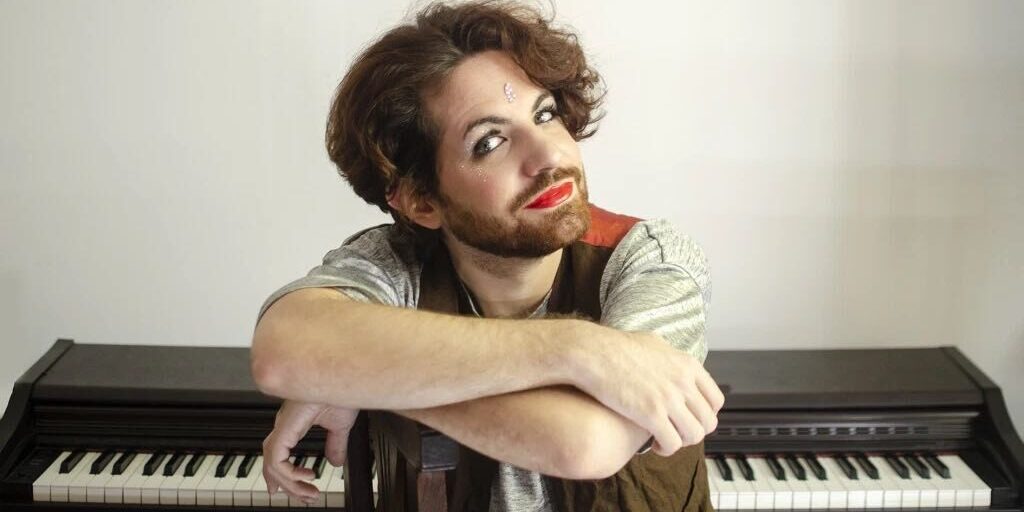
The National University of the Arts is launching a vocal technique course focused on diversity. It will be taught by Luchi De Gyldenfeldt of Queer Opera.

Share

The National University of the Arts (UNA) is launching a new vocal technique course this semester, focusing on diversity. Luchi De Gyldenfeldt, from Queer Opera, is the instructor for this new course within the Bachelor's Degree in Lyrical Singing.
Text and photos by Noelia Pirsic *
Shortly before the start of the pandemic, Luchi de Gyldenfeldt gave his identity as a baritone one last chance. He sat down at the piano, laid down the sheet music, and began to sing the low notes that his entire life had told him were his due, given his physical condition. This time, his body gave him a limit: his throat began to close up, and he couldn't produce a sound. "I was mute." Luchi, who two years earlier had graduated with honors from the National University of the Arts (UNA) with a Bachelor of Music degree specializing in Opera Singing, and who just a few months before had performed on the stage of the Teatro Avenida as Papageno in The Magic Flute —a dream role for anyone with his vocal range—knew he couldn't continue singing that way, in that register. "I felt like I was violating my throat, forcing a sound." It was the last time he did it.
Luchi had been questioning the links between voice and gender since 2017, when she was still a university student. In December of that year, a week after graduating, she performed a new repertoire for the first time with her twin sister Ferni, this time in a higher register, different from what she had been using in her singing lessons. That day, at the end of the performance, her loved ones confirmed what she already knew: “This was your true graduation ceremony.” They then founded the Queer Opera , a dissident musical duo that staged the need to make diversity visible in the world of opera.

Today, as a result of an artistic, political, and personal quest, Luchi feels at ease with her countertenor voice, which she honed under the guidance of her teacher, Mario de Salvo. While continuing to perform with her sister throughout the country, sharing stages with renowned artists such as Susy Shock, and auditioning for admission to the advanced training program at the Higher Institute of Art of the Teatro Colón, she is preparing for another great challenge: to hold the position of the world's first chair of opera singing with a gender perspective , an initiative of the Department of Musical Arts at the National University of the Arts (UNA ).
“The chair will be called the Chair of Dissident Song,” Luchi explains. “There are a lot of related phrases that also give it meaning: non-binary, non-biological, with a gender perspective , but we didn’t want to give it a very long and impossible name. Saying ‘the Chair of Dissident Song at UNA’ is something easier to reproduce and replicate.”
Who is this proposal aimed at?
Our idea is to create a space free from sexist and institutional violence within the university, which remains a conservative place. There are many people who participate, or would like to participate, in academia and feel excluded because they identify as part of the LGBTQ+ community. I know these people exist. The goal of this course is to engage opera students who know beforehand that they will be working with a 31-year-old queer, non-binary, gay professor. The decision by Cristina Vázquez, Dean of the Department of Musical Arts (DAMus) at the National University of Asunción (UNA), to support young people who are passionate about changing things represents a very important shift.
How was your search for your identity in singing?
I graduated from UNA in 2017 and afterwards went through several coming-out processes related to the arts, specifically vocals. I graduated as a baritone, then became a soprano in Queer Opera, and later switched to countertenor. I'd always played at being a soprano, even as a child. Then the biological perspective began to take hold, something I'm very keen to deconstruct as a teacher as well—a norm that forced me to train as a baritone and not as a countertenor. My experience giving private lessons to trans students helped me significantly change my vocal pedagogy, moving away from the archaic, academic, and biological approach to interpreting the body in a certain way.
Who were your role models in this search?
The case of María Castillo de Lima ( Editor's note: in 2019, the singer managed to get the Teatro Colón's resident choir to change its status to place her in the voice part that corresponds to her vocal range, moving from tenor to soprano ) is fabulous and almost unique because, in addition to her change of identity and performance, she underwent a transmutation, an identity exploration through her voice. She is a trans woman and a soprano, but she could also be a trans woman like Laura Borja, who decided to remain in the tenor range. One also finds role models elsewhere: Susy Shock, Marlene Wayar, and also my sister, Ferni. People who were able to cope, survive, and make music in a system that wants to categorize you. I used to be with a teacher in a context where I was a baritone because, even though I was gay, I was a man. At 27, I told myself: "I'm already here, I'm known as a baritone, I'm already part of the system this way, I can't make this change now." At one point in my life, I couldn't take it anymore, and I found my escape in Queer Opera. Suddenly, that need to embrace my voice became an urgency, and I stopped worrying about the past. I integrated it, and that allowed me to change my vocal style.

What was your experience like during your time at the academy?
The National University of Asunción (UNA) always embraced me, always returned my love. I always had an excellent relationship with Dean Cristina Vázquez, who offered me this position. I greatly admire the affection she has for the university, to which she dedicates significant hours of her life, her vital energy: she is completely committed to her responsibilities within the institution. She began implementing the Micaela Law and created the first Music and Gender Commission last year, of which I am a member as part of the alumni body. I found many sources of love, including in the classes with Professor Bea Odoriz—a stage director—with whom I had the opportunity during my studies to practice being a countertenor. I met very important people in my life within the university, and I never distanced myself from it, not even after graduating. Likewise, to forge my own path, I had to fight a bit with academia. I was privileged to be able to do so. The university is a center of hetero-cis patriarchal power, which is why the creation of a chair of dissident song is so significant. Centers of power exclude and perpetrate violence. It is important that struggles and activism for equal opportunities are also expressed there, so that dissenting voices are neither conditioned nor rendered invisible by institutions .
What does the opening of this space represent for the LGBTTTIQ+ community?
For me, this is a historical reparation. Lohana Berkins once said, “When one trans woman gets a job in the government, it changes that trans woman’s life. When many trans women get jobs in the government, it changes the life of society.” I believe the same is true for gender and sexual minorities: we are aiming to change the paradigm, to no longer be the humanity we once were; we have a historical opportunity. There is also much to be done within the opera world: we don’t want any more banal and empty performances in the world of opera .
What opportunities do you think the creation of this new space within UNA will enable?
A singing professorship doesn't create anything; it simply makes things visible. A professorship in dissident singing doesn't create dissent; musical dissent already exists, it's out there, even outside the DAMus (Department of Music and Performing Arts) . In taking on this role as a professor, I'm thinking of others, not just myself. It's significant that this subject is emerging at the most important arts university in Latin America, which is also free and open to the public. I'm excited to imagine that people from other parts of Argentina and the region will learn about this space and feel invited to come. With actions like the creation of this professorship, the word "inclusive" ceases to be an empty term and acquires meaning through concrete policies . I feel very supported by the UNA (National University of the Arts), which respected me as a student in the past and now embraces me again with my dissent, or, as Susy Shock would say, with my monstrosity . We should be proud of the moment we are creating and experiencing. Clearly, transfeminism is impacting the political agenda to ensure that there are resources for everyone.
How do you plan to work on the assignment of vocal registers?
We're going to create a space where we can freely work vocally. We need to understand that we shouldn't define things beforehand, that we need to give more time to experiment, always taking care of our vocal health. Much of this has to do with the old Bel Canto school, where timing is very important. I felt anxious during my time at university because there was a sense of being against the clock, of having to "make a career," go abroad, have everything figured out. I think I never sang better than after the pandemic, when I didn't have any pressure to solve anything and I was able to connect more with myself. I feel confident pedagogically because, in embracing my change in vocal register, I had to learn a lot of things again and connect much more with my instrument, with my body, with my breath, with my patience, my composure. I had to be able to contemplate, to be more inward-looking than outward-looking. We'll see what registers emerge in each person.

Do you have any particular expectations about how the course will develop?
None, because everything will surprise me, because there's no precedent for this. It's going to be a course of experimentation. Everything will be trial and error; there's no room for error. It might be difficult to deal with academia in some aspects, especially regarding juries and evaluations. I understand that there will be people who won't necessarily share my perspective. We'll have to be strong there and understand that we're facing an entire system. In that sense, I also value having pianist Jazmín Tiscornia as a partner in the course. I immediately thought of her when this opportunity arose, not only because of our connection and because I know what she'll be able to contribute musically, but also because it will be a course born from love, with a professional who has a gender perspective.
What scenarios do you envision for dissident lyric singing?
First, we need to deconstruct opera singing in general. This relates to the need for academic programs that allow for genuine reflection on each individual's role . We have to find our own stage; there isn't just one: it's the one each person can imagine. I believe that historical redress involves accepting that all possible stages are ours . It's one thing to say 'no' to the Teatro Colón, and another for that stage to never call upon you or feel the need to call upon you. I believe it's necessary to reach those places. In that sense, a professorship at the UNA (National University of the Arts) is also necessary; it empowers us greatly. The stages are those that are created, those that we will create together.
This article was originally published in Opera in Argentina and is reproduced with the author's permission.
We are present
We are committed to journalism that delves into the territories and conducts thorough investigations, combined with new technologies and narrative formats. We want the protagonists, their stories, and their struggles to be present.
SUPPORT US

FOLLOW US
Related notes
We are present
This and other stories are not usually on the media agenda. Together we can bring them to light.