

March 8: Latin America marched against sexist violence and patriarchal justice
In this regional coverage of March 8th, what are the demands that resonate strongly in the region?

Share

By Georgina González Álvarez and Milena Pafundi (Mexico City), Pilar Salazar (Guatemala City), Dunia Orellana (San Pedro Sula), Paula Rosales (San Salvador), Airam Fernández (Santiago de Chile), Juliana Quintana and Jessie Insfrán (Asunción), Vero Ferrari (Lima), Ana Fornaro and María Eugenia Ludueña (Buenos Aires).
Across many parts of Latin America, the March 8th marches were powerful, despite the restrictions imposed by the COVID-19 pandemic. The demands that resonated most across different regions were the need for public policies to curb gender-based violence and reform the judicial system to ensure justice for women, lesbians, transvestites, trans people, bisexuals, non-binary people, and gender-fluid individuals. Abortion was another regional demand, and Argentina marched for the first time with this demand already enshrined in law. There were also calls for public policies that improve and guarantee access to employment for all, in a context where the lack of comprehensive public policies has led to precarious working conditions, increased unemployment, and the criminalization of sex workers and people in prostitution.
Although the number of people at the marches in some countries was lower than in previous years, there was a strong police presence and arrests in Mexico, Chile, and Paraguay.
MEXICO: against the patriarchal pact
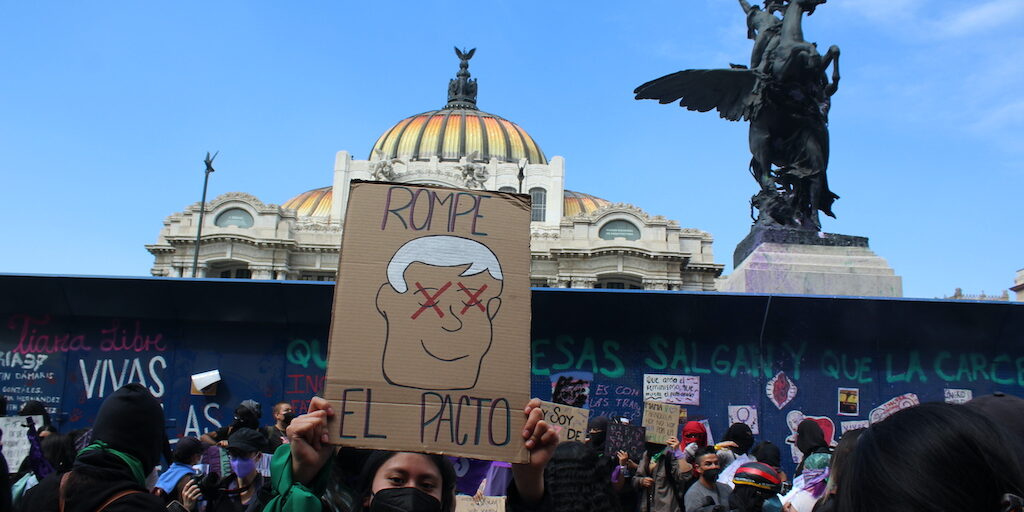
The March 8th demonstrations in Mexico City were notable for the heavy police presence and repression. They were also marked by direct criticism of President Andrés Manuel López Obrador's disregard for gender violence and the lack of justice for women.
In contrast to the historic march of 2020, the number of attendees was lower due to the pandemic. But the power of their slogans reached even the metal barriers surrounding the National Palace (Presidential Residence). The general demand was “Enough with impunity!” alluding to the president's statement when he was urged to break the patriarchal pact. In Mexico, 11 women are victims of femicide every day, and 99.7% of sexual violence crimes go unpunished.

“Stop transphobia”
Trans women, lesbians, non-binary people, migrants, members of the Mexican Alliance of Sex Workers ( AMETS ), the Center for Support of Trans Identities ( CAIT ), and cisgender feminists from the Interfeminist Solidarity Alliance joined forces and marched to the Zócalo. They demanded respect for their identities , an end to the criminalization of sex work , and called for an end to transphobia, harassment, and femicides .


A group of women wearing hoods and black spray-painted transphobic graffiti right next to the visible intersectional contingent. This led to a shouting match. They withdrew after chanting in unison that “transphobia is fascism.”
“At the beginning of the march, we didn’t feel safe. We didn’t know who was a TERF and who wasn’t. When we saw the sex workers, the trans group, it was like being at home. I’m glad to know that we’re not the only non-binary people here and that we have a whole gang (group) that’s supporting us,” Alexis and Nahui commented.
Police repression
2,300 police officers were deployed, most of them riot police, who repressed the protesters at various points throughout the city and during the demonstration. The Marabunta Brigade , an organization that defends the human rights of protesters, reported that the police used fire extinguisher powder, pepper spray, paintballs, and tear gas canisters to disperse the demonstration. They clarified that these tools are not part of the police's standard operating procedure. Authorities categorically denied their use during the protest.

Furthermore, prior to the start of the march, the police "encapsulated" a group of protesters for more than three hours and four photojournalists were beaten, handcuffed and detained.
GUATEMALA: For women's lives, without violence
On March 8th, the slogans and demands directed at the Guatemalan state centered around the ongoing murders of women and girls, which have worsened in the country this year . They also addressed the repression by the Ministry of the Interior, headed by Gendri Reyes, who has been accused of repression and violence against women following the protests of November 21, 2020.

Mónica Chub Caal, a 30-year-old trans activist, lives in Cobán, the capital of Alta Verapaz (220 kilometers from Guatemala City). She is a member of the “Office for Sexual and Gender Diversity of Alta Verapaz,” which, along with groups of rural Indigenous women and older women, took to the streets of Cobán at the call of the “Collective of Women's Organizations of Alta Verapaz.” Their main demands were an land grabbing by hydroelectric companies and landowners who have recently criminalized women in rural areas.
Other complaints include violence against lesbian and bisexual women due to discrimination, and the lack of recognition of transgender women's gender identity by the State. The "Office for Sexual and Gender Diversity of Alta Verapaz" has supported four complaints filed with the Public Prosecutor's Office this year regarding verbal abuse of transgender women by neighbors in the department of Cobán, and a total of 15 since the office's creation in 2017.

This year's complaints filed with the Public Prosecutor's Office will conclude with a "conciliation" process between the aggressors (all men) and the victims. The aim is to reach a supposed agreement of respect, which, according to Mónica, doesn't always end that way, as it's a recurring situation.

“We were the only two organizations that participated in today’s march; no other organizations joined us because of the date.” The march began in the central plaza and ended in the central park in front of the Governor’s office, where they spent about half an hour chanting and demanding: #WeWantToBeAlive #NoMoreTransfemicides #DiverseWomenAgainstAllTypesOfViolence, “recognition of our identity as trans women,” and #NoToStigmatization.

EL SALVADOR: Against State Repression
The image of three Salvadoran police patrol cars retreating before the collective cry of hundreds of women saying, "They won't stop us, they won't stop us," marked the mood of the March 8 march, held in several streets of the capital of El Salvador.
The crowd was surrounded by police and soldiers in bulletproof vests, carrying rifles, who attempted to arrest one of the participants. She was accused of defacing the walls of the National Palace with spray paint. Pressure from organized women's groups forced the security forces to back down.
Groups of feminists, transfeminists, ecofeminists, women with disabilities, workers, and journalists took to the streets to demand the legalization of abortion , the investigation and prosecution of crimes committed against women and the LGBTI population , and an end to the persecution and harassment by the State against journalists and human rights defenders .
“They don’t protect me, my friends do!” they shouted at the security forces. According to social organizations, many women who have suffered violence are discouraged from reporting the incidents to the prosecutor’s office due to the limited investigative capacity. They also indicate that many cases of physical and sexual violence go unpunished.
The walls and monuments in the city center's plazas became a platform for denouncing disappearances, rapes, murders, and attacks against women. The government, concerned about "vandalism," was very effective in removing any trace of the protests.
With the slogan "We march for our lives, bodies and territories," the women showed their concern about the advance of a government that threatens to roll back the rights of women, diverse populations and indigenous people.
“Once again, we denounce lesbophobia and transphobia, as well as the Legislative Assembly’s lack of interest in discussing the draft gender identity law. It has been shelved for almost three years now,” read Britany Castillo of the Solidarity Association to Promote Human Development – ASPIDH, at a public event before the march.
LGBTI rights organizations reported four murders in the Central American country in 2020, a 51 percent decrease compared to the same period the previous year. Three of the victims were transgender women and one was a gay man, while nine murders were reported in 2019.
The LGBTI community also demanded that the Salvadoran state be held accountable for human rights violations committed by police and military personnel, who have primarily targeted transgender women. In 2020, three officers were sentenced to twenty years in prison for the murder of Camila Díaz.
However, the Nayib Bukele government dismantled the sexual diversity directorate, which was placed under the dependency of the gender unit of the Ministry of Culture. The 131 telephone line, which handled complaints and provided guidance on rights and psychological support for the LGBTI population, also disappeared.
In recent decades, El Salvador has been an exporter of people fleeing violence and poverty, according to the study on internal forced displacement of the LGBTI population in El Salvador, "Fleeing and Surviving," conducted by the Association Communicating and Training Trans Women with HIV in El Salvador – COMCAVIS TRANS, which reported 151 cases of forced displacement, in which 67.5 percent were trans women and 17.2 percent were gay men.
Honduras: For justice and abortion
The rain didn't stop the trans and cisgender women gathered in San Pedro Sula's central park to commemorate International Women's Day (March 8th). In their words, they weren't "celebrating," they were demanding justice for the abused and murdered women in Honduras . Those gathered in downtown San Pedro Sula burned wood on the park's reddish cobblestones and shouted at the top of their lungs. They held up multicolored signs with messages against state policies that have forgotten or harmed them. One of these policies was the recent bill that absolutely condemns abortion with prison sentences and hefty fines. "Decriminalization of abortion. Neither a crime nor a sin. My right is a debt owed by the State!" read the main pink sign that several women held in the drizzle.
“We commemorate this day because the State does not recognize us,” said trans activist Viena Ávila. She arrived at the park with a small group of trans women. “And because of the many deaths that occur simply for being women.” They placed several rows of shoes on the ground to symbolize the trans and cisgender women who have been violently murdered in recent years. Under each shoe was a sign with the name of the murdered woman.
“Trans women fight every day to reclaim our rights as women. We are the voices of many sisters who are no longer with us. We identify ourselves by the shoes of many of them that have been placed here. Many of our fellow sex workers are no longer with us,” added Viena Ávila.
To protest the State's investigative ineptitude and the crimes allegedly committed by state agents against sex workers, trans and cisgender women, activists lit a bonfire with logs and threw down signs with the names of government authorities to symbolically burn the "narco-state".
PARAGUAY: "Alive, diverse and with rights"
Feminist groups and political and grassroots organizations took to the streets yesterday as part of #8MPy, International Working Women's Day in Paraguay. Under the slogan "Alive, diverse, and with rights ," they demanded a real strengthening of the healthcare system, vaccines, a response to the education crisis and corruption, and a comprehensive approach to the other pandemic: gender-based violence .
This year, #8MPy coincided with the fourth day of protests in Asunción over the lack of vaccines and medicines, and the 99.3% occupancy rate in intensive care units. The Paraguayan feminist movement joined the protests, which began on Friday with self-organized citizen groups. The pandemic has exacerbated precarious working conditions, exploitation, violence, and discrimination, and further highlighted the absence of public policies aimed at protecting and ensuring the full realization of women's rights.

Among their main demands, the feminist collective included a complete overhaul of the current government: “President Mario Abdo Benítez, Vice President Hugo Velázquez, and their entire negligent cabinet must resign, and we demand that the new government implement public policies with a gender perspective,” they stated in their manifesto. They also condemned the excessive police violence against protesters during these days of demonstrations: the use of rubber bullets and tear gas, and even a water cannon against children and the elderly.
They also demanded that the new Minister of Women have experience working for women's rights and knowledge of gender equality policies. “We will not accept appointments that are based on internal party politics. The increase in violence demands urgent action and strong leadership,” they stated.

Indigenous women, peasant women, Afro-Paraguayan women, sex workers, trans women, non-binary women, lesbians, bisexuals, pansexuals, and women of diverse gender and sexual identities, neurodiverse women, and women of different religious beliefs denounced violence in the workplace. They also denounced the oppression of peasant and Indigenous communities, linked to the expansion of agribusiness and the continuation of state terrorism, which was made evident last year with the murder of two 11-year-old girls by the Joint Task Force in Yby Yaú.

In the document, they also requested that trans women and transvestites have other employment options besides sex work . “We are excluded, discriminated against, and subjected to violence within the labor system. Therefore, what is an option for some is an imposition for others. We request that sex work be recognized for those who choose it, and that opportunities, training, and education be created for those who want other forms of employment,” they stated.

During the pandemic, women suffered the most job losses. According to data from the Equality and Non-Discrimination Observatory of the Center for Documentation and Studies (CDE), the two sectors with the highest concentration of women—self-employment and paid domestic work—have experienced significant declines. As early as 2019, the percentage of women with no income reached 39.8%.
Yesterday in Paraguay, the protests began early. As every year, women from the city of Lambaré defaced the traditional statue of La Burrerita, covering it in lilac with feminist slogans such as "We want to live" and "Free from violence." Also in the morning, activists from the Coordinating Committee of Rural and Urban Workers went to the Ministry of Health to demand the implementation of public policies that guarantee the rights of rural women. Later that morning, the Women's Platform of Bañado Sur (PMUBS) marched to the National Emergency Secretariat to protest the government's inefficiency in handling the health crisis.
Hundreds of diverse women marched yesterday in two ways. Some joined in a caravan of cars, motorcycles, and bicycles that departed from the Costanera (General Santos Avenue) at 6 p.m. heading towards Plaza de la Democracia, where the main event took place.
There were also those who went directly to the plaza and waited for the caravan to read the manifesto. In addition to the artistic and performance interventions, women from the community kitchen network in Bañado Sur offered a solidarity snack to share near the Plaza de la Democracia.
Rallies also took place in Encarnación, Ciudad del Este, and Pedro Juan Caballero. In Asunción, coinciding with the #8MPy protests, demonstrations continued in front of Congress, intensifying their demands for the government's resignation and an end to seven decades of Colorado Party rule.

Approximately 16 people were arrested last night during a citizen demonstration held at the headquarters of the National Republican Association (the Colorado Party's headquarters in downtown Buenos Aires). Early this morning, the National Police again attacked the demonstrators with rubber bullets, tear gas, and water cannons.
PERU: Justice for victims of violence
International Women's Day in Peru was commemorated under pandemic restrictions, without a march in Lima, but with a sit-in in front of the Palace of Justice. The demand was for justice for women who have suffered violence in recent years — violence that has not stopped, but has even increased in the context of quarantines and physical isolation caused by COVID-19 . Thousands of women have lost their jobs or have taken on a triple workload while also supporting their children with virtual schoolwork. Others have had to live with their abusers, unable to leave and report the violence they are experiencing. There has also been an increase in sexual violence against minors, and the disappearances and subsequent femicides continue unabated, as happened in Tacna, a border city in Peru, with 20-year-old Judith Machaca and 14-year-old Noemí Escobar. Both were found in an 80-meter-deep well in February, after their parents' tireless search, supported by feminist organizations in the city, in the face of police negligence and indifference, since it was the criminal investigation division that was involved in these disappearances, deaths, and burials of women.
These police officers, taking advantage of their access to confidential information about the women of Tacna, recruited them and forced them into prostitution. Since they also received all the reports of sexual violence, extortion, and kidnapping, they covered for each other, favored rapists, delayed investigations into cases reported by women, discouraged them from pursuing their complaints, or placed numerous obstacles in their path to wear them down and force them to abandon their cases. They also accepted bribes from those they had accused.
Another of the slogans raised this March 8th was the fight against fundamentalism , less than two months before the next presidential elections, where a candidate is promoting all the ultraconservative agendas and receiving the support of a large part of the population, in a manifestation of decades of institutional neglect of education in human rights, coexistence and respect for the diversity of the population, which would have prevented a scenario like this, and where religious forces continually intervened in the state to maintain inequalities and discrimination against women, LGBTQ+ people and indigenous peoples.
CHILE: "Transforming and building a good life together"
Women took to the streets in several Chilean cities, responding to a call from the 8M Feminist Coordinating Committee to commemorate International Women's Day with a strike. According to their report , more than half a million people gathered in Santiago, along the Alameda. Demonstrations also took place in Valparaíso, Viña del Mar, Concepción, Chillán, Iquique, and Antofagasta, despite pandemic restrictions.
The activities in more than 100 territories were promoted through social media, emphasizing not only their feminist character, but also their inclusivity and freedom from transphobia . This year, the invitation was to reaffirm the struggle to “radically transform life and build a good life together.”
Some of the central demands of the strike: cessation of patriarchal violence, the right to a feminist and non-sexist education, to work and social security, to housing and the city, access to health and technologies, the decriminalization of migration, and the fight for abortion and sexual and reproductive rights.
In Valparaíso, the slogan “They are killing us” guided the protests. According to official figures, 43 women were murdered in 2020, and this year records show seven femicides.
A defining moment of the day was the arrest of Emilia Schneider, former president of the University of Chile Student Federation, current constituent assembly candidate, and trans activist. She was painting a banner in the street with other activists when five Carabineros (Chilean police officers) got out of a car and, without justification, took her and her press advisor, Juan Pablo Esteban, into custody. In a statement, the institution alleged “disruption of vehicular traffic.” They were taken to the 19th Police Station in Providencia and released hours later. “The arrest was disproportionate and a small example of the excessive and everyday violence of the Carabineros,” said Emilia.
At the time of writing, police were suppressing the demonstration in Plaza Dignidad, after a group of hooded individuals attempted to topple the monument to General Baquedano, while the majority of those present were demonstrating peacefully.
ARGENTINA: Feminist judicial reform and trans employment quota
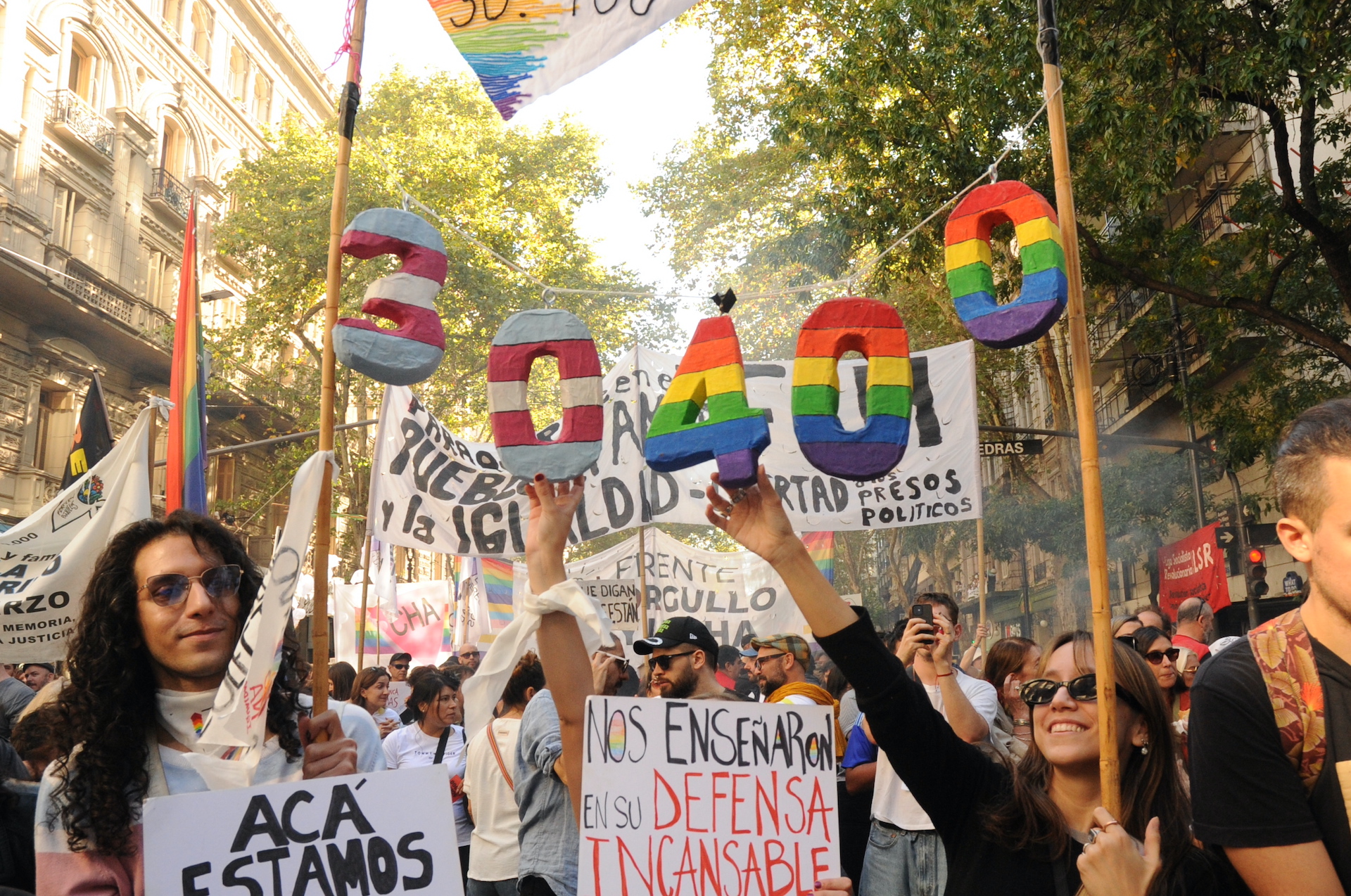
There were demonstrations in various cities across Argentina, in a context where gender-based violence has already resulted in 55 femicides this year and at least two transphobic murders. And the justice system has failed to react in time, as was the case in the violent murders of women who had filed reports of gender-based violence. The demands included: “making visible the conditions of super-exploitation of labor that the pandemic crisis has imposed on women, lesbians, bisexuals, transvestites, trans people, and non-binary individuals”; demanding a feminist judicial reform to end patriarchal justice and the effective implementation of the Micaela Law; the enactment of a trans employment quota law; and the release of women imprisoned for having abortions, among others.
In Buenos Aires, the main demonstration was held in front of the National Congress. The number of women was much lower than in previous years. Most of them marched from political, labor, cultural, or social organizations. There was a significant presence of healthcare workers. And also more Indigenous women who demanded, among other slogans, "Stop child abuse." It was also a year with thousands of women setting up street markets and managing street vending.
In Argentina, it was the first 8M march with Legal, Safe and Free Abortion - one of the strongest demands of previous marches - and the chant "It's the law" flew over the entire day.
Share
We are present
We are committed to journalism that delves into the territories and conducts thorough investigations, combined with new technologies and narrative formats. We want the protagonists, their stories, and their struggles to be present.
SUPPORT US

FOLLOW US
Related notes


We are present
This and other stories are not usually on the media agenda. Together we can bring them to light.