

Inmates at Baradero prison translate Alexa's book into Braille.
In the context of braille and gender workshops, Alexa Petonne's story reached the Baradero prison.

Share

By Rosario Marina
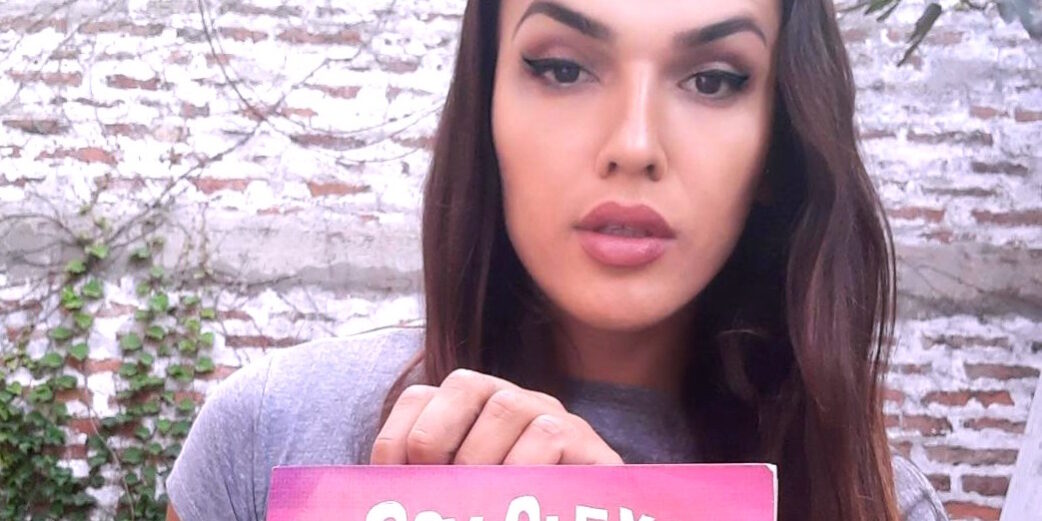
I Am Alex started out as a different kind of book: it's the story of a trans girl written by high school students. The target audience: children. Now it continues its journey, seeking to become accessible to more people. Inmates at Unit 11 of the Baradero Penitentiary are translating it into Braille as part of two workshops: one on Braille and another called "Deconstructing Masculinities."
Verónica Girandola, a specialist in children and families, and her colleague Victoria Salvo, a social worker, started the project. Editorial Chirimbote quickly joined the project, as did Alexa Pettone, the trans skater featured in the book.
“In 2019, we started developing projects to showcase the work of the inmates in the Braille workshop at Penal Unit 11, and to bring to light the incredibly valuable work of creating things in Braille. We contacted institutions that could use the materials, and special education schools approached us and took things the children had made, such as maps, diagrams of the digestive system, the respiratory system, and so on,” Verónica tells Presentes about the beginning of this story that unites three worlds that no longer seem so distant.
But it wasn't just the braille workshop that would bring this book to the prison and then make it increasingly accessible. That same year, the two professionals, who have over 15 years of experience working in prisons, started a workshop on gender violence. Today, they continue with a very specific, optional workshop focused on men facing charges related to various forms of violence.
Not everyone in the braille workshop is in the "Deconstructing Masculinities" workshop, but they all work on Soy Alexa , the story of a trans girl skater, the story of Alexa Pettone, whom they first met via Zoom in the middle of the pandemic, and then in January they managed to meet her in person.
“It was a beautiful experience to begin talking and debating with those six people,” Alexa tells Presentes . Before meeting her, the inmates read her story and dedicated themselves to telling it again for those who cannot see, and for whom braille is a way to access reading.
“There is a lot of empathy”
Verónica Girandola was also present that day: “It was a beautiful conversation when Alexa was able to visit the unit. There is a lot of empathy. The inmates struggled a lot with the recognition of their work; they go out and face a society that excludes them. It's about sharing the acceptance of others, the perspective of others. Alexa always says: I too was in a period of confinement where it was difficult for me to recognize myself and for society to recognize me, to recognize us as people. It's a bit like the position she takes, identifying with those who are now in a context of confinement. Showing society that they can do things well.”
Verónica explains that the idea is to produce more editions of this book. The project aims to print 10 copies, which will be donated to various institutions in San Pedro and Baradero, in the province of Buenos Aires.
Genre books in prisons
When Verónica asked Editorial Chirimbote for permission to translate the text into Braille, they not only loved the idea, but also donated books that soon arrived at the unit's library. But the story doesn't end there. The next book they will translate into Braille is Fran and His Dad's Letter , which addresses the deconstruction of masculinities and responsible, loving fatherhood, as explained on the back cover.
Just as the book about her life continues its journey, Alexa is also pursuing other avenues. After the publishing house asked her to contribute to a book created by high school students in San Pedro, she began exploring writing. “We are all transitioning all the time. Publicly, I'm known as a trans athlete. Through that visibility, I will continue to contribute to the true inclusion of sports, but I'm gradually leaving the skating behind; I'm 34 years old,” she acknowledges.
“Today is a key point where we are readjusting. I dream of being an actress. I'm practicing writing. I discovered something I really enjoyed. I have many things written and I dream of writing my own book. I hope it can be published in a few months,” says Alexa.
For her, what happened with Soy Alexa is a double inclusion: braille and gender identity. “Uniting those struggles in a children’s book seems fabulous to me,” she concludes.
We are present
We are committed to journalism that delves into the territories and conducts thorough investigations, combined with new technologies and narrative formats. We want the protagonists, their stories, and their struggles to be present.
SUPPORT US

FOLLOW US
Related notes
We are present
This and other stories are not usually on the media agenda. Together we can bring them to light.