

Claudia Rodríguez: "We trans women also have to defend other social struggles"
Interview by Franco Torchia with the Chilean poet and transvestite activist Claudia Rodríguez.

Share

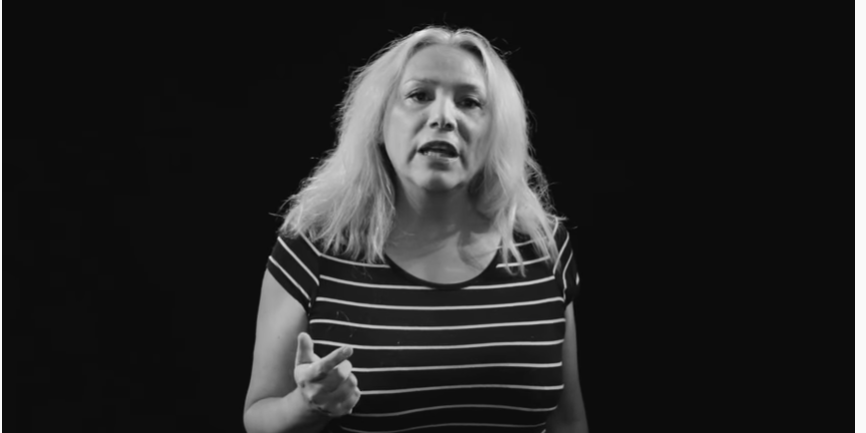
A Chilean trans leader, icon of the transvestite struggle in Latin America, poet and social worker, Claudia Rodríguez has an activist career that began in the '90s. Journalist Franco Torchia interviewed her for his radio program No se puede vivir del amor (You Can't Live on Love ), on the Public Radio of the City of Buenos Aires.
By Franco Torchia
FT : I'm going to share this memory with Claudia. Because a few minutes ago, on my way to the radio station, I was thinking about her, going over information about her, and I remembered a conversation I had 15 years ago with a trans woman—because that's how she identified—at a gas station. Her way of speaking, what she shared with me and others who were there in the early morning hours, while we were having breakfast or a drink, really struck me. Not because I'd never encountered that way of speaking or certain colloquialisms typical of trans women and transvestites, but because she had such a cheerful way of speaking. And I remember myself saying: This should be a kind of poetic language of its own. Of course, I was never able to use it myself, being a cisgender gay man, but the idea stuck with me.
When I was finally able to meet the person who is now in telephone communication with this program, to learn about her work, to read it as I read one of her poems at the beginning of the program, to listen to her, to read her in interviews, I realized that someone who was doing linguistic theory and also literary theory about what I perceived so many years ago had arrived in this part of the world, in this region.
I want to welcome Claudia Rodríguez to "You Can't Live on Love." How are you, Claudia?
CR : Hi, I'm fine, and you? Thank you very much.
FT : No, please, thank you so much. Speaking of everything I feel you're building, there's a concept you often return to that I find particularly interesting: the concept of hygienism, or how sanitized what the world understands as sexual diversity, or what the world chooses to call gender and sexual dissidence, tends to be. Do you still feel that sanitized today, or is there beginning to be some change, at least in Latin America, in your opinion?
CR : I don't think so yet. That's why I keep coming back to writing about it. I think we trans women are still being colonized, we're still being neoliberalized. We don't reflect on how, for example, we position ourselves in the world, how we establish ourselves with our struggle, with our right to health, for example. It seems to me that the guiding principle, or where we should always be, is whiteness, academia, neoliberalism. I feel that the discourse often boils down to ultimately making us good consumers.
FT : Yes, and therefore to consume those very identities. And to turn those identities or orientations into a product.
CR: Yes, as if that were the conquest. And actually, I don't think so. Neoliberalism has this difficulty that affects us all the time. Here in Chile, I'm always asking myself lately what we trans women should be talking about. I've been an activist for a long time, and when some of my comrades feel that we need to transform our bodies to achieve our desired body, we overlook, for example, that there's a much more immediate struggle, I feel, in Chile , which has to do with how we position ourselves within social struggles, how we position ourselves within this situation where there's an Indigenous community in Chile that's being oppressed, criminalized, having their lands taken away, and what neoliberalism wants from those lands is all the minerals, all the water, all the sea. And that's also worrying. So the answer I'm finding is why don't we trans activists also participate in these struggles that have to do with defending the world?
A transvestite philosophy
FT : In that order, Claudia, what happened in Chile in 2019, what did it build up and what did it dismantle in your opinion? In what sense should we be able to interpret those events today, considering the current situation you are outlining?
CR : What did 2019 leave behind, and for me, especially 2020? I think it left a great lesson, a lesson where we are part of everything social, not only in the construction of our bodies, but also in beginning a dialogue that recognizes us as connected to everything, to the land, to the water. For me, this reflection is related to distribution. Here in Chile, the fruits of natural resources are concentrated in the hands of ten families. And that impacts the generation of the people, the multitude of the people, and especially children.
In Chile, there are children deprived of all the wealth generated by the sale of natural resources by just ten families. And that, for example, I, as a 52-year-old trans woman, realize the impact of this deprivation of resources. Where, for instance, I grew up in shantytowns, in land occupations, where there was no distribution of resources for the children of this country. I realize that my lack of reading was related to that unequal distribution of resources, of life itself . This, which continues to happen in Chile, is something I want to address, I want to connect with my reflection, which stems from this desire to be as inclusive as I could have been. I speak of a poor trans poetry, when I could have spoken of a trans philosophy, for example, if I had had the resources at hand, available to me, to grow as a human being.
FT : This reminds me of something Marlene Wayar, whom you know very well, Claudia, often says, and it has to do with the possibility of establishing a transvestite epistemology now, something prior, in a sense, to what could be considered a philosophy. That is, almost like a set of methods, a kind of essential basis for viewing the world with or from the perspective of transvestism.
CR : Of course, we agree on that, and we've had conversations about it with Marlene, Susy [Shock], Camila [Sosa Villada], and all the members of the Lohana Berkins collective, where we've reflected on the right to life, to affection, to childhood, to hugs, and to non-violence. These elements should always be present in every childhood. But in all the countries that had dictatorships, that was a lack, which marked us as adult trans women.
About inclusive language
FT : Reading you, Claudia, and paying very close attention, I also notice that your postulates regarding a transvestite language, or a transvestite poetic speech, and of course, a form of writing as well, transcend certain discussions that are quite common here in Argentina today about so-called inclusive language. And it occurs to me that your idea is far superior, although it's not about establishing hierarchies, to a possible inclusive language. You are, in any case, proposing something much deeper.
CR : Of course, it seems to me that it has to do with defending life. And defending life, since it starts in childhood, isn't about pink or blue. From my perspective, it's a multitude of colors that one refers to when speaking of defending the multitude of life. There can't be just one pink color and one blue color to define us. I even go so far as to say: Diversity is so monstrous that it's frightening. How open-minded we would have to be to accept what we are. We are a diversity. Not all trans women are the same, not all women are the same, not all gay people are the same. Lohana Berkins said it countless times. It's about defending the right to exist.
FT : But I mean, regarding the discourse of poetic language, these reflections of yours on trans language, on transvestite language, they negate for me a discussion that is very frequent here, which is that of inclusive language. That diversity, which is so vast and therefore so monstrous that it frightens, can frighten, in the best sense, even more so if each of the groups that make up that diversity speaks its own language. That's what I was thinking about.
CR : So they're not sets, they're units. They're not sets yet. Of course, being able to talk to each other and understand that the other person's language is different. Now, when I started writing, this reflection on the x or the e in words wasn't there. I started writing more than 15 years ago. This is new for me too. I had my reservations about that, because for me, with the reading I'd had, it was enough to use feminine pronouns.
I read a rather interesting text by Monique Wittig where she says that only man is the center of the world; everything else is otherness. That is to say, woman is otherness, but so is gay man, and trans women are otherness. That's what we have in common with women. For me, it was enough then to define myself in the feminine, to reconcile myself with the fact that we are all otherness, because we are not the center of the world, according to what Monique Wittig said. I found her entire reflection on otherness interesting, and how I, too, reconcile myself with otherness.
Therefore, this inclusion—which I imagine you're referring to as the x or the e in discourses on sexual diversity, which is meant to be more feminist—wasn't present at the time I was reading Monique Wittig. So, for me, it was new. And challenging. I thought: if simply identifying as feminine, not necessarily as a woman, is enough to be part of the feminist struggle?
The limits of the gender identity law
FT : What real impact is Chile's trans law—which we know here as the trans law—having?
CR : I think perhaps the most important thing we could have hoped for from a law was the social decriminalization of trans, transvestite, non-binary, or gender-fluid people. But that didn't happen either. There wasn't a concrete response with the allocation of resources to work on this and reach the entire population of the country. Nor have the media decriminalized the experience of being a trans, transvestite, or non-binary person. So the impact isn't real; there's no real implementation of that potential progress. From my perspective, it was simply a political strategy by the parties to give the impression that they're closer to the people. But even at a social level, there isn't more acceptance, more jobs, or more opportunities for people to study, get an education, or leave sex work or sexual exploitation. Everything remains the same; we have to keep fighting.
FT : Claudia, you mentioned the role of traditional media. What function do they fulfill in this regard? Do they continue to heavily criminalize non-binary, trans, and transvestite identities?
CR: Of course. They trivialize it. In the newspapers, when a crime occurs, they always highlight the male name of the person who was murdered. The criminals aren't found, there are difficulties in conducting investigations, it's covered up. Everything is trivialized. Therefore, we are ultimately not recognized as people, as human beings existing in this territory.
FT : You spoke a lot about sex work. That's also part of your own life, it was part of your life. You know, I imagine, that this is another of the most intense discussions in Argentina for a long time, and in other parts of the region, not to mention the world. Do you have a position on this, perhaps not a binary one, that doesn't end up responding to that abolitionist-regulationist opposition?
CR : What I've come to reflect on is that there are no children who do sex work; that's sexual exploitation. You can't say that there are minors who engage in sex work, because the mere fact that they are minors already means they are being exploited. Now, if there are adults who do sex work and are doing well, they have every right to speak out however they want and defend whatever they want to defend. But I do recognize that there is a lack of opportunities and that many adults, those over 20, haven't had the opportunity to choose, haven't necessarily had the chance to reflect on all the possibilities in their lives, and that they too could be being exploited. There's a bit of everything. And I've also seen academics talking about the topic without having had any practical experience. I believe that the most important voices to listen to are those of the people who have actually been through that situation, who reflect on the violence they've experienced, the lack of opportunities they've faced, the risks to their lives they've faced, the exposure to diseases they've endured. I'm always ready to listen to their reflections.
On cowardice
FT : In your poetry, Claudia, there's something I've noticed that I think you work on intensely. And since you mentioned Camila, I want to say that I learned about your work a few years ago through Camila Sosa Villada, who spoke to me about you almost as much as Fernando Noy spoke to me about Camila. It's also about building these networks. But what is cowardice? In the poem I read at the beginning of this program, I saw the word "cowardice" several times. What does it mean to be a trans woman, or a monster in this sense, or a cowardly transvestite, for you? What is that cowardice?
CR : Sometimes it's about surviving. Sometimes it's about dyeing your hair blonde, like Marilyn Monroe, to survive. I'm a coward. Sometimes it's necessary to look at the word cowardice with tenderness, because if it continues to survive… but cowardice can also be a survival strategy, keeping a low profile, wanting to become invisible in the crowd. Because theoretically, we see ourselves as heroines, heroic, to do justice, to have the hand of justice, the sword of justice. A double discourse arises there. I would like to be heroic, a heroine, and do justice to the client who doesn't pay me. But ultimately, I end up being a coward, because by not confronting the client or the police, I survive until the next day. These are reflections on the poetic. They are also philosophical reflections on what we trans women have to talk about.
The sexual dictatorship did not end
FT : Claudia, what happened in October 2019 in Chile brought us together, I remember, we tried to reach out to those responsible from here in Buenos Aires, with a slogan—I'm going to call it that on purpose—I'm speaking clearly of a rallying cry, a statement I've returned to throughout this program in some conversation, and I'd like to bring it up again now with you. "To return" is a misnomer, and I love that it's a misnomer in this dialogue with Claudia Rodríguez. And it is: The sexual dictatorship hasn't ended. That's what was seen on the streets of Santiago back then, and I want to ask you if, in fact, the sexual dictatorship hasn't ended.
CR : The thing is, we sexual diversity, the sexual diversity organizations, the gay men who created the first LGBTI organizations in Chile, even contributed to maintaining the sexual dictatorship. The practices of the first gay organization in Chile were misogynistic, lesbophobic, and transphobic. And there were transphobic lesbians, and there are trans people who are misogynistic and lesbophobic. So it's not just a slogan against heterosexuality, it's against ourselves because we are all shaped by patriarchy, we can't deny it.
I can't deny that I'm also a misogynist and that I'm working on the misogyny within myself, in my heart, because I have sisters, because I have a mother. And not only that. I've received and grown thanks to women with whom I've connected and formed alliances. How can I not question how misogynistic I am? Also in this accusation about TERF feminism, which hates trans people. How much misogyny, I ask myself, is there. How much lack of solidarity with feminism and with the women who have historically been raped, murdered, trivialized, and dismembered.
I find that the LGBT organizations that emerged in Chile from this, in quotes, “democracy,” did not fully fulfill their function and adhered completely to neoliberalism, defending marriage and other bourgeois comforts, and did not necessarily work on the issue of sexual liberation. Today, young people continue to contract HIV because the only thing they understood, or understand, is that happiness is found solely in the moment of penetration. Feminism, on the other hand, explains or helps the community understand that the entire body is sexual and that anal penetration is not the only real contact. This misconception is dangerous because it has not had a real impact on condom use, and it is the practice that young people still defend and promote.
We are present
We are committed to journalism that delves into the territories and conducts thorough investigations, combined with new technologies and narrative formats. We want the protagonists, their stories, and their struggles to be present.
SUPPORT US

FOLLOW US
Related notes

We are present
This and other stories are not usually on the media agenda. Together we can bring them to light.