

Transphobic discourse, the true Trojan horse of feminism
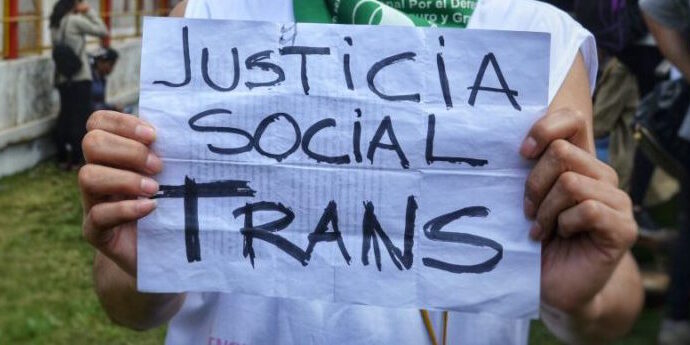
How far have we allowed transphobia to advance in Mexico that now “feminist marches” are being called to prevent trans populations from accessing rights?

Share

This article was published and then censored in the Mexican media outlet Milenio due to transphobic pressure.
By Laurel Miranda
If you're a feminist and you don't stand up to those who, in the name of this political movement, perpetrate violence against trans and non-binary people, I'm afraid to say that's called complicity. Just as we speak of the patriarchal pact to denounce the complicity among men, as well as their silence or passivity in the face of misogynistic acts by their peers, we can and must also speak of those cisgender feminist women who choose to ignore the transphobic acts of their supposed comrades in the struggle.

How far has transphobia advanced in Mexico that now “feminist marches” are being called not to fight for women's rights, but to prevent trans people from accessing them ? This is precisely what is happening in places like Puebla, where a radical feminist group has made it its main objective to prevent the passage of the Agnes Law , an initiative that would allow trans people to have their gender identity recognized through an administrative process. Something similar is happening in the State of Mexico, where another group has called for the March 8th march to be “against the erasure of women.”
Which women?
What does this alleged erasure of women refer to? Which women? White women, women of color, poor women, sex workers, trans women…? How could more than half of the world's population be erased? Well, in the same way that discursive constructions like "gender ideology" or "gay lobby" came forcefully from the most conservative sectors of society to repress sexual and gender diversity, we now face the alleged "erasure of women," an idea that (apparently) is not driven by the church or the far right, but by feminist voices of journalists, writers, and intellectuals, such as the former Spanish Socialist Workers' Party (PSOE) deputy Ángeles Álvarez , the Mexican anthropologist and academic Marcela Lagarde , or the creator of Harry Potter, J.K. Rowling .
The fight against the “erasing of women” has been erected to prevent countries like Spain, the United Kingdom (and now Mexico) from enacting laws that would allow the recognition of the gender identities of trans and non-binary people through administrative procedures and no longer through trials or gender certifications, for which psychological or psychiatric support is needed, as well as hormonal treatments, which have historically contributed to the pathologization of trans people.
In Spain, for example, Ángeles Álvarez and the trans-exclusionary wing of Spanish feminism believe that if the Trans Law is passed, it would jeopardize the representation of women—again: which women?—in various spheres of public life, such as politics, sports, entertainment, and so on. Álvarez's argument falls apart when we see in the statistics that trans people are a minority worldwide, yet they suffer a high rate of hate crimes, a high suicide rate, and a reduced life expectancy. In contrast, there are few trans people in the spheres described above, and yet they are sensationally exploited, particularly in the world of sports, to claim that their presence threatens the chances of victory for "biological women" (sic).
I find it incredible that in 2021, after decades and decades of feminism and gender studies, phrases like "biological women" and "biological men" (sic) are still being used as arguments to dismiss the legitimacy of trans identities and to openly wage a fight against our most basic rights: identity, free development of personality, non-discrimination, access to education and decent work.

Rather than opposing the "erasure of women," trans-exclusionary voices are against the category of gender itself and in favor of asserting the material reality of sex as the sole and decisive factor in determining who is and is not a woman. This is, therefore, an essentialist stance against which feminism has been fighting for years. Furthermore, they believe that a "primary oppression" stems from their sexed reality, thus universalizing the experiences of all women and disregarding aspects of identity such as race, class, or sexual orientation, which, in the case of some women, constitute the primary factor in the oppression they experience.
“There are women who are Black, women who are lesbians, women who are trans, and poor women. They suffer discrimination not only for being women, but also for their race, their gender, or their socioeconomic status (…) Feminism is against gender oppression and exploitation. If there are women affected by racism, homophobia, or transphobia, fighting against that is part of liberation,” says Reni Eddo-Lodge, a British feminist and journalist.
It is because of the particularity of our realities and the different forms of violence we experience that I feel it necessary to be honest and point out that on this occasion I am speaking about how dangerous trans-exclusionary discourse is for trans women; however, I would like to emphasize that this discourse also attacks other possibilities for life: trans men, for example, who are called “sisters” if they decide to detransition, or traitors and “lesbophobic” if they decide to remain steadfast in their gender transition. One only needs to look at the violence with which trans men, who also have the capacity to gestate, have participated in marches in favor of the decriminalization of abortion.
As Gracia Trujillo and Moira Pérez point out , “TERF feminism is often highlighted for its opposition to incorporating trans women into the women's movement (or the collective itself). However, it is actually an exclusionary feminism in broad terms, which, from a position of privilege, opposes various forms of decisional autonomy, bodily autonomy, the right to identity, the right to a life free from violence… The exclusionary feminist movement is against many forms of existence: not only the entire spectrum of trans and non-binary people, but also sex workers and anyone who uses surrogacy, among others. In the case of the latter two, sex work and surrogacy are understood in all cases as violence against women. This analysis does not reflect reality, obstructs the advancement of rights for the people directly involved in these practices, and places them in positions of passive victims without, moreover, listening to them.”
The danger of this discourse lies not only in its struggle to restrict rights, but also in its role as a breeding ground for reinforcing stigmas and prejudices against our community . We have, for example, the recent case of the graffiti painted by transphobic protesters to oppose the Gender Identity Law, which, nevertheless, was attributed by local media to trans people. Ultimately, the discursive and media construction of our identities, which associates us with the abnormal, the out of place, the angry, also fuels hate crimes against us, particularly transfemicides.
In the current context, not subscribing to transphobic discourse or distancing oneself from it is not enough: one must also take a stand against it. For this reason, I applaud the Dignas Hijas collective, who, since August of last year, after observing how feminism is being instrumentalized for transphobic purposes, launched the #NotInOurName initiative to emphasize that “trans people’s rights are human rights, not a threat.”

Dear allies, dear cisgender feminists, if you wish to identify the Trojan horse within your movement, I invite you to analyze which discourse most closely resembles that of the far right. Is it the one that fights for the rights and dignified existence of trans people, or that of their abolitionist “sisters,” who see a threat in otherness? Let's not be mistaken: halting laws that allow the recognition of gender identities will not result in fewer trans people; it will only make our lives more difficult and limit our access to our rights.
Right now, the offensive is targeting trans people and sex workers, but if this inaction continues, you will also suffer the consequences. No to the (cis)patriarchal pact.
We are present
We are committed to journalism that delves into the territories and conducts thorough investigations, combined with new technologies and narrative formats. We want the protagonists, their stories, and their struggles to be present.
SUPPORT US

FOLLOW US
Related notes
We are present
This and other stories are not usually on the media agenda. Together we can bring them to light.