

Historic: A trans woman and a gay man aspire to become members of parliament in El Salvador
Alejandra Menjívar and Erick Iván Ortiz will compete on February 28 in the national elections.

Share

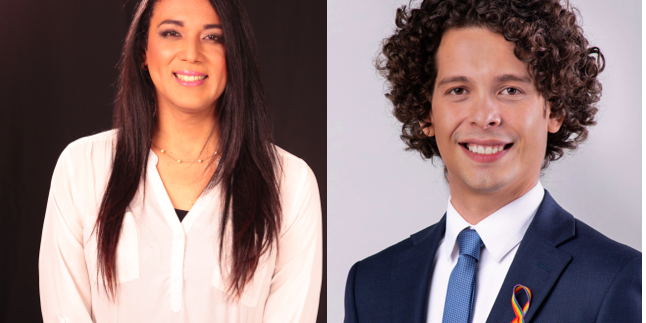
Alejandra Menjívar and Erick Iván Ortiz will compete in the national elections on February 28. She is seeking a seat in the Central American Parliament (Parlacen), and he is running for a seat in the Legislative Assembly. Their candidacy comes at a crucial moment for Salvadoran democracy.
By Stanley Luna
The mayoral and legislative elections in El Salvador on February 28 will, for the first time, include a transgender woman and an openly gay man on the ballot. Alejandra Menjívar is running for a seat in the Central American Parliament (Parlacen), and Erick Iván Ortiz is running for a seat in the Legislative Assembly.
If elected officials, both have on their agenda issues that are a debt owed to the LGBTI population in the country: bringing the Gender Identity Law to discussion – for which there has been a draft bill in Congress since 2018 – generating protection mechanisms for sexual dissidences and ensuring that the country complies with international resolutions, which it is legally obligated to fulfill.

Menjívar is 34 years old and is a candidate for Parlacen for the Farabundo Martí National Liberation Front (FMLN), the left-wing party she has been a member of since 2008 and of which she is the National Secretary of Sexual and Gender Diversity.
He worked on the construction of the government plan of Mauricio Funes, the first Salvadoran left-wing ex-president, who governed between 2009 and 2011, and is now in exile in Nicaragua after accusations of corruption.
In 2009, the current candidate began as a volunteer in a project with the Solidarity Association to Promote Human Development (Aspidh Arcoíris Trans) and became involved in the fight for the human rights of the LGBTI population, which marked the beginning of her activism.
With 60% of his party's votes
She made the decision to run for Parlacen deputy and not for the Legislative Assembly as a test for the FMLN base, to see how open they were regarding the participation of sexual dissidents in public office, she explains in an interview with Agencia Presentes.
“Parlacen is not only an entity for Central American integration, but it also has to do with recommending to the States of the region where public policies should be directed,” says Menjívar.
In the FMLN's internal elections, Menjívar finished fifth out of 20 pre-candidates. He obtained more than 60 percent of the votes from party members nationwide. In the primaries, an openly gay man was also chosen as the mayoral candidate, while other members of the LGBTI community will participate in the February elections for council members, aldermen, and alternate representatives.
The members of the Central American Parliament (Parlacen) are elected in democratic elections. There are 20 members representing Guatemala, El Salvador, Honduras, Nicaragua, the Dominican Republic, and Panama. Former presidents and vice presidents of these countries also become members of parliament immediately upon completion of their terms.
Roberto Zapata, secretary of the organization Amate El Salvador, acknowledges that not only in El Salvador, but in any country, LGBT candidates or officials face “barriers” before and during their term of office.
Listen to civil society
The candidacies of Menjívar and Ortiz for Congress, he says, are generating excitement among organized civil society and the LGBTI community in general. If they become representatives, they will have to legislate in favor of this population across the board. And, at the same time, legislate on other social issues, incorporating the component of inclusion.
“If they are elected to their positions, I hope they will be open to carrying out the initiatives called for by organized civil society. That if we approach them, they will be receptive,” the activist stated.
Zapata points out that, in the case of Menjívar, she has been responsible for informing, since her candidacy, about the functions of Parlacen, an entity little known to Salvadoran society.
Menjívar asserts that she sees the opportunity within the Central American Parliament (Parlacen) to influence member states to pass laws supporting sexual minorities and women's sexual and reproductive rights. She also emphasizes the importance of adhering to binding resolutions, such as the 2018 Inter-American Court of Human Rights ruling, issued through an advisory opinion in Costa Rica, which mandated the guarantee of marriage equality and legal gender recognition for transgender individuals. This ruling applies to El Salvador and 19 other countries in the Americas.
Although voting in El Salvador for mayors and representatives is based on appearance, without a Gender Identity Law, she believes it's impossible for the Supreme Electoral Tribunal to allow her to run in the elections using her chosen name, as it did in her party's internal elections. If they require her to use the name on her identity document, she will opt for her surnames. In fact, her campaign has focused on positioning herself as "Menjívar Guadrón" and "Aleja Menjívar."
“It’s complicated, it’s complex, it’s a completely adverse situation, because, obviously, I’m going to be up against several people who are already part of the system, but that’s what motivates us,” Menjívar says.
“Everything from now on is new”
Erick Iván Ortiz, candidate for Nuestro Tiempo, a party founded by former deputies of the conservative Nationalist Republican Alliance (ARENA) party and which will debut in this year's elections, seeks to be a deputy for the department of San Salvador, within which is located the capital of the Central American country.

Ortiz is 29 years old and has been involved in human rights advocacy for almost a decade. She is part of the Salvadoran LGBTI Federation, which brings together several organizations that fight for the rights of sexual minorities in El Salvador.
In 2017, he was part of the group of six young people who resigned from ARENA's youth wing after publicly showing their support for progressive issues, such as same-sex marriage and abortion.
“It must be said that mine is the first openly LGBTI candidacy for a seat in the Legislative Assembly, so everything from now on is new, it has not been explored, but what I would hope is that, from the LGBTI population, we can also become aware of the importance of representation,” she says.
If he becomes a congressman, Ortiz says he will promote the Gender Identity Law and present a draft National Law against Discrimination in the Legislative Assembly, to create an institution that protects the rights of the population and is independent of the Executive branch.
Current government debts and outlook
On February 28, the party founded by President Nayib Bukele, Nuevas Ideas, will also participate for the first time in the elections for deputies and mayors.
In his year and a half in office, Bukele has shown no interest in creating public policies to benefit the LGBTI population . Moreover, on the second day of his administration, he transferred the functions of the Directorate of Sexual Diversity, created during the first FMLN government under pressure from civil society, to the Ministry of Culture. This ministry has one of the lowest budgets.
The office was attached to the now-defunct Secretariat of Social Inclusion and was budgetarily under the Presidency. Its functions included training staff from various ministries, organizing job fairs for LGBTQ+ individuals, and establishing a call center to handle complaints of discrimination against LGBTQ+ people working in government institutions. To date, civil society organizations are asking whether the government will follow up on these actions.
With the seats won by Nuevas Ideas, plus the bloc of other right-wing parties that do not have public policies in favor of the LGBTI population on their agenda, Zapata warns that they are preparing for more setbacks in human rights.
“It is most likely that the majority of the legislatures will end up being quite conservative, which could result in setbacks rather than progress on human rights. We have already seen this within the Executive Branch. Now, it is likely, and we are preparing for it, that it will also happen in the Legislative Branch,” he warns.
Share
We are present
We are committed to journalism that delves into the territories and conducts thorough investigations, combined with new technologies and narrative formats. We want the protagonists, their stories, and their struggles to be present.
SUPPORT US

FOLLOW US
Related notes
We are present
This and other stories are not usually on the media agenda. Together we can bring them to light.