

He is indigenous and LGBT, and he is at the helm of the first indigenous radio station in El Salvador.
Marcelo Galicia, 29 years old and Nahua-Pipil, is the youngest director of the Association of Participatory Radios and Programs of El Salvador.

Share

By Stanley Luna, from San Salvador
Photos: Courtesy of ARPAS
Ten years ago, Marcelo Galicia made history by becoming the director of the first radio station for indigenous peoples in El Salvador, a country that rejects its ancestral roots and reports alarming cases of intolerance towards the LGBTI population.
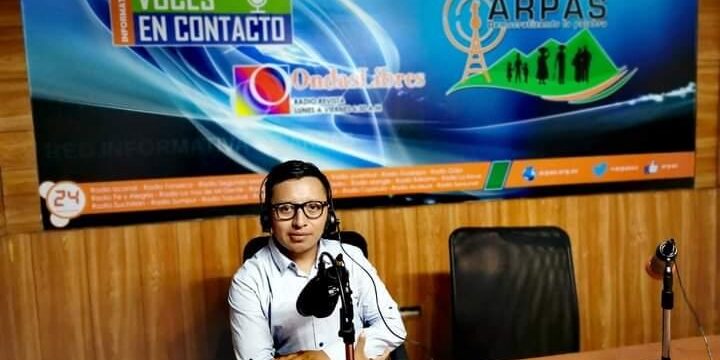
Galicia is 29 years old and has dedicated half his life to community communication. He is the youngest director of the radio network of the Association of Participatory Radios and Programs of El Salvador (ARPAS).
In Tacuba, a municipality located 118 kilometers from the Salvadoran capital and declared a territory of indigenous communities by the Legislative Assembly, he directs the radio station La voz de mi gente and is also a correspondent for ARPAS.
The radio station began broadcasting locally in 2005. “It’s programming that we want people to identify with. That’s why the station is called The Voice of My People, so that people feel engaged and involved. So they feel that there’s a media outlet that listens to them, that gives visibility to their problems, that accompanies them and also supports them,” she says.
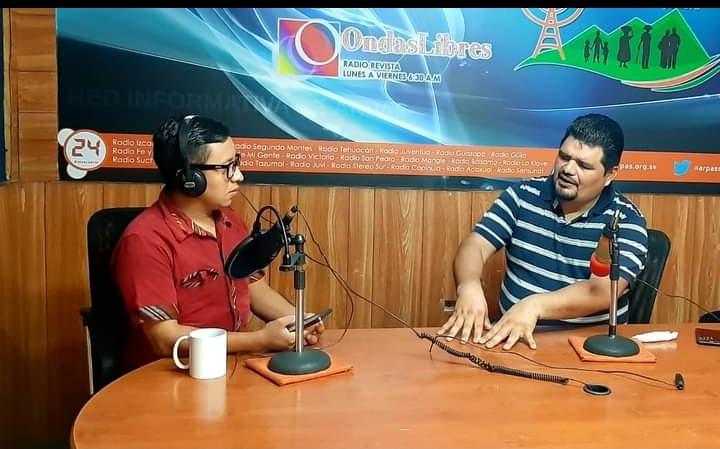
Corazón Ancestral is the name of the participatory program of the indigenous communities, where they address topics such as natural medicine, community organization, history and cultural expressions.
The building that houses the radio station, in the center of Tacuba, is also known in the municipality as the Youth Center. In this space, young people meet to receive training workshops due to the lack of a Municipal Youth Policy.
Galicia leads a team of 14 young journalists. Their work focuses on raising awareness among young people about social issues and sexual diversity. The topic has historically been taboo in El Salvador, and also within certain communities.
He is from the Nahua-Pipil people, one of the three indigenous peoples of El Salvador—Nahua or Nahua-Pipil, Lenca, and Kakawira. He defines himself as a culturally and sexually diverse man.
Speaking about the discrimination he has suffered for openly accepting himself as a gay man within an indigenous community, he says: "There are people who, in a Christian way, almost stone me, like Mary Magdalene."
He grew up in a Catholic home, where he never spoke to his family about his sexual orientation. He says that religion has a “radical” stance toward sexual diversity.
Machismo and indigenous communities
As a child, he dreamed of becoming a priest. But in his teens, his social and political education led him to work in communications and community activism.
He believes it hasn't been easy. Because of his sexual orientation, he has suffered homophobic attacks. Although over time, people have begun to recognize him as a leader, even in decision-making spaces dominated by heterosexual men. "Machismo patterns are quite prevalent in indigenous communities," acknowledges Amadeo Martínez, Senior Advisor of the Indigenous Council of Central America.
Martínez is a 59-year-old Salvadoran Indigenous leader of Lenca origin. Within the communities, he has met LGBTQ+ people who also identify as Indigenous. But some, he says, decide to migrate to urban areas because they are victims of discrimination based on their sexual orientation, gender identity, and gender expression.
In indigenous communities, there are no laws or statutes prohibiting sexual minorities or same-sex relationships. The prohibition, he clarifies, stems from "morality."
Much of the indigenous worldview in various territories is rooted in the traditional concept of family imposed by the Spanish who invaded the Americas. “They couldn’t conceive of the idea that ‘family’ could also refer to a pair of sisters or brothers living together; that wasn’t seen in that context,” Martínez adds.
A classist and racist country
In 1931, General Maximiliano Hernández Martínez came to power in El Salvador through a coup d'état, marking the beginning of five decades of military dictatorships.
He ruled until 1945, but in January 1932 he murdered thousands of Nahua-Pipil indigenous people and peasants in the west of the country, who rose up against the expropriation of their lands and the labor exploitation to which the landowners subjected them.
The repression against the indigenous people became systematic, and they were forced to hide their identity. Galicia is learning Nahuatl, the language forgotten by her ancestors, also victims of land dispossession.
The Salvadoran Constitution recognized the existence of indigenous peoples until June 2014. The Salvadoran National Indigenous Coordinating Council (CCNIS) estimates that 11% of the total population of the Central American country is indigenous.
Two stigmatized identities
In Galicia there are two stigmatized identities: being indigenous and being gay, says Amaral Arévalo, a researcher at the Latin American Center for Sexuality and Human Rights at the State University of Rio de Janeiro.
To these stigmas, Arévalo adds the discrimination that exists in El Salvador due to economic conditions, because, he assures, it is a country where racism and classism are mixed.
During the colonial period, according to the researcher, there was a convergence between Western patriarchy and indigenous patriarchy, where discrimination against women continued.
“From my perspective, in the case of discrimination processes within indigenous communities, there can be this type of patriarchal link to discrimination processes against people of sexual and gender dissidence,” he explains.
In Tacuba, Galicia has witnessed how discrimination against Indigenous and LGBTI people has become more visible during the COVID-19 pandemic. Currently, at La voz de mi gente (The Voice of My People), she and her team are working on an informational campaign in Nahuatl about biosecurity measures to prevent infections.
“I also plan to focus on becoming an international spokesperson for the rights of cultural and sexual diversity,” he concludes. Furthermore, he aspires to specialize in digital journalism, either within or outside of El Salvador, and to bring these topics to an online radio station.
We are present
We are committed to journalism that delves into the territories and conducts thorough investigations, combined with new technologies and narrative formats. We want the protagonists, their stories, and their struggles to be present.
SUPPORT US

FOLLOW US
Related notes



We are present
This and other stories are not usually on the media agenda. Together we can bring them to light.