

This is how 300 LGBT+ people live in the first Honduran migrant caravan of 2021
Presentes accompanied more than 300 Honduran LGBT+ people who joined the first migrant caravan heading to the US.

Share

By Dunia Orellana, from El Florido, Honduras-Guatemala border
One hundred trans women are among the more than 300 Honduran LGBT+ people who have decided to flee their country in the migrant caravan that departed from San Pedro Sula in the early hours of Friday, January 15, 2021. They are all stranded in Chiquimula, Guatemala, waiting for the authorities of that country to approve their passage to reach Mexico and then their destination in the United States.
Like the other 8,000 members of this first migrant caravan of 2021, the 300 members of the Honduran LGBTI+ collectives have suffered from long walks in the rain and cold, uncomfortable journeys in the back of cars and trucks, as well as beatings and blows from the Honduran and Guatemalan military forces.
Military and police repression
In Aguascalientes, where they were allegedly taken under false pretenses by infiltrators, some 1,000 Honduran migrants were met by hundreds of Honduran soldiers and police officers armed with armored vehicles, rifles, and pistols. The soldiers had orders to shoot the migrants if they resisted returning to Honduras, according to an observer from an international cooperation agency.
Meanwhile, in El Florido, the caravan's true meeting point on the border between Honduras and Guatemala, Guatemalan military forces responded with sticks and blows to the caravan's intention to pass through that Central American country to reach Mexico.
Trans women and men, lesbians and gay men are fleeing inequality, discrimination, and poverty caused by the profound disparities faced by diverse populations . The LGBTI migrants in this caravan are also fleeing the COVID-19 pandemic, as well as the effects of Hurricanes Eta and Iota, which struck the country in November 2020.
Much of the LGBTI population in northern Honduras lost their homes and belongings when the passage of two hurricanes destroyed entire neighborhoods and buried them under tons of mud.
The government of Juan Orlando Hernández has not done all the work expected in the areas affected by the natural disasters that devastated the country last year. Entire neighborhoods remain hidden under mud, where medical brigades and government food aid have not reached.
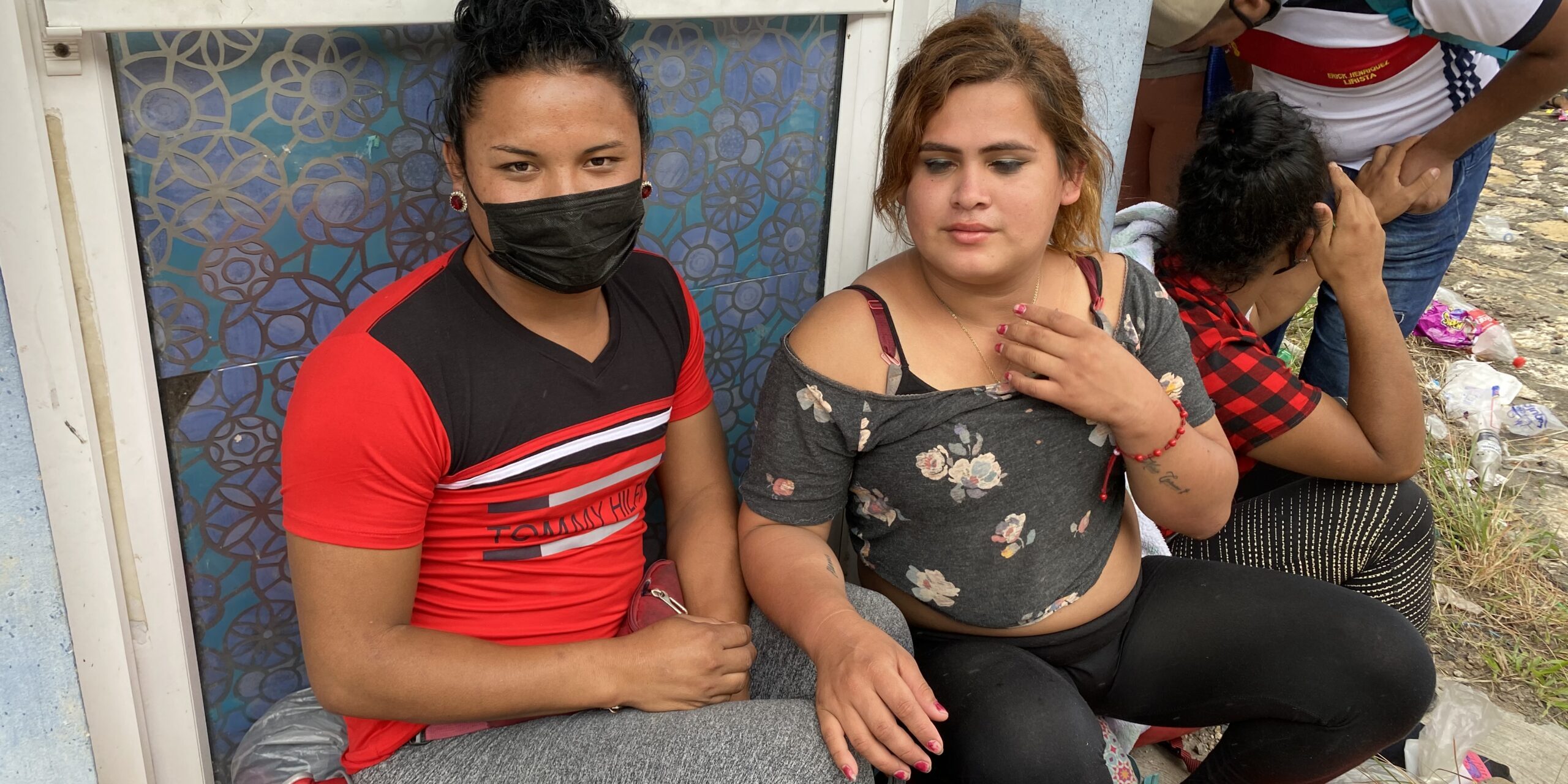
Agencia Presentes accompanied many of the Honduran trans girls who embarked on the journey with the first migrant caravan of the year.
Transphobia in the caravan
LGBTI+ groups, especially trans women and gay men with feminine gender expression, are verbally and physically harassed during the caravan's journey, as evidenced by Agencia Presentes, which accompanied the 8,000 migrants to the border of Honduras and Guatemala.
An example of mistreatment and discrimination against LGBTI+ groups in the migrant caravan is the case of Fabiola, 20, who traveled from Tegucigalpa to escape discrimination and transphobia.
During their journey, a man abused his power by hitting Fabiola "to get her out of the line of men." Bystanders witnessed a series of verbal insults and harassment directed at the trans women, with people using words like "faggots," "faggots," and "assholes," among others.

Although this is her second time traveling, Fabiola is hopeful this time that she will be able to cross the border, go through Mexico, and arrive safely in the United States.
The trans women walked hundreds of kilometers to reach the border. They were exhausted and their feet were blistered. They preferred to walk rather than hitch rides on the back of cars or trailers because riding on vehicles exposes them to more danger and harassment. If they do hitch a ride on a trailer, they never do it alone. They travel in groups to minimize discrimination and ridicule.
Many of the trans women didn't have money for the trip, so some fell behind. They were hoping to get some money to continue their journey.
“We have suffered discrimination. We live in the department of Colón and they don’t accept us as we are, they look at us as a phenomenon,” Salomé, a trans girl from the Honduran Atlantic coast, tells Presentes.

“When we go to ask for support, they discriminate against us. After the pandemic, sex work collapsed, and we have fewer and fewer resources for daily survival,” said a trans woman from the municipality of Villanueva who did not want to be identified.
Gissele fled with a group of young people from the department of Nacaome, Valle. It's not the first time she's done this, but she's hopeful that this time she'll make it to the United States. She hopes to obtain the papers that will legally certify her as a woman. "We face discrimination, ridicule, and no work," she lamented.

Nineteen-year-old Danny ran away from home because he couldn't be himself. His mother doesn't yet know he's on his way to the United States and that he's facing a series of challenges in Guatemala to reach Mexico. That doesn't matter to Danny, who lives in Santa Bárbara, one of the departments with the highest rates of sexual abuse and discrimination against teenagers and young adults.
Honduras is one of the worst countries in the world to be an LGBTQ+ person. The government, led for the past eight years by Juan Orlando Hernández, has stalled a gender identity law in the National Congress. Furthermore, the Supreme Court has not ruled that same-sex couples can enter into civil unions, despite the efforts of organizations such as Cattrachas, Somos CDC, Kukulkán, and Oprouce, among others.
We are present
We are committed to journalism that delves into the territories and conducts thorough investigations, combined with new technologies and narrative formats. We want the protagonists, their stories, and their struggles to be present.
SUPPORT US

FOLLOW US
Related notes
We are present
This and other stories are not usually on the media agenda. Together we can bring them to light.