

Non-binary youth in Paraguay are resisting a conservative country through art
For some, it's physical violence; for others, it's the erasure of their existence. This is how non-binary people resist in Paraguay.

Share

By Juliana Quintana
Photos: Jessie Insfrán
In the final weeks of 2020, the newspaper HOY published an article about Giovana Soria, whose video had gone viral a few days earlier. In it, the well-known TikToker came out as non-binary to her family and friends. “ How is it that something that doesn't hurt anyone makes you feel so bad?” she wondered. “It affects me so much when someone offends me and doesn't understand that I've already been through this in other contexts. It's not right to be asked if I want to be trans, a man, or a woman. I have to deal with society, and I also have to deal with you all.”
But hours later, the website—part of one of the country's largest multimedia conglomerates, owned by former president and anti-rights activist Horacio Cartes—took down the article by award-winning journalist Aizar Arar, and Paraguay was left without the opportunity to learn Gio's story.
For some, there is physical violence; for others, an erasure of their existence. Both appear in the daily lives of non-binary people, who have been suppressed from books, history, and language. There is a conscious effort on the part of the mechanisms of social control.

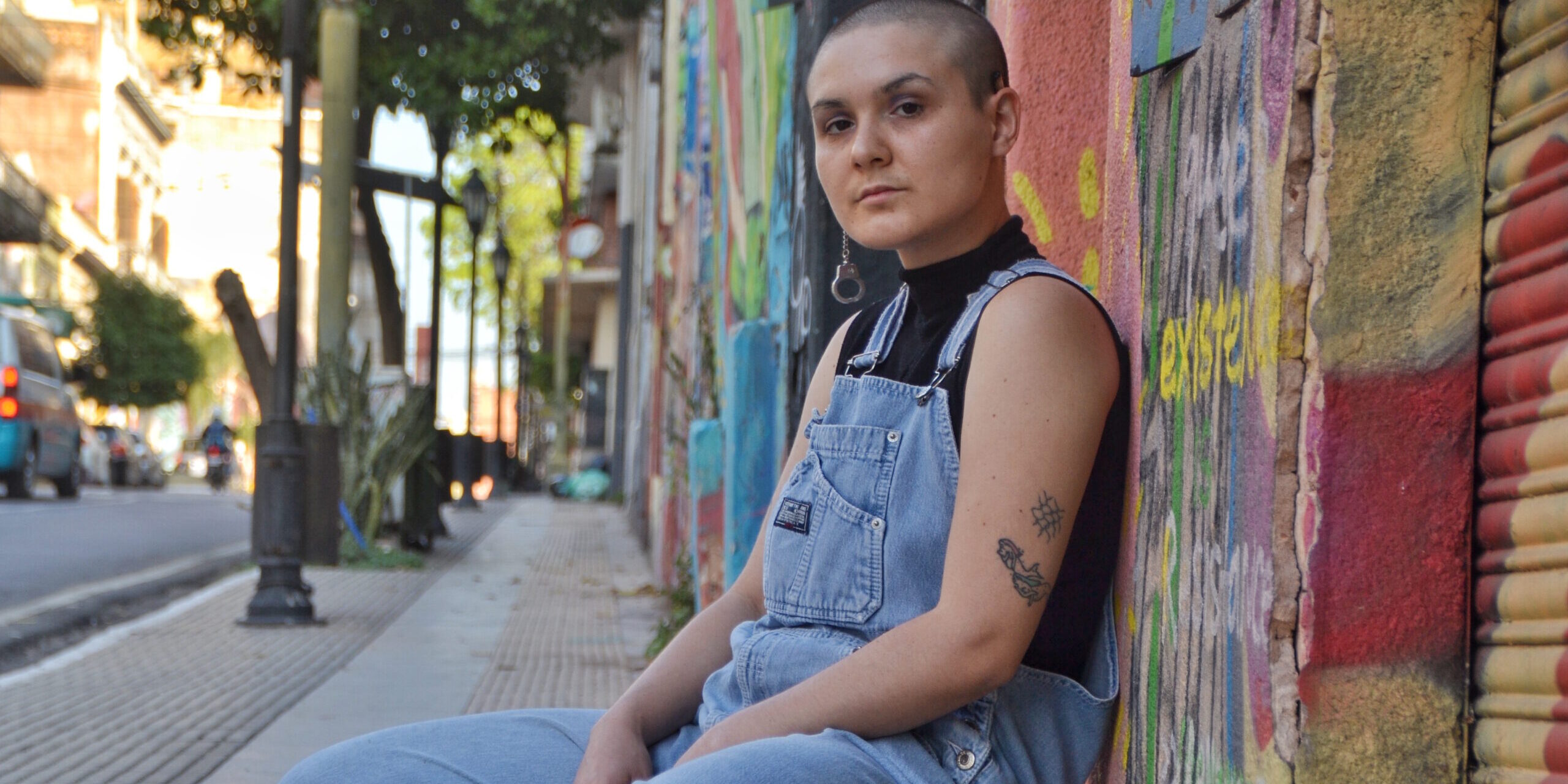
The opposite of nature is not culture, the opposite of the individual is not the collective, the opposite of man is not woman. This is how Chancleta Tatá, a non-binary Paraguayan visual artist based in Buenos Aires, expressed it.
“Binary thinking leads us to stagnate spaces for collective construction; it constantly sabotages our ability to find common interests that unite us and facilitate the coordination of actions. For me, being non-binary also means being a bridge between things; we need to unite. It also means taking a political stance of no longer wanting to contribute to the hetero-cis-patriarchal-speciesist regime, of renouncing the privileges I had as a cis girl, because I think they are based on the oppression of other beings, and I refuse to continue being part of that,” she says.
First the sound, then the meaning.
In Élian's words, coming to terms with her identity was "a long labor." When she was 20, she became interested in the debate surrounding inclusive language. The internet had always been an escape, and that's how she discovered that there were other people who used different names. She already felt non-binary before even knowing there was a term to define it. "I use any pronoun. Although for others I understand that it's an urgent right to use the one that corresponds to them, for me, it's still a kind of game," she reflects.

After a year and a half of searching, she read about the experiences of other trans people looking for a name and discovered it's quite a ritual. Some wander among the graves in cemeteries, others look in the dictionary and choose at random. The first name she chose was Orlando, after the Virginia Woolf novel. But she felt it didn't fit. “I started to despair, until one day I stumbled upon this one and it was just too perfect. It was exciting, I felt so euphoric. Choosing your name is like being baptized,” she says.
“The name is for others,” she wrote in her poetry collection Tajo/Refugio, published by Aike Biene , before adopting the name Élian. “That book was written by someone searching for their identity. It speaks a lot about time. It’s as if it were stuck in a permanent state of flux. As if something transcendental had been hidden from you. The cut is a wound that doesn’t heal, a wound that takes a long time to darken. A deep wound, one you curl up in, take shelter in like a refuge. A wound that, once healed, becomes a home. I think there’s a reconciliation with my body and with myself,” she says.

Non-binary tenderness
James is 26 years old and clearly remembers how he felt watching an episode of Sailor Moon in which the characters Haruko and Michiru gazed into each other's eyes while sitting by the window. In the dub of the series, they were portrayed as cousins, but during the episode, they acted as a couple. “It's clear that, through the clothing, the idea was ingrained in me that there were different kinds of women and that everyone referred to Haruko as male. So, I thought I might be more like my mom's friends who had short hair and were more masculine.”

Since November, she has been working on her project, Non-Binary Tenderness, a photo-diary in which she explores her own identity. “Non-binary is an umbrella term. I feel like I'm gravitating towards genderqueer , something that wants to be agender . But proposing that in a binary society is impossible . I try to educate people within my social micro-ecosystems, with the people I'm interested in connecting with,” she explains.
Elle believes people are conditioned not to feel tenderness. James would like it if, when someone mentions their name, they think of tender moments in their life. They often wonder: can I establish that in my daily life, or is it too difficult? What does tenderness look like in a time when touching each other isn't an option? “The sweetest people I know are non-binary and trans; they've been through the most intense things you can imagine. From all that rottenness that exists in this real world emerge these identities that are full of something bright and beautiful,” they say.
“Heterosexual culture is vigilant and punishing.”
The burden of social, employment, healthcare, and legal discrimination faced by non-binary people falls repeatedly on the disciplinary mechanisms of institutions. This ranges from street harassment to the need to constantly conceal one's identity to access employment or medical care.

“For the system, we simply don’t exist. You’re either a man or a woman, or they don’t pay attention to you, they don’t hire you. And that’s even though I know I have ‘passability,’ meaning I understand that it’s a privilege to dress as a woman and be believed. I know my body is hegemonic enough to play the game, to generate desire if I need to. Because a large part of my value to society as a woman is how much desire I generate. How much. How much I excite. How much they want to sleep with me,” says Chancleta.
When looking for work, she often sees classified ads from private companies seeking secretaries. Requirement: female. Dye your hair, change your resume photo, write an F. Something similar happens to Élian, who feels she has to survive in the closet to keep working.

The importance of inclusive language
Geo S. believes there will always be issues regarding how others perceive us. But that shouldn't stop us from striving to correct our language in our interactions. “Some people seem ashamed to use inclusive language. I think that discomfort isn't theirs to bear. It's a constructive process, even with friends, to talk about it, to interrupt, to correct. We have to stop ignoring it because this is what prevents us from simply being ourselves in our daily lives.”
The reconfiguration of language is an aspect on which everyone agrees. James explains that it's not a privileged, white, Anglo-Saxon perspective. “What I propose is coexisting with cis people who consent to alienation. I'm not here to bother anyone, but if I have to bear the weight of existence, let it be as I want it; at least that much. In this 5'4" that I am, I have to be in charge, at least in that respect,” he emphasizes.
We are present
We are committed to journalism that delves into the territories and conducts thorough investigations, combined with new technologies and narrative formats. We want the protagonists, their stories, and their struggles to be present.
SUPPORT US

FOLLOW US
Related notes


We are present
This and other stories are not usually on the media agenda. Together we can bring them to light.