

Legal abortion in Argentina: The LGBTIQ+ communities have been there, contesting the meaning
Decades of encounters and disagreements between feminist and LGBTIQ+ movements show dialogues that were not always comfortable, not always fair, not always in agreement, but there was an implicit pact.

Share

That Montenegro*
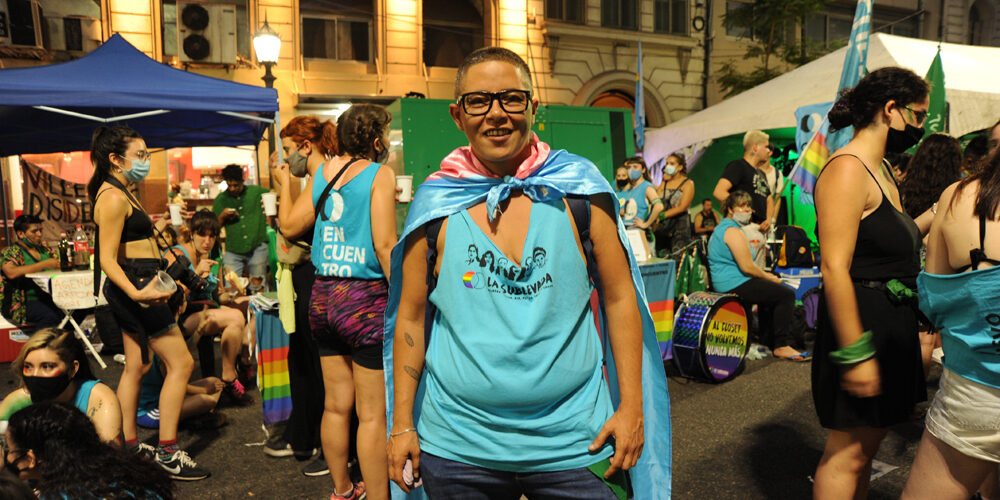
Photos: Constanza Lupi and Ariel Gutraich
And one day, after going to the plaza so often—I take that back, to the plazas, all of them—with our green scarves tying injustices to our bodies; with our flags bearing the faces and names of those who fought before us, and paraphrasing the trans poet: “To give light, they set themselves on fire…”; with our slogans always reformulated so that we can all be included:
We made it into law.
Decades of struggle seep into our tongues, into our words, and also into these feelings of exhausted bodies, which we celebrated yesterday knowing we will fight again tomorrow. A past of revolts writes our pages, the happy ones and the others, those that still hurt, for the lives lost in struggle, lives that no victory can bring back.
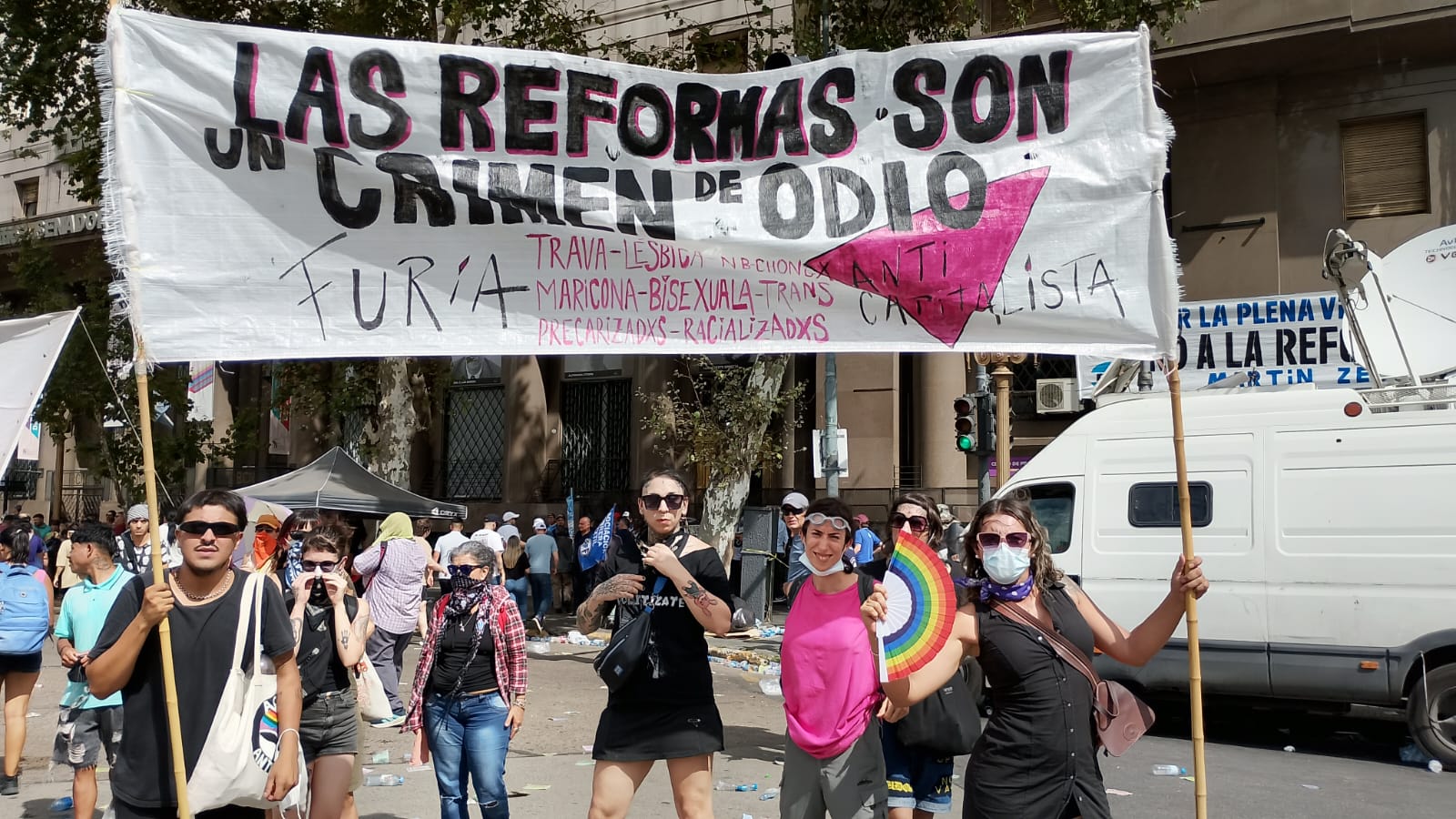
A story that neither begins nor ends with the recognition of a right enshrined in law. A law that, if we examine that history, has its recent antecedents and is inscribed within a whole genealogy of struggles for our sexual, reproductive, non-reproductive, relational, and identity rights, which far exceeds the right to legal, safe, and free abortion. Decades of encounters and disagreements between feminist and LGBTIQ+ movements bear witness to dialogues that were not always comfortable, not always fair, not always fruitful, but there, in the streets, in that collective confrontation, there was an implicit pact: Sexual rights are human rights, and as such, they are fought for and defended against all odds.

Many struggles behind legal abortion
Argentina undeniably has a history of these struggles, which didn't begin today with legal abortion, and we know they won't end there either. Since the return of democracy (December 1983), we can trace these interconnected events: divorce, the repeal of police edicts, the Comprehensive Sex Education Law, the Equal Marriage Law, the Mental Health Law (the first in the world to prohibit pathologizing people based on their sexual orientation or gender identity), the Gender Identity Law, the Medically Assisted Reproduction Law, and now, legal abortion. Nearly four decades of struggle demonstrate that, among many other issues, the LGBTIQ+ communities have been there, challenging the heteronormative meaning and norms against both our own people and outsiders, sometimes with greater or lesser success, but always there, building a collective body.

One of these great battles, which remains ongoing, specifically concerns dismantling heterosexuality as the norm and cisgender identity as a predetermined destiny, even after the aforementioned laws have been enacted. This is a battle we wage not only against the most reactionary and conservative sectors of churches and states, both here and around the world, but also against those feminist movements that often fail to question their own (im)proper privileges.
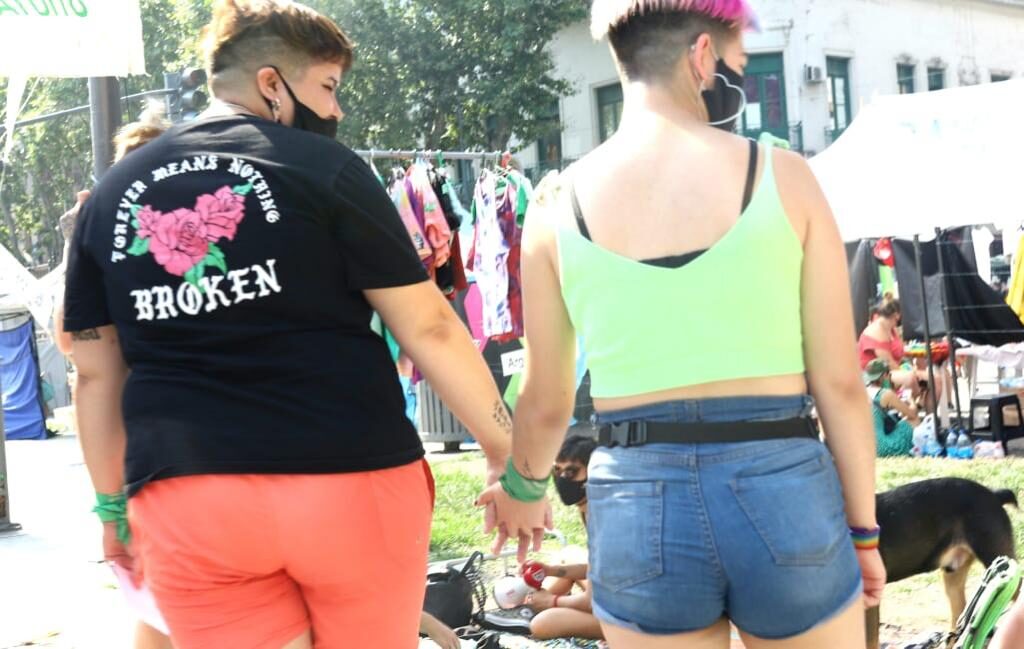
These sectors still struggle to imagine—let alone support—a life in which a trans man—like myself—can have sexual and emotional relationships with cis men or trans women, a decade after the recognition of our sexual and emotional practices—enshrined in marriage equality—and almost a decade after the right to our identity was established in the Gender Identity Law. Something, even within our own circles, seems to still want to impose cisheterosexuality on us as the only way to (sur)vive. And I say “sur)vive” not randomly, because the cost of our disobedience remains tragically palpable.

The debts of the health system
Examples abound, even here: Almost no trans man in Argentina is offered, for instance, the option to freeze his eggs when starting testosterone treatment, allowing him to make future reproductive decisions. This right is guaranteed by the Medically Assisted Fertilization Law and the Gender Identity Law, which refer to the right to comprehensive healthcare. Generally, the healthcare providers through which we access hormone reversal treatments do not explicitly inform us that the use of synthetic testosterone is not directly related to contraception and that our reproductive and non-reproductive health requires a comprehensive approach. Not to mention the scant investment and research on the intersectionality between hormone treatments and sexual and (non-)reproductive health. Or the still limited availability of surgeries and/or hormone treatments in the public and private healthcare systems. Or the persistent non-compliance of social security organizations and private health insurance companies with the Gender Identity Law. And I could go on… Access to formal employment, education, housing. Of course, democracy still owes us everything, and not only democracy, but also many activist groups that continue to forget/erase our contributions to this history.

Nothing we did, we did alone.
A rallying cry that has accompanied us in the streets for years proclaims: “And now that we are together. And now that they see us…” I close my eyes for a while, in this early morning that tastes of victory, and I see us, I see us clearly, fighting side by side. I see an endless list of trans men, lesbians, gay men, transvestites, trans people, non-binary people, bisexuals, intersex people, pushing the gears of a history of struggles for our autonomy. Autonomy that our own experience prevents us from inscribing within the individualistic, meritocratic, liberal logic of “do it yourself.” Because nothing that we were and are, we did in solitude. And that “now that they see us” continues to be a desperate cry to friends and enemies, to those who still cannot imagine our affective and sexual bonds, our erotic practices, our deviant languages, always elusive, always complex, eternal deserters of any norm or normality. A war cry that does not ask for permission, but demands our place in those stories, which produce meanings, for the right to exist and to resist.

Today we woke up with a little more room in our chests. Our bodies, though tired, breathe better, recognizing themselves as part of a vast and collective network. A small opening unfolds in the face of the injustice we have banished. Abortion is legal, safe, and free for everyone. We, the eternal fugitives from every closet, have crossed another threshold. Now, as this is still the time for revolution, as Lohana pointed out in her impossible farewell, we know that the struggle continues. We know that both the implementation of the law and its monitoring are followed by work that activists and militants have always embraced. To continue, always to continue, breaking with cisheterosexuality as the only desirable destiny. We, whom they tried tirelessly to convince that our existence was impossible, continue.
*[1] Ese Montenegro, a trans man activist. A teacher trainer in Comprehensive Sexuality Education (CSE), illustrator, and advisor to the Women and Diversity Commission of the Honorable Chamber of Deputies of the Nation. Author of the book “Unraveling Cissexism on the Road to Legalizing Abortion” (ellipsis 2020)
We are present
We are committed to journalism that delves into the territories and conducts thorough investigations, combined with new technologies and narrative formats. We want the protagonists, their stories, and their struggles to be present.
SUPPORT US

FOLLOW US
Related notes
We are present
This and other stories are not usually on the media agenda. Together we can bring them to light.