

Paraguay 2020: LGBT people resisted state violence and discrimination through self-management.
The year of the pandemic was characterized by a deepening of the social and economic crises that already existed in the LGBT population.

Share

By Juliana Quintana
Photos: Jessie Insfrán
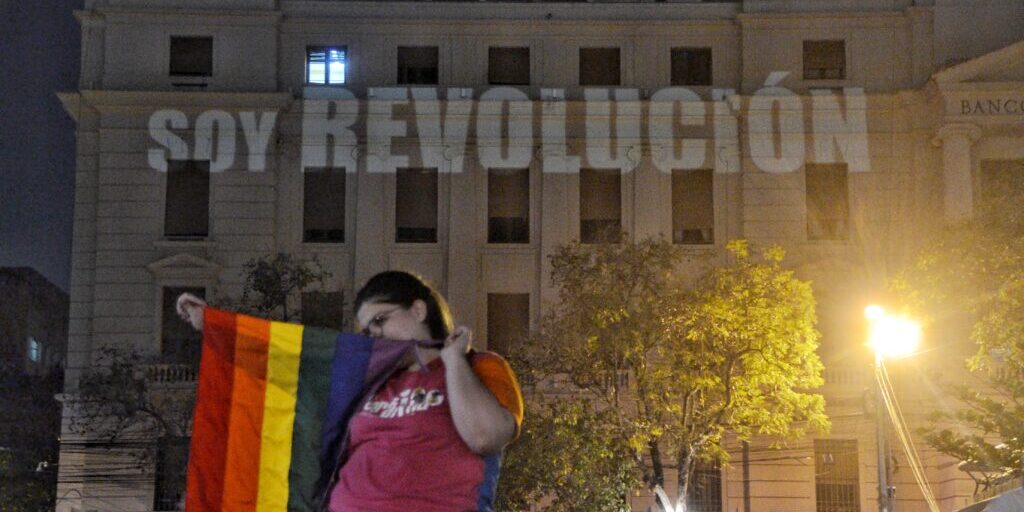
The year of the COVID-19 pandemic was characterized by a deepening of the social and economic crises already affecting the LGBT population. Political abandonment and the absence of a financial support system from the State forced many to work in the informal sector. For people of diverse sexual orientations and gender identities, the year unfolded amidst community kitchens, self-management, lack of healthcare, and lack of access to housing. Added to this was police violence and the forced return to the closet during the lockdown period .
The latest report from the Human Rights Coordinator of Paraguay (Codehupy) , in its section Resisting is Creating , written by Rosa Posa and Carolina Robledo (from Aireana, a group for lesbians), Mariana Sepúlveda (from Panambí, an association of transvestites, transsexuals and transgender people) and Erwing Augsten (from the Network against all forms of discrimination) characterizes this period as "one of the worst conditions for LGBT people."
Police and military violence against trans people
The documentation and registration center for violence against transgender people, Panambi, and Aireana's Rohendu service have registered an increase in cases of violence and discrimination since the start of the pandemic . According to Panambi's data, they have received 100 complaints so far this year. Fifty-two percent came from Asunción, and 31% from other cities in the Central Department. The remainder came from various parts of the country.
In July, 35 people were detained by Navy officials in Ciudad del Este, accused of murdering a non-commissioned officer in an armed confrontation. Among those detained were three trans women who were kidnapped and tortured.
Rohendu, for its part, handled a total of 200 cases, including complaints, requests for advice, and psychological support. Between March and August 2020, the period of greatest restrictions due to the health emergency, the number of calls requesting help for panic attacks, anxiety, or suicidal thoughts increased by 55% compared to 2019.
The Paraguay HIV/AIDS and Human Rights Counseling and Reporting Center received 190 reports, 70 of which were from transgender people and cisgender gay men . During the reporting period, the three organizations received a total of 370 reports.
Physical assault and discrimination were the main forms of violence suffered by transgender people this year. The number of complaints has doubled compared to the previous period. The fight against the pandemic was not waged on a level playing field. According to human rights defender and transgender activist Yren Rotela, 99% of the transgender population is involved in sex work.
Police harassment of sex workers
The health emergency reduced the demand for sexual services, meaning sex workers had to work longer hours to earn the same amount . The activist stated at a press conference with the Paraguayan Human Rights Coordinator (Codehupy) that, forced to continue working during the period of movement restrictions, police officers took advantage of the situation to extort bribes.
The Lince group, which was authorized to enforce health measures, harassed them even more than before and threatened to arrest them in their workplace .
Trans people did not benefit from any of the Government's programs: Ñangareko (which, in theory, allocated G. 500,000 -USD 72.82-, to people in vulnerable situations) and Pytyvõ (the subsidy of G. 547,210 – USD 79.70- was supposed to be allocated in two payments to independent workers who were affected by the health crisis).
According to several interviews conducted with the community by Latitud 25 , this is related to the fact that the ID card contains the birth certificate data and is perceived as "not matching" with the image of the trans person applying.
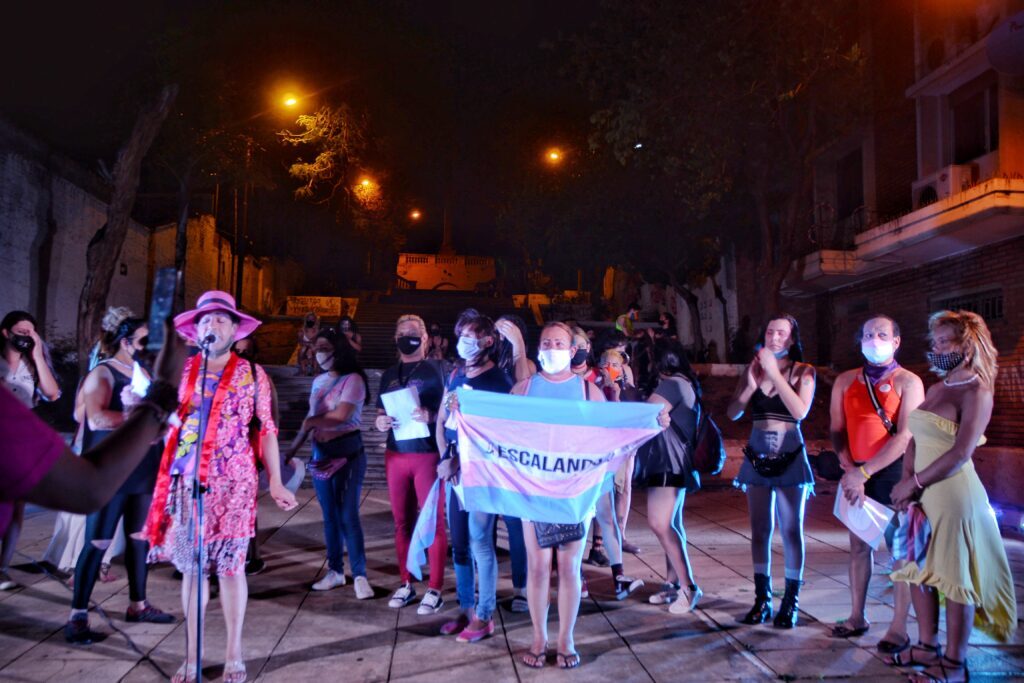
Unable to go out into the streets, organizations like Casa Diversa, Escalando, Panambi, and Transitar had to resort to appeals for donations to cover the emergency needs of transgender people, and to collecting non-perishable food items for community kitchens. Casa Diversa prepared food kits and hygiene products for transgender people and distributed them on several occasions.
Also, in July of this year, 35 people were detained by Navy officials in Ciudad del Este, under the pretext of being suspected of murdering a non-commissioned officer in an armed confrontation. Among those detained were 3 trans women who were kidnapped and tortured.
A faith that outweighs rights
“Let those with the multicolored flag come and tell us: 'We want your children.' They hide behind lies, they hide behind flags, but rest assured, we are many more, we are better, and they will not defeat us,” said former Paraguayan president and leader of the Honor Colorado movement, Horacio Cartes. “We love God, Paraguay, our families, and our children. They will not take away our dream of defending the family.”
On December 9, the keynote address “Defense of Life and Family: Top Priorities in Paraguay” was held in the auditorium of the National Republican Association (ANR), and was also streamed online. Miguel Ortigoza, a pastor from the Family Worship Center (an evangelical megachurch with branches throughout the country) and one of the main spokespeople for the anti-rights movement in Paraguay, was also present.
“No one is born gay; it’s an identity issue that can be perfectly resolved. These people suffer a lot, and statistics show that suicide rates among them are high. There are programs like those run by the Ministry of Women that promote new masculinities. Many people are working at the national level to prevent the European Union programs, which are providing $86 million, from moving forward. Since those programs haven’t worked, they’re now targeting children through the Ministry of Children and Adolescents,” he explained, referring to the Children and Adolescents Plan presented by the Ministry of Children and Adolescents .
An investigation titled “Deny Yourself” which includes a series of investigative reports coordinated by Agência Pública de Periodismo of Brazil in partnership with Ojo Público in Peru, Mexicans Against Corruption and Impunity of Mexico, reporter Desirée Yépez of Ecuador and El Surtidor, in Paraguay revealed how Exodus, the international religious group that promotes the “reorientation” of LGBTQI+, operates.
So-called “conversion therapies” are not prohibited in Paraguay. The report exposed several cases of LGBTQI+ people who were subjected to forms of torture, and those responsible remain unpunished . Following the precedent set by the “Cures That Kill” , in which Aireana and the LGBT coalition participated, the Paraguayan Society for the Study of Human Sexuality released a statement in 2011 denouncing the sexual reorientation therapies being practiced in the country. The Paraguayan Society of Psychiatry also issued a statement on this issue.
Progress in the fight for rights
The Codehupy report also highlights the approval of the Public Defender's Office's Protocol for the Care of LGBT Individuals , the most progressive policy on human rights and equality in the country. "It is clear that, to continue moving forward against all odds, it is necessary to resist, contributing creativity to this resistance to eliminate, once and for all, the barriers imposed by the State and even by a large part of civil society," they state.
A significant milestone in the country was the swearing-in of Kimberly Ayala, the first transgender person to become a lawyer . In November, she submitted her request to be sworn in before the Supreme Court of Justice for the third time, and after five years since graduating from law school and having been denied the right to be sworn in and admitted to the bar twice, she finally took her oath on a historic date.
The first school for LGBT people, Transformando , began classes in a blended learning format. Courses range from math, science, and communication to human rights and comprehensive sex education for transgender individuals. Residents of Casa Diversa, located in San Lorenzo, a city 13 kilometers from Asunción, received classes this year not only in theater, makeup, and hairstyling, but also in photography, writing, and public speaking. They created a school that allows them to regain faith in education.
Finally, Aireana promoted Lesbian Visibility Day in Paraguay after recovering the story of Feliciana Coronel, better known as Chana, a woman imprisoned in the Buen Pastor (the women's penitentiary in Asunción) who had claimed the right to intimate visits for lesbians 27 years ago.
“For the pioneering lesbians, for Chana and her companions who paved the way for us and started the lesbian revolution in our country. Today, September 16, we all celebrate together the day of lesbian visibility in Paraguay,” Aireana stated.
Panambi also emphasized the importance of the Day of Visibility for Trans, Transvestite, and Non-Binary People in Paraguay. They chose October 15, 2017, in homage to the day their comrade Romina Vargas was murdered. Last year, the Paraguayan justice system convicted a transfemicide for the first time , and it was Romina's.
“The existence of this day is important because our society still suffers from transphobia, which extends to all areas of our society. On this day, we reaffirm the need for a Gender Identity Law, access to education, and safe and free healthcare,” Casa Diversa wrote on social media. From 1989, the fall of the Stroessner dictatorship, to 2020, 63 murders of trans people were identified.
We are present
We are committed to journalism that delves into the territories and conducts thorough investigations, combined with new technologies and narrative formats. We want the protagonists, their stories, and their struggles to be present.
SUPPORT US

FOLLOW US
Related notes

We are present
This and other stories are not usually on the media agenda. Together we can bring them to light.