

Claudia Vásquez Haro, the first trans woman to earn a doctorate from a public university in Argentina
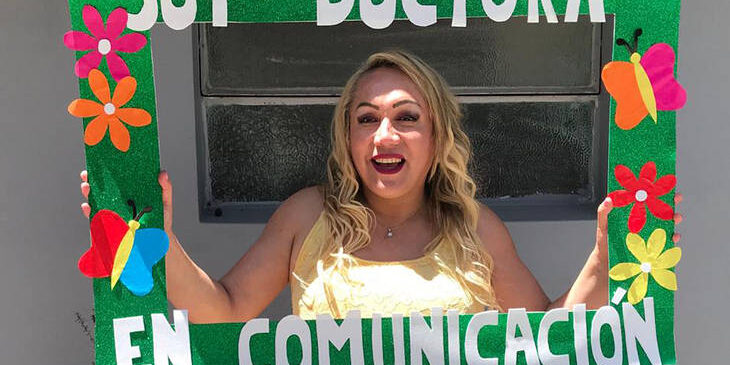
On December 11, 2020, Claudia Vásquez Haro became the first trans/travesti woman to earn a doctorate from a public university in Argentina.


Share

LA PLATA, Argentina. Claudia Vásquez Haro arrived in La Plata on November 5, 2000, after landing at Ezeiza Airport on a flight from Lima, Peru. Her sister Laly, the eldest of six siblings, was waiting for her that day at the airport with a bag of clothes. Claudia was 26 years old, and after hugging Laly tightly, the first thing she did was go into the airport bathroom and change .
With the lightness and determination of someone who has decided to take a leap, she removed the loose, athletic gear she had worn during the trip and put on a black chiffon top and beige dress pants. Then she slipped into high heels, with a certain feeling of also rising a few centimeters above life and beginning an existence—which, in truth, had already begun—where she could fully be Claudia. Fantasizing about living her gender identity freely, she repeated to herself: “Nobody knows me here. Here I’m going to do my own thing. I don’t have to ask permission; it’ll be easier.”
Many years later, at another airport, he will have another revelation, another transition: the self-perception of La Plata .
“I came here motivated by my sister. She was always like a second mother to me. She had been telling me for a long time that in Argentina education was public and free, and that there was more openness to gender issues. I came with the idea of fulfilling my dream and studying like Claudia ,” she says with a soft Peruvian accent.
She was a teenager when her sister Laly left the family home in Trujillo to come to La Plata to study nursing. Claudia had worn heels and wigs since she was 13, and had a feminine gender expression.
“I knew that La Plata was a strategic place to study. Not like in the capital, where the UBA is lost. Here the university is the central axis of urban life. And I think that the construction of La Plata's identity is multifaceted in every sense.”
Arriving in Argentina
Twenty years ago, her sister Laly lived in Villa Argüello, and that's where they headed from Ezeiza. A Peruvian neighborhood—Claudia recalls—on the edge of the city, where a friend of her siblings, also from Peru, had lent Laly a plot of land and the family had built a small house. In La Plata, the Peruvian migrant community is the third largest, after the Bolivian and Paraguayan communities.
Claudia's first job was the one she learned in Peru, where she styled the hair of beauty queens and was an expert in colorimetry. She started by cutting the hair of her sister's contacts and within a few months became the most famous hairdresser in the José Luis Cabezas neighborhood, on the border between Berisso and Ensenada.
But in those early days, as Argentina entered a serious political and economic crisis, Claudia did what she could: cleaning houses, caring for the elderly. There wasn't much money for haircuts, so she traded her scissor hands for bags of rice.
She wore little makeup, and although she always liked to be very well-groomed and stylish, she dressed simply. She didn't want to attract attention .
Sometimes she pretended to be her nephew Francis's mother so that her trans identity wouldn't prevent her from getting a job. Later, she found employment at two large hair salons in the city: "Supercortes" and "Pelomanía." With part of her earnings, she continued her studies. For two years, she took all the courses she could at the La Plata Chamber of Hairdressers and Stylists , as well as at the Vocational Training School on 59th Street: public speaking, human resources, protocol, and etiquette.
Life in Trujillo
As a girl, she was studious and diligent, with a thirst for learning. But in Trujillo, she attended a century-old all-boys school, and when she was 12, her mother was advised that it would be best for her to withdraw. She changed schools. Her father still scolded her if she didn't get the best grades. Later, a 12-year silence would settle between them.
Claudia would leave class and stop by Omar's hair salon, a friend who was teaching her the trade and promising her: "This will give you a plate of food."
After graduating from high school with top honors, Claudia tried a couple of career paths, but neither appealed to her. Meanwhile, cutting, styling, and coloring hair provided her with a living and later, a name for herself. She won first place in a hairdressing competition and became well-known. But being a trans woman in 1990s Trujillo wasn't easy. She was 18 when she decided to move for the first time, and with her mother's help, she opened her own beauty salon in Cajamarca, where she eventually employed 10 people.
Being a migrant
“I was always migrating,” he says.
When Claudia arrived in Argentina, neither the Equal Marriage Law (2010) nor the Gender Identity Law (2012) had yet been passed. But here she could live her identity.
One of her first political acts as a teenager was to get her eyebrows permanently tattooed. It was her way of resisting: every time young trans women were arrested in the streets of Trujillo simply for wearing makeup, the police would throw water in their faces, as if identity were something you could put on and take off . So one day it occurred to Claudia that if she tattooed her eyebrows, when they threw water on them, they would still be there, unharmed and defiant against any repression.

In La Plata, the atmosphere seemed different. Until she was arrested.
“I’ll never forget it: we were walking down 7th Street with Romina, a trans friend. We were buying clothes, looking fabulous, with our bags, when the police asked us for our documents.”
"What have we done?" she asked with a Peruvian accent. The policeman responded with a blow that knocked her to the ground.
“I was scared, I didn’t know about the codes of conduct. They addressed us using male pronouns and we ended up at the police station.”
Romina, more experienced, showed that she was not afraid, and the police responded with two slaps: “Don't dress like women, you are men. It says so in the edict. You can't walk in the street.”
They were taken to the first police station and then to the ninth, the same one where Miguel Bru, a journalism student from the same faculty where Claudia later studied, was killed and disappeared.
Romina was made to take off her clothes and parade naked. Claudia thought: "Now they're going to make fun of me because I'm all padded with push-up bras..."
“In the end, they drew up a report. They wrote whatever they wanted on it. They fabricated a case saying we had disrespected them. They sent us to the judge, and the judge punished us. It was so unfair…,” he recalls.
In search of answers
The word "unfair" echoed in her mind and body. The feeling that this was happening to others was so strong that Claudia tried to find explanations. While continuing to work as a hairdresser, she enrolled in the Faculty of Journalism.
“I went to find the answers to my questions.”
In 2005, at the university (then located on 4th Street, between 43rd and 44th), she met Lohana Berkins and Marlene Wayar, trans activists. They had come to present the book * La gesta del nombre propio ). That encounter was key. At the end of the talk, Claudia bought the book.
Published by the Mothers of Plaza de Mayo publishing house , coordinated by Lohana and Josefina Fernández and with a prologue by Diana Maffia, it is a collective investigation carried out by transvestite and trans activists, researchers and feminists, which collects and analyzes data on the structural violence suffered by transvestite and trans people: one of the many is police abuse.
Claudia finished it that same night, in three hours.
“I’ve never wanted to read anything so badly. I’d never even bought a book about trans women! It blew my mind. What was happening to me was happening to all of us. It was an awakening. Saying: 'I’m not alone, there are other women fighting and with more experience.'”
With one foot in activism
Claudia had already been drawn to activism through her migrant identity, having met activist Lourdes Rivadaneyra a few years earlier when a new immigration law was being presented. But entering university and meeting Marlene and Lohana represented a major leap in her awareness and political engagement. It was a new way of relating to others and to the La Plata area. It was also in 2005, in the Journalism classrooms, that she heard Flavio Rapisardi and Raúl Zaffaroni speaking about sexual diversity.
“It was understanding that everything that happened to us trans women was a product of other things. I had to be careful because of the edicts and the immigration law. Once they were about to deport me after going out to defend a friend. And I had to marry a friend's sister so they wouldn't kick me out. I didn't want to leave. I had built my network of friends and activism.”
In those days, Claudia worked mornings and went to her classes in the afternoons. Every now and then, the police tried to arrest her on some street in the city, but she was no longer afraid. She would recite to them the Yogyakarta Principles on the application of international human rights law regarding sexual orientation and gender identity.
“I entered the university and made that space my own. My professors were happy, I participated in the classes. The university opened my mind. It was my first trench in La Plata ,” says Claudia.
After years of working at "Pelomanía" and "Supercortes," she managed to build a clientele. By then, she was living in a house on 116th Street, between 35th and 36th, which she had been asked to look after because it was in probate. And that's where she started setting up her small beauty salon. She wanted to finish her degree quickly: she quit her job and supported herself with her clients. She studied journalism from Monday to Thursday and worked Friday, Saturday, and Sunday.
“I’ve been organized since I was a girl. To avoid falling flat on my face, you have to build a cushion so it doesn’t hurt. And this applies to life, love, and anything you face.”
She says proudly that Lohana went to that house. And Lohana wanted all trans women to go to university.
Claudia's academic life
Claudia graduated in 2012. Years earlier, Jorge Jaunarena, the faculty's Human Rights Secretary and a member of the Miguel Bru Association, had suggested she become more involved in the area, particularly regarding sexual diversity. And when Claudia received her degree, he offered her a position in the secretariat and the opportunity to coordinate some gender studies classes, a topic that was rarely discussed.
Florencia Saintout immediately took over as dean, and Claudia continued her academic work while opening herself up to other types of activism.
In 2008, along with another trans woman, Nicole González Beamonte (known online as La Rubia Peronista ), she founded the first trans organization in La Plata: Juntas por la Dignidad (Together for Dignity). They wrote their names on slips of paper and drew lots to decide who would be president and vice president. Then they went out into La Plata, looking for transvestites and trans people. They walked around strategic areas at night: Calle 1, the diagonal avenue. They distributed condoms to about 200 transvestite and trans women.
—"Don't you prostitute yourself?" they asked Claudia.
"No. I'm a hairdresser: I can cut your hair, girls," she offered, trying to lure them into activism. She insisted: "We have to get together to demand our rights."
“I was the crazy one and they didn’t even pay attention, they made fun of me,” she recalls.
Claudia and Nicole (who was working at the Human Rights Secretariat at the time) wanted to organize something, to invite them to a meeting. They fantasized: how many could they have approached on those walks? “If 20 come, we’ll make history,” they told themselves. But the day of the meeting arrived, and not a single trans woman showed up.
Between the classrooms and the street
In 2008, the Faculty of Journalism at UNLP granted a pioneering recognition to gender identity: it was the first public university in Latin America to recognize the self-perceived identity of its students.
The trans women trying to survive on the streets—due to a lack of access to other work—found out. Claudia played volleyball with some of them, the Peruvian women, on weekends. She's been playing volleyball with them for over 12 years.
—So now at your faculty they consider you a woman, baby! Congratulations!—, they told her.
When those same trans women suffered a violent and arbitrary arrest by the police, they didn't hesitate to call her. There were about 20 of them. Claudia was outraged: she remembered the water thrown in her face, the endless hours at the Ninth Police Station in La Plata. Filled with fury and helplessness, she called on the university, the Miguel Bru Association, and the Provincial Commission for Memory . And she got the media to come.
"If you want, you can talk," Claudia urged them. "But let's think about what we're going to say. Let's not go off on tangents. The media always tries to lead you astray." She ended up talking to the press herself.
Territorial construction
By 2011, she was already part of the inner circle and joined the working groups for the Gender Identity Law . It was approved in May 2012. And President Cristina Fernández de Kirchner handed out the first ID cards with the changed names at the Casa Rosada in July 2012: she invited trans and travesti people, and there, among others, was Diana Sacayán, the driving force behind the transvestite and trans job quota who was murdered in 2015. (And Claudia was there, invited because of her activism but at that time still without her Argentine ID: she obtained it in 2014 and was the first migrant travesti to receive it rectified ).
The ceremony was broadcast nationwide. The camera briefly focused on Claudia, who reacted quickly:
—Thank you, Cristina, because the law also applies to migrants —she said.
—Of course, absolutely. For the greater homeland —the president replied.
The trans women of La Plata saw the scene on TV. That night, upon returning, Claudia went to the red-light district and stayed talking to many of them. She invited them to another meeting.
"That time, 100 transvestites arrived together. At 4 in the afternoon! Something I'd never seen before!" she laughs.
With that foundation, he built Otrans La Plata, which later expanded to Otrans Argentina .
—We built a territorial organization in the city with its own identity, led by transvestites and trans people.

Trans communication
In 2015, Otrans spearheaded the Federal Transvestite and Trans Call, with a presence in 18 provinces. It also leads a borderless communication initiative: Sudaka TLGBI+ , a digital news agency staffed by transvestite and trans people that seeks to challenge the dominant narrative.
“Everything from La Plata,” Claudia emphasizes, adding that one day she’d had enough. “We trans women got tired of it. We don’t want to be called to a march when everything’s already been arranged. We trans women aren’t just decorations. So we organized our own march here,” she explains. “It’s curious because Otrans is the result of the systematic violence of the police and the judicial system that criminalizes trans and travesti women. Because where there is the most violence, there is also the other side: resistance,” she describes.
“La Plata is the city of trans women, transvestites, and trans people. But the contributions of migrants here are also key. Migrant women have put their bodies on the line. Most of the trans women who were in prison were migrants. And they are the ones who died under Macri. We produced a report that says 90 percent of transvestites and trans people deprived of their liberty in the province of Buenos Aires are migrants. Why? Because we know that the justice system is patriarchal, racist, and xenophobic. And let's not forget that this is the largest fruit and vegetable growing region in the country, made up of Bolivian people.”
“There’s nothing better than marching down Diagonal 74”
Claudia is fully aware that they organized in a city emblematic for these demands and for its student and worker struggles, for the Mothers and Grandmothers of Plaza de Mayo. The other front was and continues to be the open public space: the streets and plazas, which she adores. And every Sunday she plays volleyball with her trans friends in the woods of La Plata.
“Nothing is more revolutionary: it is one of the political communication practices that we deploy.”
Another place where he feels at home is when he marches along the diagonal streets to protest. Or, every now and then, to celebrate.
“There’s nothing better than marching along Diagonal 74, which goes from Plaza Italia to Plaza Moreno. We have to pass by, eh… those bars full of pakis (heterosexuals) on our Pride March route.”
A true role model
Since that flight that brought her from Lima, Claudia has taken many planes as a trans activist from La Plata, Argentina, and Latin America. In 2017, she was chosen to travel to Geneva on a historic mission to the UN: on behalf of 22 women's civil society organizations, she delivered a report to CEDAW (Committee on the Elimination of Discrimination Against Women) denouncing the human rights situation of transvestites and trans people in our country.
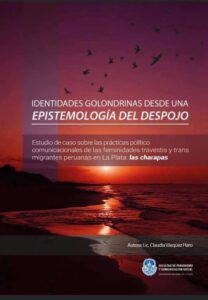
A professor at the Faculty where she graduated, Claudia has become an activist and ambassador for the intersectionality of her identities: transvestite and migrant. In the first half of December, she defended her doctoral dissertation in Communication, a research project focused on this core issue: “Swallow Identities from an Epistemology of Dispossession.” It is a case study on the political and communicational practices of Peruvian transvestite and trans migrant women in La Plata.
Claudia is not only the first trans woman to earn a doctorate from a public university, but she does so with a thesis that contributes to the production of trans academic knowledge, questioning theory from epistemological frameworks related to dispossession and making an intersectional approach to gender, race, and migration. Her thesis was supervised by Florencia Saintout and Adriana Archenti (UNLP) and Verónica González (UNC), and the jury (Facundo Ábalo, Silvia Delfino, and Juliana Marinez) evaluated it as outstanding.
Military personnel during a pandemic
The pandemic hit as Claudia was developing new projects at Radio Provincia AM 1270. On Mondays from 9 to 10 pm, she hosts Sudaka , an intersectional transfeminist program with a human rights perspective, with the news agency she runs (which recently celebrated its first anniversary). On Tuesdays and Fridays, she's a culture columnist for Tarea fina , an afternoon magazine show on the same station.
Since the lockdown began, she's been going back and forth, asking on social media for everything from food to sewing machines so her trans friends, some of whom are incarcerated, could make face masks. The living conditions of these people, whose life expectancy in Latin America is 35 years, were already precarious and have worsened with the pandemic.
It is estimated that there are around 300 transvestites and transgender people in La Plata, Berisso, and Ensenada, and most survive through prostitution. If they don't go out on the street, they don't eat. At all hours, they would go out with Otrans to deliver food or resolve cases of arbitrary arrests, because in theory, transvestites and transgender people were breaking the lockdown when in reality they were trying to survive. Meanwhile, and alongside organizations from all over the country, Claudia continued to advocate for the only thing that can change things in the long term: the labor inclusion of transvestites and transgender people.
“Having a job allows you to quarantine at home. Without a job, we cannot plan for a life on equal terms.”
Claudia lives alone, “where Barrio Norte ends and La Loma begins.” Her house has become a collection center for food and clothing. A center named Pamela Macedo Panduro.
“In memory of a transvestite migrant colleague who died deprived of her liberty on January 1, 2017, in the Florencio Varela prison unit,” she explains.
Transvestite, migrant and from La Plata
One day Claudia had to stop. She spent a week running a high fever. The thermometer fluctuated between 40 and 41 degrees Celsius: she had Covid. She was sweating so much that her lips felt completely dry and she felt like her eyes were going to burst . She was in a very bad way. Her sisters, both nurses—Laly, the eldest, and Jessica, the youngest—monitored her closely by phone, and her boyfriend took care of her.

“Getting infected made me rethink many things. Among them, redefining and valuing the bonds of solidarity. Those of us who had this virus went through moments of absolute loneliness. For me, it was realizing that those bonds were stronger than ever. My blood family has always been key in facing life and its problems, and so has my trans family. We have already experienced what it means to be confined. And we have endured very difficult times through mechanisms that have taught us to organize ourselves and have given us invaluable experience.”
It's been a while since Claudia last flew. But one of the last times she had a kind of revelation. During a layover on her way back to Argentina, she deeply wished she were home. In La Plata.
I was born in Peru, but I'm a resident of La Plata by choice. Every day of my life unfolds here, amidst the diverse peoples and cultures that enrich this multicultural city. Just as I chose my name, I chose where to live and where to build my life. I am trans, a migrant, and a resident of La Plata.
Photos: Claudia Vásquez Haro's Facebook page and Presentes Archive/Ariel Gutraich
* Acá Está La Plata/0221 , where this profile was originally published, is a project that unfolds ten stories from La Plata. Edited by Abel Escudero Zadrayec, it portrays ten characters from La Plata through the eyes of ten writers. Claudia's story is one of these, a story of people who live in the city, experience it, and embody it in their lives.
We are present
We are committed to journalism that delves into the territories and conducts thorough investigations, combined with new technologies and narrative formats. We want the protagonists, their stories, and their struggles to be present.
SUPPORT US

FOLLOW US
Related notes


We are present
This and other stories are not usually on the media agenda. Together we can bring them to light.