

Diverse families in Paraguay fight for visibility and rights
The Paraguayan state has a unique nuclear family model that reproduces traditional gender roles.


Share

By Juliana Quintana
Photo: Alfredo Quiroz
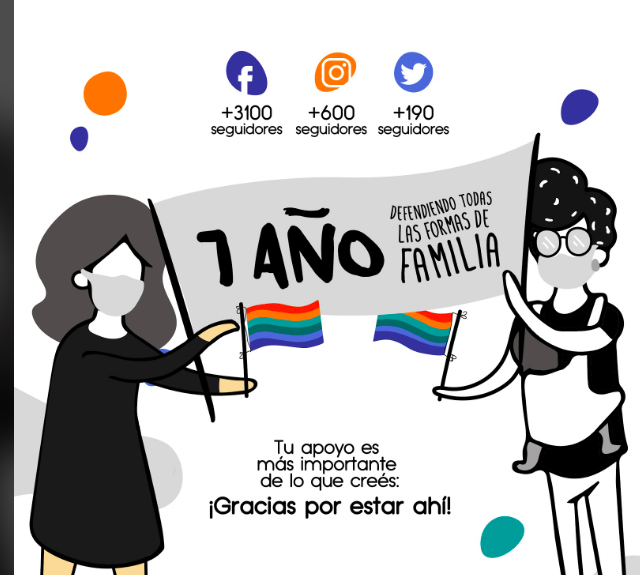
Being an LGBT parent in Paraguay is a journey of isolation. Parents must get used to being listed as single on official documents and witnessing discrimination against their children for coming from a same-sex parent family. The country lacks legal recognition of LGBT families. There are no policies for raising children, no marriage equality laws, and no reproductive, adoption, or parental rights for people of diverse sexual orientations and gender identities. Paraguay is one of the few Latin American countries that still lacks a law against all forms of discrimination. This is why platforms like "Nos queremos igual" , stemming from a campaign that seeks to give visibility to all families.
The definition of family we learn in school is that of a cis-heterosexual mom and dad, a traditional description that not only defines the boundaries of our social structure but also a set of moral values. We were taught that divorce breaks up the home, that adoption brings problems, that transgender children don't exist, and that same-sex parent families are dangerous for raising children. But being a family is not a noun but a verb; it's a fluid category that is constantly evolving.
The Paraguayan state has a single nuclear family model that reproduces traditional gender roles. But in our country, family configurations are very diverse, and the complexity of family arrangements challenges the heterosexual model. Historically, Paraguay has a long line of women who migrated to Spain or Argentina to support their families, meaning that hundreds of children were (and still are) raised by their grandparents. Similarly, there are women from the Bañado Sur neighborhood who work outside their communities caring for the children of other families.
Nationwide, three out of ten women are heads of household, and 30% of households, both in rural and urban areas, are composed of extended families . This is according to the General Directorate of Statistics, Surveys, and Censuses. But even the words used to describe household composition discriminate. Nuclear households are considered “complete” when both parents are present, or “incomplete” when only one parent is part of the family.
Many LGBT people in the country remember their childhood with a mix of confusing feelings: being bullied from a young age, discriminated against for their sexual orientations or gender identities, kicked out of their homes, or forced to come out more than once. But the importance of parental figures in either helping or hindering their lives also emerges.
“Being a lesbian means having society against you.”
Malena became a mother at 19. Her family pressured her to marry her boyfriend at the time. After four years together and a second child, she decided to become independent because she wasn't comfortable being a stay-at-home mom. “My family is very conservative and believes that women should be mothers and nothing more. When I separated from my children's father, I explained to them that it wasn't the life I wanted. They rejected me. They treated me as if I had no say in how to raise my son because I'm a lesbian. They didn't want me to have any contact with them,” Malena recounts.
Since she wasn't working at the time, she agreed one day to let her children's father enroll them in a school near her house. But they never returned. Malena had to beg him to let her see them or for him to agree to let them spend the weekend with her. For a long time, she had to go to her parents' house and stay overnight. Sometimes she saw them for three hours, other times they weren't brought at all. This went on for a year and a half.
Her father hasn't spoken to her since they separated. Her mother was upset for a long time, and although their relationship has improved considerably, she still doesn't accept that she's a lesbian. There was a time when she started to get scared because she hadn't been allowed to see her children for two months and their father wasn't responding. She went to see a state attorney to request divorce proceedings and was given an appointment for a month later. Nothing came of it. She doesn't dare move forward with the divorce because she's afraid they'll take the children away from her forever.
“When they come to visit me, I show them how I see life, but they go back to their dad and receive a sexist upbringing. I'm not involved in their upbringing. It's a conspiracy between everyone, my family and him. Now they don't make as much of a fuss, but they influence their upbringing. With the quarantine, it's much worse because I didn't see them from when it started until about two months later. They only came three or four times, and it's been like six months of quarantine now,” Male says.
For her, having children in this society is the world's biggest mistake, and being a lesbian means having society against you. "You're a single person without the state, without family, without anyone to support you except for a group of friends you have to fight with. I'm among all those marginalized people," she says, confessing that her greatest fear is that her children will grow up in the body of a man who doesn't respect diversity.
“Having a child is like you went too far”
Gabriel moved to Paraguay in 1995. He came from a very religious family in Buenos Aires. He frequently traveled to Villarrica (161 kilometers from Asunción) to teach Psychology at one of the largest medical universities. Most of the students were foreigners, and there was a sense of freedom in the city. One of the students was Jorge, Gabriel's current partner.
“We used to meet at night at the house of this friend who was from Villarrica. We went in silence, we used a code, visibility was very difficult. We were afraid of being ostracized. There were people who were strongly labeled as homosexual, and given the way people in Villarrica acted, they were forgiven because of their culture, but I was from Asunción and I didn't want to go through that. Homosexuals were called 'faggots 108',” Jorge recalls.
Between Gabriel's trips to Villarrica, Jorge worked up the courage to ask him out, and they started seeing each other. After a while, they moved to Asunción together, and seven years passed before they began to consider parenthood . “ We knew it was going to be a very difficult issue in Paraguay. It's something that's talked about, but for many, actually having a child is like going too far. I was very afraid, wondering, 'Are we doing the right thing?'” Jorge wondered.
Gabriel worked as an educator in Fortaleza, a center for children living in poverty. There he met Tamara, a 15-year-old girl who was pregnant with Rubén. After giving birth, Tamara went to live with an NGO that supports adult sex workers and child and adolescent victims of child sexual exploitation. She stayed there for two years until she and her son were expelled. Gabriel lost track of her but learned that Tamara had become pregnant again, this time with Alegría.
A year later, a nurse at the hospital where Jorge worked told him about a woman in Fortaleza who was expecting a baby and didn't know what to do with the two children. That's how Jorge met Tamara. She went through all the prenatal care with Jorge and Gabriel, as well as attending psychological support workshops. That's how his relationship with Tamara began.
From Monday to Saturday, Tamara would drop the kids off in Fortaleza, pick them up on Saturdays, spend time with them on the streets on Saturday and Sunday, and then take them back on Monday. “And when she dropped him off in Fortaleza, she would stop by my office and we would talk until one day she came and told us she couldn’t take Rubén anymore. She asked if we could keep him,” Gabriel recounts.
That's how Rubén arrived at Jorge and Gabriel's house. It was a rainy Thursday, and he came with nothing but a large t-shirt and underwear. "We set conditions for his mother: we told her that every Saturday morning she had to go pick up Alegría from Fortaleza and bring her home so Rubén could play with his little sister because we thought it was good for him to maintain contact with her," Gabriel says.
Until one day Tamara told them she had gotten a job in Brazil and would be gone for a month, leaving Alegría in Fortaleza. But she disappeared. “Things got difficult for us with Rubén because he became very anxious when she didn't come back, so he started therapy. We took him to see his little sister one day in Fortaleza, and that's when they told us Alegría was gone, that a stranger had taken her,” Jorge says.
After several inquiries, they found her barefoot in Cateura (the Asunción landfill) with her paternal grandmother. They managed to get her biological father to sign a document stating he wanted nothing to do with his children. Tamara returned a few months later and obtained Alegría's birth certificate. With that, she got her identity card without a father.
“There wasn’t much time to think. She grabbed her things and left, and we were left with a baby who had a thousand health problems. Three days later, we had to take Alegría to the hospital with antibiotics because she was sick. Nobody asked us anything, only who the father was. That’s when we started to integrate her into our lives. With Tamara’s help, we managed to get her to start coming once a year for Christmas. She came every year at least once; she was always very present,” Jorge says.
To be listed as a single mother
Romina and Marisol met in a religious movement; from best friends they became life partners, and today they have been together for 14 years. In 2015, they decided to become mothers. That year, a group called Familianas emerged following a visit to Paraguay by Chilean judge and lawyer Karen Atala, who sued the Chilean state before the Inter-American Court of Human Rights for discrimination after the Chilean Supreme Court denied her custody of her daughters because she is a lesbian and lives with her partner.
The activism within Familianas for the inclusion of diverse families was supported by Aireana and consisted of a series of talks, camps, and spaces where children could meet and share. “The idea was to have a safe space for lesbian mothers. There were thousands of concerns, and among those stories was ours—we wanted to be mothers,” Romina recalls.
One day, taking advantage of Marisol attending a conference in Corrientes, they inquired about assisted reproduction. Romina contacted members of Les Madres Argentina to connect them with a doctor, and they made an appointment. From that moment on, they began saving. In December of that year, Marisol became pregnant, and their daughter was born in August 2016.
“From that moment on, it seemed important to me that my whole family knew about our relationship. My mom kept it a secret for a long time because I didn't want to destabilize the family's past, but it seemed important to me that she grow up in a real family. And if they were going to reject me, it was best to know as soon as possible,” Romina recounts.
Adding to the uncertainty of how Romina's family would react was the fact that they had paid a year earlier for health insurance that covered everything related to the pregnancy. But one day, the gynecologist inadvertently wrote on an ultrasound order: "patient with artificial insemination," and when they went to have it done, the insurance company rejected them, saying they didn't cover any births resulting from artificial insemination.
“At that point, we lost our insurance. So, we decided to withdraw: they weren't going to cover the ultrasound or anything else anymore. In other words, all that money we'd paid for that year was for nothing. But if the doctor hadn't made that observation, they would never have found out. We managed to get a consultation with another doctor, and finally, Clarita was born in a public hospital where I couldn't be involved as much as I would have liked,” Romi recalls.
On the day Clarita was born, Marisol was forced to use both of her surnames, and Romi was not allowed to include any of hers. They remember it with great sadness because they know the legal implications of not registering Clarita as their daughter.
“What if something happens to my partner and I can’t legally keep my daughter? What if we separate? How are we going to fight for custody?” she says. But she fondly remembers the decision to co-parent with her partner, which gives her the strength to face, one by one, all the challenges that arise.
We are present
We are committed to journalism that delves into the territories and conducts thorough investigations, combined with new technologies and narrative formats. We want the protagonists, their stories, and their struggles to be present.
SUPPORT US

FOLLOW US
Related notes
We are present
This and other stories are not usually on the media agenda. Together we can bring them to light.