

What you need to know about the new HIV and STI Bill
What are the key points of the new bill on HIV, Hepatitis, Tuberculosis, and STIs? And why are they calling for urgent treatment?

Share

By Rosario Marina
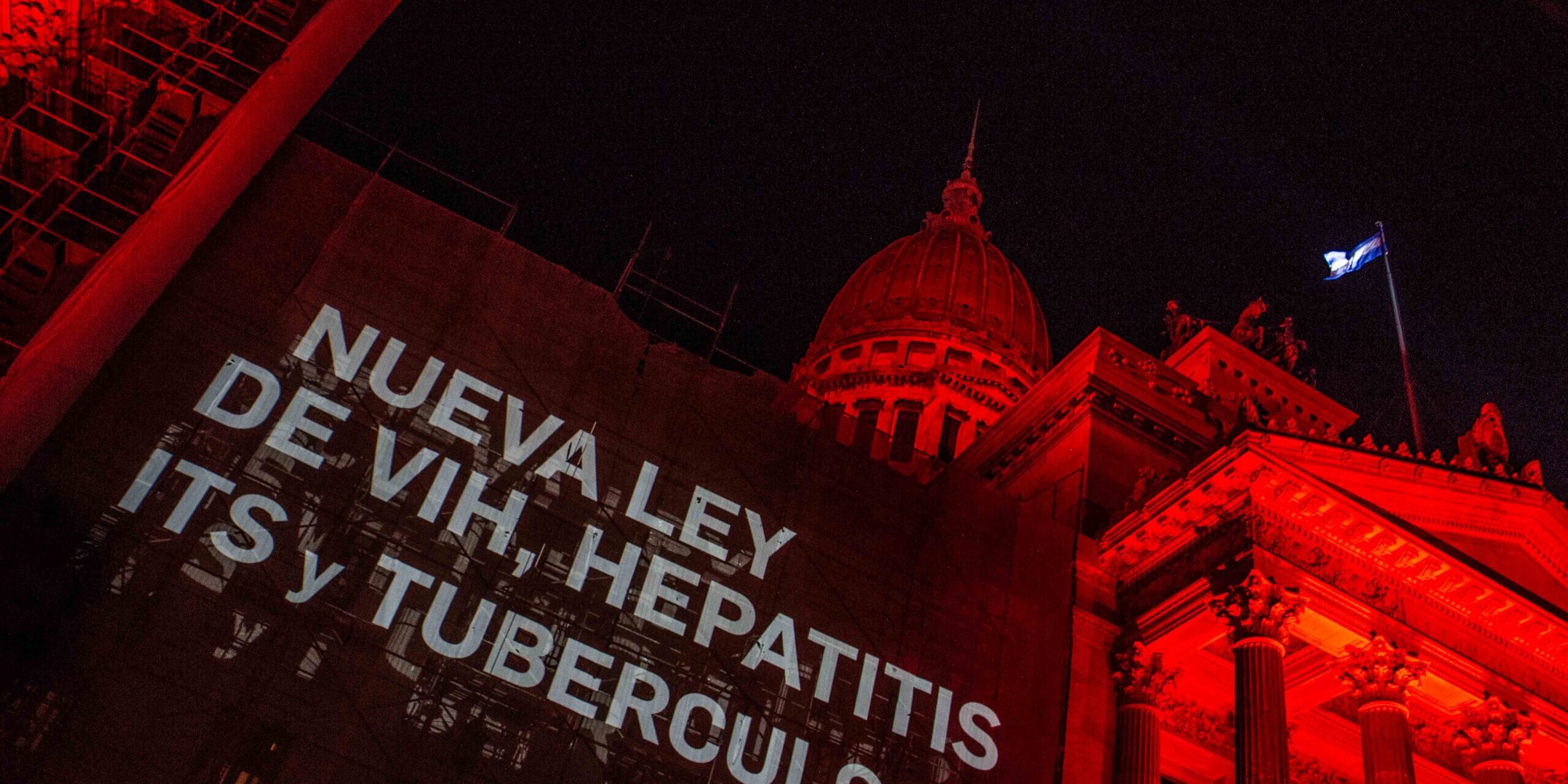
Photo: Tomás Labrousse for Ciclo Positivo
A new bill addressing HIV, Hepatitis, Tuberculosis, and STIs is awaiting consideration in Congress. The 24-page document was submitted in late October, following two failed attempts in 2016 and 2018, and was developed through a collaborative effort with 40 organizations. This time, there is greater hope that it will become law. The current law dates back to 1990, and while it included provisions considered progressive at the time, it has become outdated and insufficient.
this "maximum law" was developed
How do we move forward? That's what the members of the National Front for People's Health wondered in May—amid the Covid-19 pandemic. The idea arose to meet via Zoom, Sunday after Sunday, to debate every point, every comma, and every word, in sessions lasting more than five hours. These sessions culminated in a bill ready to be submitted to the National Congress.
Starting with a project signed by leading members of parliament from different political blocs makes a difference. Having the support of the Ministry of Health and UNAIDS does too.
“It’s a comprehensive law,” José Di Bello, president of the GEP Foundation (Positive Effect Group), who presented the bill to members of parliament, activists, and the Secretary of Access to Health, Carla Vizzotti, told Presentes. Di Bello knows that the bill may not be passed exactly as written, but it will cover many more rights than Law 23.798, which is 30 years old and whose text fails to acknowledge many of the advances made in recent times.
Why is a new law important?
“We believe it is very important that the legal framework be updated after 30 years,” Vizzotti said during the Zoom presentation, thus expressing the support of the National Ministry of Health. Alberto Stella, UNAIDS Director for the Southern Cone, was emphatic: “We need this law because it is a fundamental contribution, a gateway to the much-needed concept of universal health coverage.”
In dialogue with Presentes , representatives of the main organizations that wrote the project highlighted the key points: “The imprint of the bill has to do with an advance of rights, even in this of no longer seeing HIV only from a medical approach but from a social approach , giving a response to the social determinants,” explained Mariana Iacono, national representative of ICW (International Community of Women Living with HIV/AIDS).
Matías Muñoz, president of Ciclo Positivo, agreed on this point: “The most important thing is the paradigm shift towards a human rights approach . Above all, working against discrimination and stigma, two issues that have made AIDS a public health problem today .”
Emir Franco, who is in charge of RAJAP (Argentine Network of Positive Youth), adds a comparative fact regarding the current law: “This project, unlike the current National AIDS Law, has a rights-based approach, understanding health as a comprehensive response and not just a biological one .”
Key points for a new law
The organization Ciclo Positivo highlights some of the main points:
- The shift in perspective: the 1990 law has a biomedical focus, while the current bill adopts a gender and human rights approach. It seeks to highlight the social determinants of health and eliminate stigma.
- Prohibition of HIV, Hepatitis, TB and STI testing for employment in pre-employment medical examinations.
- Non-contributory pensions for people with HIV and Hepatitis B or C who have unmet needs. Provision of treatment for those who acquired the virus through mother-to-child transmission and for other key populations such as women, trans people, transvestites, and non-binary people, etc.
- Creation of a National Commission on HIV, Hepatitis, TB and STIs made up of different ministries, scientific societies and civil society organizations that work on the issue.
- Extension of the provision of formula milk up to 18 months (previously it only went up to 6 months) for babies of positive mothers.
- Creation of the National Observatory on Stigma and Discrimination within the INADI framework, seeking to ensure that HIV infection, Hepatitis B or C, TB or any STI cannot be used to impede the exercise of rights.

Will the third time be the charm?
This isn't the first time an HIV bill has reached Congress. In fact, it's the third attempt. The first two times it lapsed, meaning the stipulated time between its introduction and its debate in session passed. Organizations explain that this happened because of a lack of political will.
This time the organizations have hopes: the project presented on October 26, which entered under number 5040-D-2020, bears the signature of 17 deputies from political parties as far apart and diverse as the Frente de Todos, UCR, Coalición Cívica, Pro, Frente de Izquierda y los Trabajadores and Partido Socialista.
The signatories are: Carolina Gaillard; Leonardo Grosso, Cecilia Moreau, Mara Brawer, Mónica Macha, Brenda Austin, Carla Carrizo, Itai Hagman, Ayelén Sposito, Maximiliano Ferraro, Silvia Lospenatto and Romina Del Plá.
Project History
“It was already presented twice, in 2016 and 2018. In 2016 it received a favorable opinion from the health committee, but it didn't advance in the other committees. In 2018 it was directly shelved in the health committee by decision of the then-ruling party,” Emir Franco told Presentes .
The 2016 project was the first to come along to review the existing legislation.
The 2018 project added some of the main concerns left by the Macri administration with its cuts in the health sector.
Actually, the project began to take shape in 2014. That year a process of building and formulating the project began, with consultation with different civil society, academic, scientific organizations, UNAIDS, the Pan American Health Organization, etc.
After several meetings during 2015, the first presentation took place in 2016. “A trans colleague managed to get it approved through a member of parliament. That's when we started campaigning to get it approved. It was a long and difficult process,” Di Bello recalls.
The chair of the Health Committee at that time was Representative Carolina Gaillard (Frente de Todos), who had not signed the bill but did help it advance in the Chamber of Deputies. Today, she is the main signatory of this bill, which was presented last Monday.
Matías Muñoz knows the entire journey of this project. “The first presentation was in November 2016. I remember we couldn't even reach a quorum to discuss the bill. Many of the organizations that are still working to get the law passed were already present. “We were very disappointed to see that the representatives from many political blocs were turning their backs on the HIV law,” Matías recalls.
“In 2017 we obtained a favorable opinion from the health committee, but unfortunately it fell into a drawer under the watch of Congressman Daniel Lipovetzky, who at that time chaired the general legislation committee, and there it remained until it lost its parliamentary status,” explains Muñoz, now president of Ciclo Positivo.
“At that time, we were in the middle of the Macri administration. The situation had become very complex regarding the response to HIV, especially in terms of treatment,” Di Bello recalls.
Therefore, faced with the emergency shortage of medicines, reagents, condoms and formula for babies of women with HIV, several organizations formed the National Front for the Health of People with HIV.
By that time, the Kirchner administration had succeeded in establishing non-contributory pensions for people with HIV who were in extremely vulnerable situations. But in 2016, not only were no more pensions granted, but some people stopped receiving them altogether.
That's when they realized that, although the right seemed guaranteed, they couldn't risk having their lives drastically altered by shifting political winds. In 2018, they decided to reintroduce the bill and added two points: non-contributory pensions and early retirement.
“The proposal was that a person with HIV who found a job wouldn't need 30 years of contributions, but rather 20 years of contributions and over 50 years of age to access retirement. The idea is to anticipate this, firstly because it's difficult to find work, and secondly because after many years of medication, while antiretrovirals are wonderful, they also cause other types of damage to the body, known as premature aging,” explained Di Bello.

Pandemic and HIV medication
This new presentation of the bill comes amid a pandemic that revealed problems in access to HIV medication and delays in the arrival of reagents to many Argentine provinces, as can be seen in the report by Ciclo Positivo that was made in June and July 2020, and published in September.
The report includes testimonies from 506 people surveyed from almost every part of the country. Among its conclusions, it warns that “the results show persistent barriers to access, in some cases deepened and compounded by new ones.”
Furthermore, of all respondents, 75% of those living with HIV reported needing a medical consultation related to HIV/AIDS during the mandatory social isolation period. 18% of them said their appointment was canceled, and 8% indicated they went to a previously scheduled appointment but were not seen.
In 12 jurisdictions across the country, respondents reported being informed of shortages of reagents for at least one of the follow-up studies, and in 9 of them, of shortages of medications.
The Argentine Network of Positive Youth (RAJAP) also reported on its social media that, out of a total of 300 surveyed, only 8.3 out of every 100 people under treatment in Argentina have received medication quarterly or for a longer period of time, as recommended by the Joint United Nations Programme on HIV/AIDS (UNAIDS) and endorsed by the Ministry of Health of the Nation.
“If people who stopped taking their medication for any reason can't access the system again because of the pandemic, they aren't giving appointments. The same thing is happening with viral load and CD4 tests; the excuse is the pandemic, but the hospitals tell us there are no reagents. There were complications at the beginning of the pandemic, mainly with health insurance companies and prepaid medical plans, because they weren't responding due to the work-from-home policy. This caused people to run out of medication,” Emir Franco, president of RAJAP, Presentes
Another situation that has organizations on alert was the resignation in September of Sergio Maulén, who headed the Directorate of Response to HIV, STIs, Hepatitis, and Tuberculosis. It wasn't the first time Maulén had held that position: he also served in the previous administration of President Mauricio Macri, and on that occasion, he also resigned when the Ministry of Health was downgraded to a Secretariat, and after refusing to sign a 25% budget cut for the Directorate.
We are present
We are committed to journalism that delves into the territories and conducts thorough investigations, combined with new technologies and narrative formats. We want the protagonists, their stories, and their struggles to be present.
SUPPORT US

FOLLOW US
Related notes



We are present
This and other stories are not usually on the media agenda. Together we can bring them to light.