

What was “The Dance of the 41”, a foundational piece in the LGBT history of Mexico
The Ball of the 41 was a party that ended in a police raid in 1901 and put the issue of homosexuality on the public agenda.

Share

By Georgina González
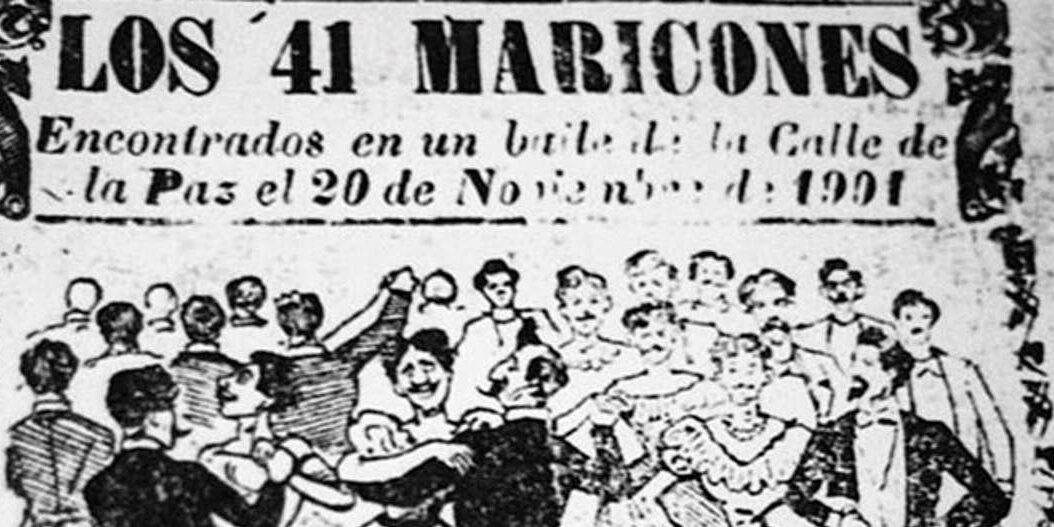
The Dance of the 41 was a party that ended in a police raid. It happened in November of the newly born 20th century during the dictatorship of Porfirio Díaz. Today, that dance and that number represent, in the social imagination, the foundational event of Mexican LGBT history.
At that time, homosexuality was not explicitly defined as a crime. However, the Penal Code of 1871 left the phrase "offenses against morality and good customs" open to the free interpretation of the police and those administering justice.
“In Mexico, there was no sense that homosexuality existed per se . (The Dance of the 41) shook the Porfirian structure because it is not the plebeians (working class) who do the dance, it is the elites, and it implies that the Porfirian structure is no longer virile and masculine,” explains Alonso Hernández, Mexican LGBT+ historian and chronicler.
“Police break up a gay meeting”
“On the night of November 17-18, 1901, on Fourth Street in La Paz (now Ezequiel Montes, located in the Tabacalera neighborhood of Mexico City), an unprecedented event occurred. A policeman noticed men and women in fine clothes and suits gathering at one of the houses and assumed it was a very important party. He approached closely enough to see that they were all men, and half of them were dressed as women and the other half as men. He was very surprised and went to the nearest police station to report it (announcing an action considered illegal), and the police arrived promptly,” recounts Alonso Hernández.
Carlos Monsiváis, in a chronicle published in 2002, describes the dawn of that night.
“At three in the morning on Sunday, November 18, 1901, the police interrupted a meeting of homosexuals, some of them dressed as women. Of these, 22 were dressed as men and 19 were cross-dressers. These are the possessions of those arrested, imagined or extracted from police gossip (there is no official report): skirts, expensive perfumes, wigs with curls, false hips and breasts, earrings, embroidered shoes, makeup in white or strident colors, low shoes with embroidered stockings, fans, short silk dresses, fitted to the body with a corset.”
The Dance of the 41
“The myth says there were 42 people. It is known that the governor gave a list to General and President Porfirio Díaz, who upon reading the 42 names said: 'there are only 41 here.' “That is why it is known as 'the dance of the 41',” adds Alonso Hernández.
“(…) the one who disappears from the list, buys his freedom at a golden price and flees across the rooftops, is Don Ignacio de la Torre, married to the daughter of Porfirio Díaz. More than any other fact, what distinguishes the raid is the presence, certified by massive gossip, of the First Son-in-Law of the Nation,” Monsiváis narrates in his story.
Regarding the identities of the other 41, there is little information available given the "impression of the news." However, Monsiváis says he is certain of three names: "Jesús Solórzano, Jacinto Luna, and Carlos Zozaya," and that, a century after the events, the only certainty is "the presence of Nacho de la Torre."
The sanctions
"The vagrants, thieves, and effeminate men who have been sent to Yucatán have not been assigned to the Army battalions operating in the campaign against the Mayan Indians, but to public works in the towns conquered from the common enemy of civilization," El Popular published on November 25, 1901 .
Nineteen of the 41 people arrested were sent to Yucatán to "pay for their crime with forced labor," Monsiváis maintains.
El Hijo del Ahuizote, a satirical and narrative newspaper opposed to the Porfirio Díaz regime, stated on November 21, 1901, that the people arrested were those who could not pay for their freedom.
“(…) in the poor it’s filth, and in the rich it’s a refined display of coquetry and good taste. If the governor violated the law with general applause, he should have acted equally, so that he would have been more appreciated, instead of leaving the seed and scattering the leaves of the plant. Now he can’t even walk down the street with a friend, because then they call him a member of the Club of 41.”
The raid “invented” homosexuality in Mexico
For Monsiváis, the 1901 raid “invented” homosexuality in Mexico. In turn, it “revealed the fragilities of determinism,” where “the stigma covers everyone, but physical punishments are meted out only to a few,” he says.
Furthermore, press reports from the time, engravings and caricatures by José Guadalupe Posada that illustrated the dance contributed to the collective imagination amid homophobic jokes, rumors and legends to link the number 41 with homosexuality.
The stigma continued after the Porfiriato. In 1965, the chronicler and military officer Francisco L. Urquizo wrote, “In Mexico, the number 41 has no validity and is offensive to Mexicans (…) The influence of this tradition is such that even in official matters the number 41 is ignored. There is no Division, Regiment, or Battalion in the army that bears the number 41 (…) Nobody turns 41. There is no car with a license plate 41, nor any police officer or agent who accepts that number.”
A century after the dance, Carlos Monsiváis concluded that “the most significant aspect of the episode of the 41 is, of course, the raid with its absolute denial of human and civil rights. From that moment on, a precedent was set, and what followed was legal because it had already been: continuous raids, police blackmail, torture, beatings, imprisonment in jails and the Islas Marías prison. All that was needed in the file was a phrase: ‘Offenses against morality and good customs.’ Nothing more was required; there were no defense lawyers (in the case of the homosexuals , not even public defenders), no trials, only judicial whims dictated by prejudice and ‘disgust.’ And society, or the people who found out about it, found these procedures normal or even admirable.”
This description is not far from the realities experienced today by LGBT+ populations who are criminalized and have their access to justice obstructed.
We are present
We are committed to journalism that delves into the territories and conducts thorough investigations, combined with new technologies and narrative formats. We want the protagonists, their stories, and their struggles to be present.
SUPPORT US

FOLLOW US
Related notes



We are present
This and other stories are not usually on the media agenda. Together we can bring them to light.