

The LGBT+ community in Peru took to the streets in defense of democracy
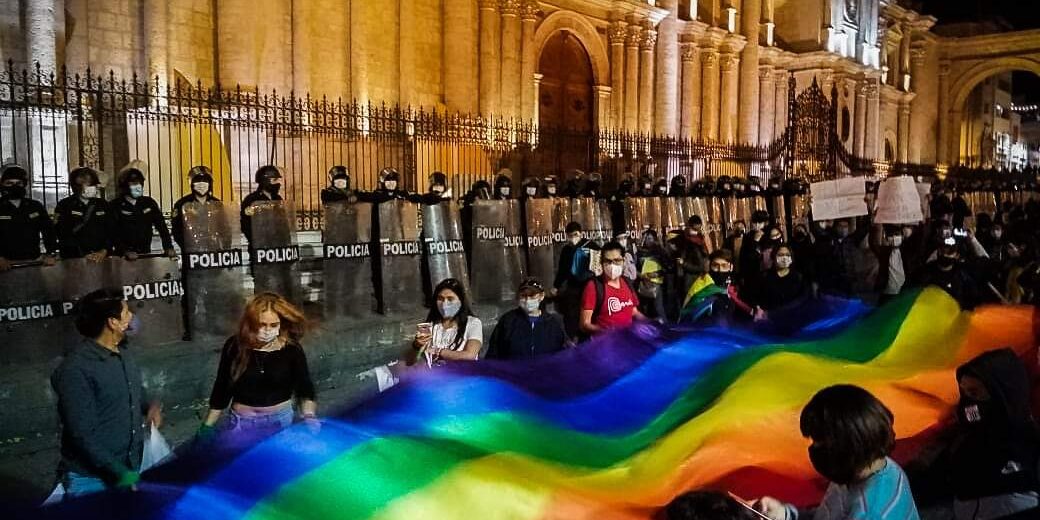
Students, workers, feminists, and a strong presence from the LGBT+ community are mobilizing to reject what they consider a coup d'état.

Share

By Verónica Ferrari , from Lima
Photos: Arequipa LGBT Network, Trujillo by Yago Martín, Okno, Huancayo Diversidades Wanka
[NEWS UPDATED ON 11/15]
Since Tuesday, November 10, the streets surrounding the Congress of the Republic of Peru have been filled with popular demonstrations that were brutally repressed by police forces, culminating in the deaths of two young people. Students, workers, feminist groups, and a strong contingent from the LGBT+ community mobilized to reject what they considered a coup d'état by the Legislative branch. Following the social unrest, interim president Manuel Merino resigned this morning, after six days in power, representing the most conservative, anti-rights, and corruption-ridden forces in the government. His successor has not yet been named.

Added to the political crisis is the economic and health crisis that led to more than 60,000 deaths due to the absence of a health system that could cover the care of all coronavirus patients.

An anti-rights cabinet that lasted six days
Prime Minister Antero Flores-Aráoz, known for his racist, classist, misogynistic, and homophobic ideology, placed figures linked to the Fujimori dictatorship and of conservative ideology in key ministries.
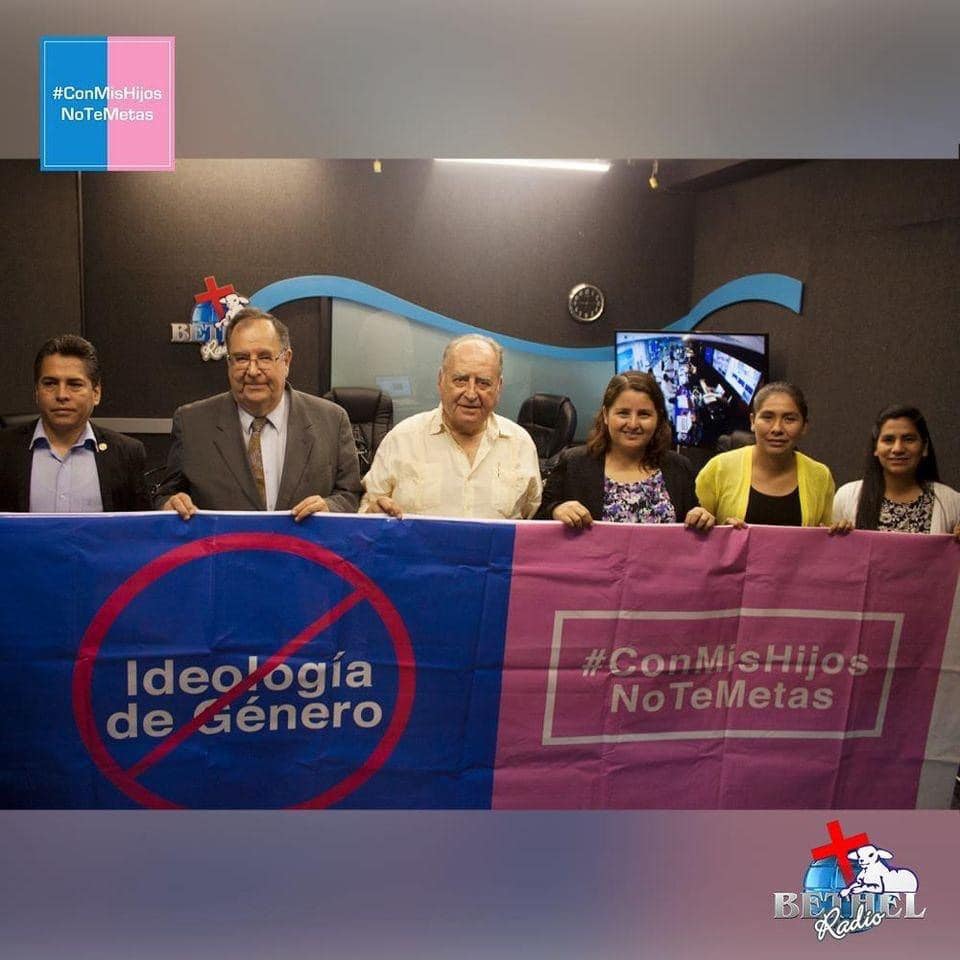
The Minister of Women and Vulnerable Populations, Patricia Teullet, denies that forced sterilizations and the genocide of Indigenous women—considered a crime against humanity—took place , calling them “a myth.” Meanwhile, the legal process remains stalled, facing all the legal traps set by the Fujimori regime to avoid prosecution and prevent victims from accessing justice and reparations for over twenty years.

Justice Minister Delia Muñoz, who worked for Alan García's government, is a well-known Fujimorista, and is currently trying to obstruct the Constitutional Court from resolving the jurisdictional challenge against the removal of former President Martín Vizcarra; in addition to delegitimizing the protest marches.
The Minister of Education, Fernando D'Alessio, a vice admiral in the Peruvian Navy, was previously the Minister of Health under Pedro Pablo Kuczynski. He was appointed solely to process the pardon for dictator Alberto Fujimori, bypassing all legal procedures and using falsified medical information to secure the release of the former president, who had been convicted of crimes against humanity. This was the first step that ultimately forced former President Kuczynski to resign. Lacking any merit in the field of education, he has accused protesters of terrorism and has also made homophobic comments on social media.
The LGBT+ community resists and expresses itself
In this context, where a conservative right wing that would never have come to power through popular vote has taken over the Executive branch, the minimal progress that women and the LGBTQ+ community had been supporting is now in jeopardy . For example: guidelines for implementing a gender perspective in education; access to sexual and reproductive rights for women and LGBTQ+ individuals, especially girls and adolescents, with a legal process underway to halt the free distribution of Emergency Oral Contraception, part of the kit distributed in cases of sexual assault; and policies on gender equality and against violence against women, among others.

The trans women's organization, Féminas, stated on its social media that “trans women will also take to the streets to defend democracy today, tomorrow, and for as many days as necessary. #WeAreAllFeminas #MerinoIsNotMyPresident.”

The Lima Pride March collective also issued a statement calling for a march this Saturday, November 14th, with the following slogan: “LGBTI people reject the current illegitimate government, that is why we are organizing ourselves to take to the streets and demonstrate. We hope to see you there!”

Marches also took place in Huancayo, Arequipa, Chiclayo, Iquitos, and Cusco.
We are present
We are committed to journalism that delves into the territories and conducts thorough investigations, combined with new technologies and narrative formats. We want the protagonists, their stories, and their struggles to be present.
SUPPORT US

FOLLOW US
Related notes


We are present
This and other stories are not usually on the media agenda. Together we can bring them to light.