

The murder of Honduran trans activist Vicky Hernández reaches the Inter-American Court of Human Rights
On November 11, the Inter-American Court of Human Rights will address the responsibility of the State of Honduras for the extrajudicial execution of Vicky Hernández, a trans woman and human rights defender.

Share

By María Eugenia Ludueña and Dunia Orellana
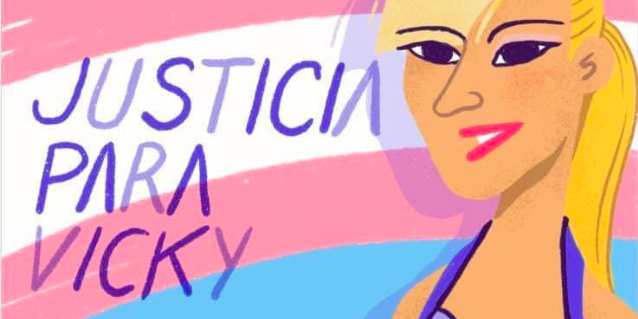
Illustrations: Cattrachas
The Inter-American Court of Human Rights has convened a public hearing for November 11 and 12, which LGBTI+ organizations are already considering historic . The hearing will address the responsibility of the State of Honduras for the extrajudicial execution of Vicky Hernández, a trans woman and human rights defender.
Vicky was 26 years old when she was murdered, between the night of June 28 and the early morning of June 29, 2009, during a curfew she was unaware of. It was just hours after the coup against then-President Manuel Zelaya, which established the de facto government of Roberto Micheletti.
These two hearings are of enormous importance to the entire region and to Honduras in particular, one of the most dangerous countries in Latin America for LGBT+ people.
For more than 11 years, the lesbian organization Cattrachas has been demanding justice for the murder of Vicky and also to ensure that other hate crimes do not go unpunished: 116 trans women and 250 LGBTIQ+ people have been murdered in Honduras since 2009.
“With so much impunity, with so many deaths, this is like collective justice,” Indyra Mendoza, coordinator of Cattrachas, told Presentes. “The names of other trans women will be there. There was prejudice, discrimination, violence, hatred, but in the end, we will achieve that collective justice.”
The case reached this stage following a petition filed by Cattrachas on December 23, 2012. Years later, the U.S.-based Robert F. Kennedy Human Rights organization joined the defense. The hearings will be held virtually at 8:30 a.m. (Central America time) and are expected to be broadcast via the Inter-American Court of Human Rights' social media channels.

Marlene Wayar, summoned as an expert
For the hearings, the Court has summoned the Republic of Honduras, the victims' representatives, and the Inter-American Commission on Human Rights to hear their arguments. It has also called as witnesses a colleague of Vicky's, her family, lawyers, and the Argentine trans activist Marlene Wayar.
Wayar, a social psychologist, was invited to speak about the role of the State as a causal link of systematic violence towards trans people and to develop transfemicide as a category to conceptualize crimes based on prejudice for gender identity or expression.
Wayar met the Honduran organization Cattrachas when she was invited to a meeting of LASA (Latin American Studies Association) in Boston.
Also called as an expert witness, lawyer Carlos Zelada will explain the context of violence against LGBT people in Honduras; the concept of violence motivated by prejudice against trans people; and standards for investigating these cases. Vicki Hernández's family members will also testify as victims: her sister Merelin and her mother Rosa Argelia Hernández Martínez . Criminal lawyer Edgar Fernando Pérez Archila will also provide expert testimony on how the facts of the case fit a pattern of extrajudicial execution motivated by prejudice under the standards of criminal and international law, and what the guidelines for the investigation should be if it is proven to be an extrajudicial execution motivated by prejudice.
What is being reported?
Vicky Hernández survived on the streets of San Pedro Sula by working as a sex worker. She was also a well-known activist with Unidad Color Rosa, a trans women's organization in that Honduran city.
On the night of June 28, she went out into the street, unaware of the curfew. That same night, Zelaya was taken from his house at gunpoint. The following morning, Vicky was found dead on a street in the Ruiz neighborhood, in northeastern San Pedro Sula. In the darkness of that night, the only people out and about in the city were members of the Honduran security forces.
The autopsy—carried out much later because the victim was denied that possibility at the time due to her gender identity and because she lived with HIV—revealed that Vicky was murdered with a firearm, according to a document from the Inter-American Commission on Human Rights (IACHR) issued in December 2018.
A 2010 amnesty decree protects those responsible for institutional violence. The lawsuit seeks to overturn it in order to identify the chain of command behind the murder of the Honduran trans activist .
“It is alleged that the death of Vicky Hernández occurred in two relevant contexts. On the one hand, the alleged context of violence and discrimination against LGBT people in Honduras with a high incidence of acts committed by the public forces and, on the other hand, the alleged context of the coup d'état that occurred in 2009,” says the text with which the IACHR announced the news in September 2020.
State-sponsored and bias-motivated crimes
Therefore, not only is Vicky's death being judged, the violence motivated by prejudice based on her gender identity and expression, but it is also argued that the Honduran State did not adequately investigate the facts of the case, with due diligence and within a reasonable time, and that these facts remain unpunished.
Because this chain of events began with the crime and continued with the handling of Vicky's body, on which they refused to perform an autopsy. “Human rights organizations denounced that forensic authorities refused to carry out the autopsy report under the pretext of assuming that the victim was living with HIV,” states a document from the IACHR.
It is alleged that “the State of Honduras is responsible for the violation of the rights established in articles 4.1, 5.1, 8.1, 11, 13, 24 and 25.1 of the American Convention on Human Rights, in relation to the obligations established in article 1.1 of the same instrument.”
On social media, slogans are already circulating: “Justice for her family. Justice for all trans people in Honduras. Justice for all LGBTI people in Latin America.” People are being encouraged to join the virtual activities using the hashtag #JusticeForVicky.
We are present
We are committed to journalism that delves into the territories and conducts thorough investigations, combined with new technologies and narrative formats. We want the protagonists, their stories, and their struggles to be present.
SUPPORT US

FOLLOW US
Related notes


We are present
This and other stories are not usually on the media agenda. Together we can bring them to light.