

Kimberly Ayala was sworn in as Paraguay's first trans lawyer
Kimberly Ayala was sworn in as a lawyer at the Palace of Justice in Asunción.

Share

By Juliana Quintana, from Asunción
Photos: Jessie Insfrán
Kimberly Ayala was sworn in as a lawyer at 11:00 a.m. at the Palace of Justice in Asunción. She submitted her oath request to the Supreme Court of Justice for the third time, and after five years since graduating from law school and having been denied the right to be sworn in and admitted to the bar twice, she finally threw her cap on a historic day. Her achievement represents a milestone in the country, as she is the first transgender person to become a lawyer.

Under the slogan “Graduation caps up for Kimberly,” various organizations gathered on the esplanade of the Palace of Justice in Asunción. Among those present were the Paraguayan Human Rights Coordinator (CODEHUPY), Amnesty International, Diversxs, the Paraguayan Network for Sexual Diversity (REPADIS), the LGBTI Coalition, It Gets Better Paraguay, and the Network Against All Forms of Discrimination.
In 2015, Kimberly graduated with a law degree from the National University of the East (UNE). She earned top honors in her graduating class, but was never able to practice law because the justice system did not recognize her gender identity. Even so, she is accustomed to fighting for her rights. For years, she has been a member of the Diverses group in Hernandarias (her hometown). In fact, she was present last year when anti-rights groups attacked the LGBT march in the Alto Paraná department.

Shortly after graduating, Kimberly began processing her paperwork in Hernandarias to be sworn in as a lawyer. Her cousin, who works at the courthouse, tried to help her with the process, but they wouldn't allow it because her photo "didn't match" the name. When Kimberly called, they told her she needed to get a new photo to resolve the issue.

“The person who attended to me told me to put my hair up and wear a tie and makeup. I got even more upset and told her I wasn't going to submit to that because it's like denying my identity. I am a trans woman and I've been living as a trans woman for a long time. This is something I've already created, something that's mine. I told her my other identity is in the past,” Kimberly told Presentes. But they wouldn't let her take the oath.
From there, she began to seek help. She obtained legal representation from a lawyer in Asunción who approached the Supreme Court several times. When she received no response, she went to the gender equality secretariat. They issued a ruling on the case and referred it to the full court of ministers. “The interim president at that time was very conservative, so things didn't progress. I didn't receive any recommendations, not even from the gender equality secretariat,” the lawyer stated.
There was no excuse to continue delaying the oath.
Outrage led Kimberly to take a break from the case. During that time, she worked in marketing and also as a hairdresser. In 2019, the Paraguayan Institute for Comparative Studies in Criminal and Social Sciences (INECIP), which supports social causes, intervened and submitted her application to the Judiciary for the second time to be sworn in as a lawyer. They managed to speak with a minister who seemed willing to help, but there was still no response.
This year, Rosalía Vega from Amnesty International learned what had happened and contacted Kimberly. Julia Cabello, a lawyer with Codehupy, took on her case. They both worked together to ensure that Kimberly's constitutional rights were respected.

“There was no legal basis to prevent her from taking the oath. She fulfilled all the established requirements to register and be sworn in as a lawyer. Anticipating any situation, we requested, through a public information request, from the Supreme Court of Justice a few months ago, all the resolutions and requirements for a person to take their oath and register as a legal professional. That information was provided to us in writing by the Judiciary. Any additional requirement would have been illegal and arbitrary,” Cabello stated.
She wasn't asking for a name change, only to be sworn in using her current image. According to Cabello, the ruling from the Supreme Court's gender secretariat stated, among other things, that it would be absurd for the photograph not to correspond to her current appearance. This was especially true because the Paraguayan identification department, the agency established by the Paraguayan state to determine a person's identity, had issued Kimberly an identity card with her birth name and her current image.

“This is very important because it will set a legal precedent, it will establish that we can achieve anything we set our minds to. This will provide a very positive outlook and future for the entire trans population, which has always been so marginalized and excluded. It's important for people to see how this society closes doors and windows to us, even when we meet all the requirements that society imposes to be a citizen. And in this case, it was nothing more than discrimination,” said Kimberly.
No progress on a gender identity law
The president of the Judiciary, Alberto Martínez Simón, speaking to a local radio station, cited Article 25 of the National Constitution. “It states that each person can express and create their own identity in whatever way they freely choose, and therefore a person can come dressed as a woman if that is their feeling. I see no legal impediment to denying the oath of office to a person who has completed their studies,” the official stated.

However, some names are still awaiting the Court's approval. Yren Rotela and Mariana Sepúlveda, both transgender rights activists, reported that there has been no progress on their name changes. In Mariana's case, she had to undergo a psychological evaluation, and after Judge Karen Leticia González ruled in favor of the Constitution and in accordance with international law, the Court of Appeals submitted the case to the Supreme Court for an advisory opinion.
The ruling was appealed by prosecutor Sara González Valdez, who argued that the judge's decision violates Article 56 of Law 1266/1987 of the Civil Registry, which states: “The Civil Registry Official shall not register ridiculous names or names that may mislead regarding sex, nor more than three names.” While Paraguay currently has no law prohibiting a transgender person from changing their name, there is still no gender identity law guaranteeing this right.
“My transition happened during my fifth year of university. All the students and professors at that time supported me. Many congratulated me. There were also some who didn't like it, but overall, the reception was very good,” Kimberly recounts. She won a scholarship to pursue a master's degree in higher education in Ciudad del Este, where she was known by her chosen name.

“I know it’s difficult to ask them to adapt to the new name, but it’s time to start now in this country. I’m not the only one at university. I know there are trans psychologists, trans philosophers, other trans women who have already finished their degrees, only they didn’t have the same problems I did because law school is incredibly sexist.”
The right to work belongs to everyone, as does the right to free expression of personality. “We are the only country in the region that does not have a law against all forms of discrimination, and not because we naively believe that a law will solve the problem, but it will certainly contribute to a society that is a little more aware and more tolerant of rights. Otherwise, we are failing to uphold what our own constitution says,” Cabello explained.

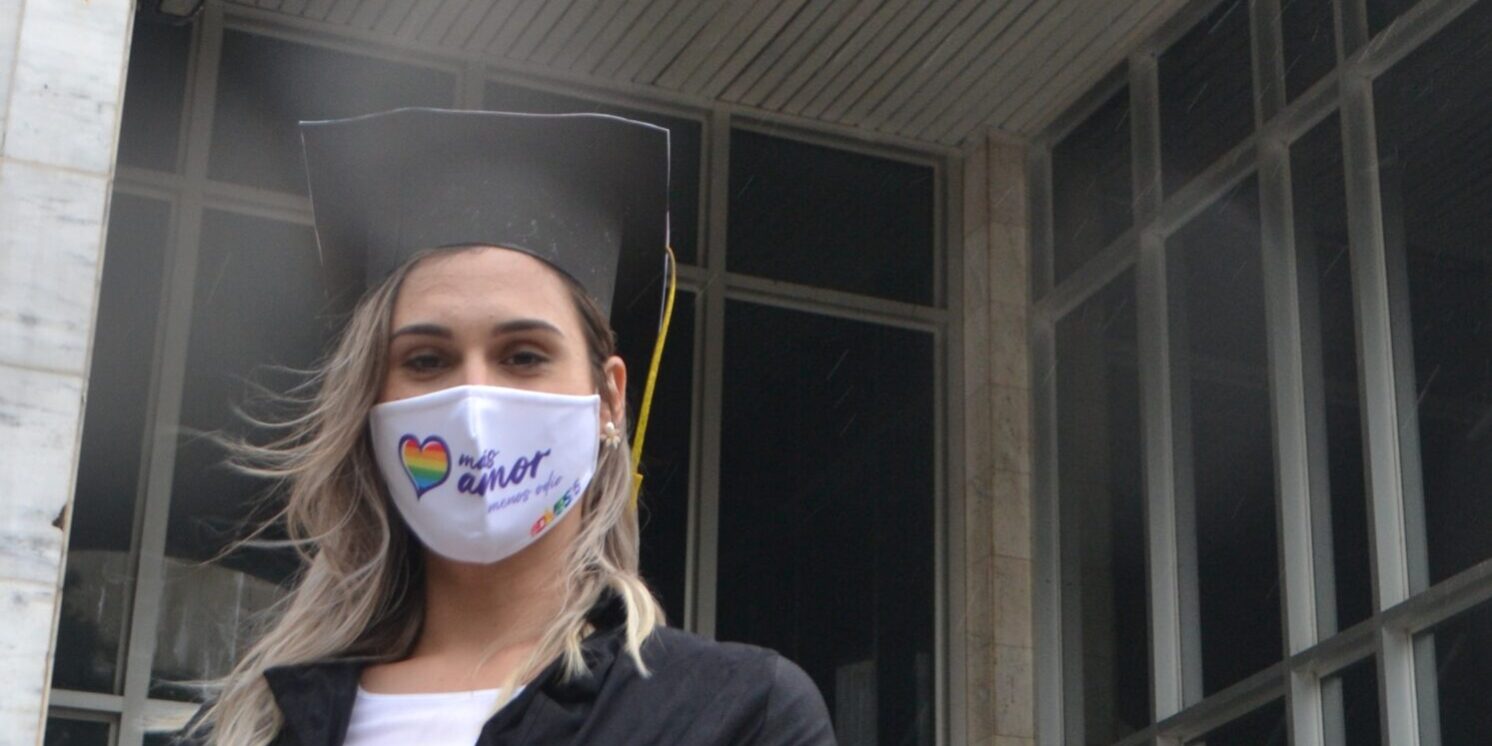
Although she was forced to swear using her birth name, Kimberly took her oath wearing a face mask that read “More love, less hate.” Her dream is to work with her fellow trans women who are incarcerated and to apply to become a judge. “This is an example that it is possible, being free and expressing our personality,” she stated.
We are present
We are committed to journalism that delves into the territories and conducts thorough investigations, combined with new technologies and narrative formats. We want the protagonists, their stories, and their struggles to be present.
SUPPORT US

FOLLOW US
Related notes


We are present
This and other stories are not usually on the media agenda. Together we can bring them to light.