

Homophobic torture in the Chilean Navy
The Navy told Presentes that “there will be an investigation” and that they don't know “when it will be completed.” Consequences of psychological damage.

Share

By Airam Fernández, from Santiago, Chile
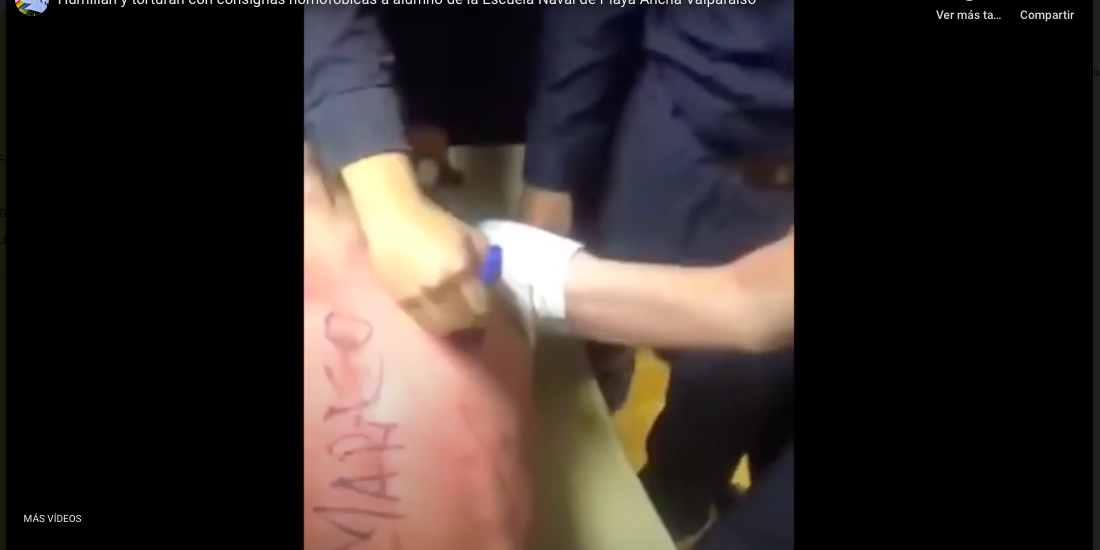
They have him bound hand and foot, crucified, while they yell at him, laugh at him, and beat him. The victim is blindfolded and can be seen writhing and moaning in pain. Then they write on his torso with a blue ink pen: “Maraco, fleto” (in Chile, these are derogatory terms used to refer to gay men). These images circulated on social media starting the night of October 27 and went viral in the country. According to the account that posted them , the video was recorded on August 4 of this year, during the anniversary of the Playa Ancha Naval Academy in Valparaíso.
The Chilean Navy issued a statement asserting that the video is not recent, but rather from 2018. They also stated that “the necessary internal investigations will be carried out in order to take the appropriate measures.” They added that the incident “is contrary to the values and principles that define” the institution.
Inquiry without date
Presentes contacted the Navy to find out about the progress of the investigation, but they only said that "there will be an inquiry" and that they cannot say "when it will be completed", through an email response sent from the Communications Directorate.
As of the time of this writing, we were unable to confirm whether the young man being tortured in those videos is LGBT+. However, given the clearly homophobic nature of the footage, we investigated the harm caused by such an act. In this regard, we consulted Dani Figueroa, a psychologist and psychotherapist with experience working with LGBTQ+ individuals and those with disabilities, and also an activist with Disidencias en Red (Dissidents Network ).
"The police institution endorses and encourages violence"
-Of what happens in that video, which lasts a few minutes but is very violent, what do you find most serious? What behaviors or patterns do you observe?
The normalization of torture practices, as well as the distortion that occurs in each individual as they embody the dehumanization inherent in the scene, with its screams and lack of control, strikes me as a maelstrom of privileged men who boast of their position to inflict pain, playing with submission and hierarchy . I am struck by the relationship between confession and submission as forms of expropriation (one of the men beating him asks him to name the best graduating class at that school). At the same time, the dissolution of guilt among the masses and its consequent impunity reveal how the police institution endorses and fosters violence, concealing patriarchal hatred of difference .
-What kind of psychological damage can be caused to an LGBT person by being subjected to such torture?
The consequences of discrimination, sexual violence, and torture can be numerous and vary widely in intensity and severity. They range from post-traumatic and acute stress syndromes, psychosomatic disorders, social isolation, sleep difficulties, suicide, substance abuse disorders, self-destructive behaviors, and psychotic episodes, among others. These consequences can also damage emotional and family relationships. In the case of torture, the consequences can lead to the need for psychiatric hospitalization or lengthy recovery processes.
It is important to consider that LGBTQIA+ people experience discriminatory and violent situations more frequently and directly . It could be argued that they are more prone to developing these conditions. Identity formation can be severely affected by the presence of a discriminatory environment, generating greater internalized phobia and constant minority stress, which can contribute to the emergence of depressive and anxious symptoms. Many of the expressions used in that video are not far removed from the reality of many schools and homes where homophobic discourse is part of everyday life .
Pain and coercion, anonymity and impunity
On social media, some people are saying it wasn't an attack or torture, but rather a "normal" practice in the army. But it's clearly a way of normalizing violence. What do you think?
-Indeed, it's normalizing violence, although I also think these are forms and codes that are repeated throughout history. It's very clear that they know how to use pain and coercion to impose ideas, taking advantage of the fragility of masculinity itself, which shields itself behind violence and privilege to act with complete anonymity and impunity , using confession as a means of expropriation to end the torture. This reminds me of Christianity and the Crusades, along with the mockery and ridicule of identities, especially women's. The victim's nervous laughter makes me think about the function of concealment: to soften the blow, provide cover, and avoid the inevitable patriarchal punishment, triggering fear of prejudice, stigma, and self-rejection. It also highlights the militarization and hierarchical discipline used to impose truth and respect. I think the scene isn't far removed from everyday practices in many homes and from our history, and that's precisely what's most worrying.
"Dissidence and diversity embody social stigma every day."
-Have you ever encountered similar cases firsthand?
-Not cases this serious. But dissidents and diverse groups embody and experience social stigma, discrimination, and silence every day .
–How can we guide victims who have experienced such a situation but are afraid to report it or seek psychological help?
Regarding victims of gender-based violence, sexual violence, and torture, there are nuances in the interventions. And there are reparations programs in place. However, police impunity and social stigma prevent these cases from becoming visible or resulting in effective convictions. I strongly agree with the notion that these matters are often considered "private" within each family, and therefore go unreported. In response, the LGBTQIA+ community itself seeks to provide spaces for support, healing, and the creation of collective memory as a way to resist and help heal the wounds inflicted by this system.
Regarding more specialized psychological approaches, these require arduous work in recognizing and questioning the victim's position, as well as a reinterpretation of traumatic experiences and their meaning. Psychotherapeutic work allows for exploring new ways of constructing oneself outside the concept of pathology, and this perspective makes therapeutic conversation more accessible to those who are more resistant. Furthermore, it is interesting to broaden this perspective to one that considers mental health as a tool for protection and healing from violence, particularly against the LGBTQIA+ community.
I believe that facilitating and creating spaces for supportive and empathetic listening is important. For those who have experienced similar situations, it's an alternative that allows them to become more aware of the wounds from these events and, consequently, begin to heal.
We are present
We are committed to journalism that delves into the territories and conducts thorough investigations, combined with new technologies and narrative formats. We want the protagonists, their stories, and their struggles to be present.
SUPPORT US

FOLLOW US
Related notes

We are present
This and other stories are not usually on the media agenda. Together we can bring them to light.