

I for Intersex: the affirmation of my body and identity
The doctors told my parents that I would have to have a blood test to determine my chromosomes so they could assign me a sex.


Share

I was born in the 1980s in a private hospital in Mexico City. At birth, the doctor announced I was a healthy baby girl, but moments later, to my parents' surprise, they reported that they weren't actually sure if I was a boy or a girl. I had genital differences, or "ambiguous genitalia.".
The doctors told my parents that I would need a blood test to determine my chromosomes so they could assign me a sex. The result was XX, I was assigned female, and after several tests, I was diagnosed with non-salt-wasting congenital adrenal hyperplasia (CAH).
In my case, I was born with a clitoris larger than what is considered "normal" for a woman and with a urogenital duct, that is, my urethra and vagina open into the same place.
To this day, I am grateful that the doctors at the time did not offer my parents the option of “feminizing” genital surgery. This is a medically unnecessary procedure commonly performed on infants and young girls who, like me, are born with genital differences or “ambiguous ” genitalia. During the surgery, the clitoris is cut to reduce its size, and a vaginal canal is created to allow for penetration. People who have undergone these procedures have denounced them as violations of bodily integrity and self-determination, and as Intersex Genital Mutilation, before human rights organizations around the world.
The doctor spoke of my body as a disease
From the time of my diagnosis, I had to undergo blood tests twice a year, and I was taken to an endocrinologist who performed a physical exam in which he touched my genitals and checked my development. These genital exams are performed on everyone with bodies similar to mine, and their frequency has been denounced worldwide as unnecessary. In my case, I had to endure them from infancy until I was about 12 years old, twice a year. These experiences were very difficult for me. It was very hard to be there, to undress in front of the doctor, and to have him touch my body and genitals while I had to answer strange questions like, "Do you feel anything?" or "Does it hurt if I do this?" What is a 5- or 6-year-old girl supposed to answer to those questions?
During those consultations, my mother was usually present, which gave me security, but it also caused me great conflict since her presence endorsed those examinations that made me so uncomfortable.
I always felt that something wasn't right; it frightened me and made me feel helpless and vulnerable. The doctor would talk about my body using words like: disease, hypertrophy, strange, unusual, correction, abnormality, virilization, all while touching me. At the time, I was too young to understand it all, but over time, the frequency of the examinations and the words he used hurt me. I became increasingly withdrawn, and a feeling of sadness settled in, a sense that something was "wrong" with me, though I wasn't sure exactly what it was.
Surgery "to be able to have sex"
When I was 8 years old, I was taken to another doctor at a public, specialized, or tertiary-level hospital in Mexico City. The visit was to assess the possibility of genital surgery. We went to that hospital, and all my mother told me was that they would examine me “like the other doctor did”—that is, perform a genital examination.
I was furious. I didn't want anyone else to see me. I told them I didn't want to go, but they forced me to go and forced me to have them examine me and touch my genitals—three doctors at the same time. It was quite a traumatic and frustrating experience. Finally, the doctors told my mom that I would need genital surgery so that I "could have sex," but that it would be best to have it done when I was older, and it had to be done "three months before I married my husband"—I was eight years old! What husband were they talking about?! Why did they think that sex only happens within marriage? I've never agreed with the idea that the only way to enjoy a body like mine is to conform to the heterosexual mold of marriage and vaginal penetration.
I discovered exactly what the reason was for those horrible genital examinations when in high school they put up two illustrations, one of male genitals and one of female genitals. Upon seeing them, I immediately noticed that my genitals did not resemble either of the illustrations: "I am deformed!" I thought in anguish. I was in a state of shock; no one had ever told me about this.
One day, while my mother was at work, I searched the entire house for any medical documents that might shed some light on what was happening to me, on why I was so different from other people. I finally found a folder full of medical documents, and in them I read for the first time "female pseudohermaphroditism" and "congenital adrenal hyperplasia." I wasn't entirely surprised to find those words; somehow they made sense, and I finally felt I was close to finding answers to the questions that had haunted me for most of my life.
The path to activism
I started researching the new term "intersex" and devoured everything I could find on the subject, and over time, I began to value my body and its characteristics more. I also found a video featuring a Mexican intersex girl with a similar condition to mine. I was able to contact her and chat with her online, and she helped me a lot in finding new meaning in my body, and therefore, in my life. Thanks to all this information, I gradually healed the negative feelings I had toward my body and its characteristics.
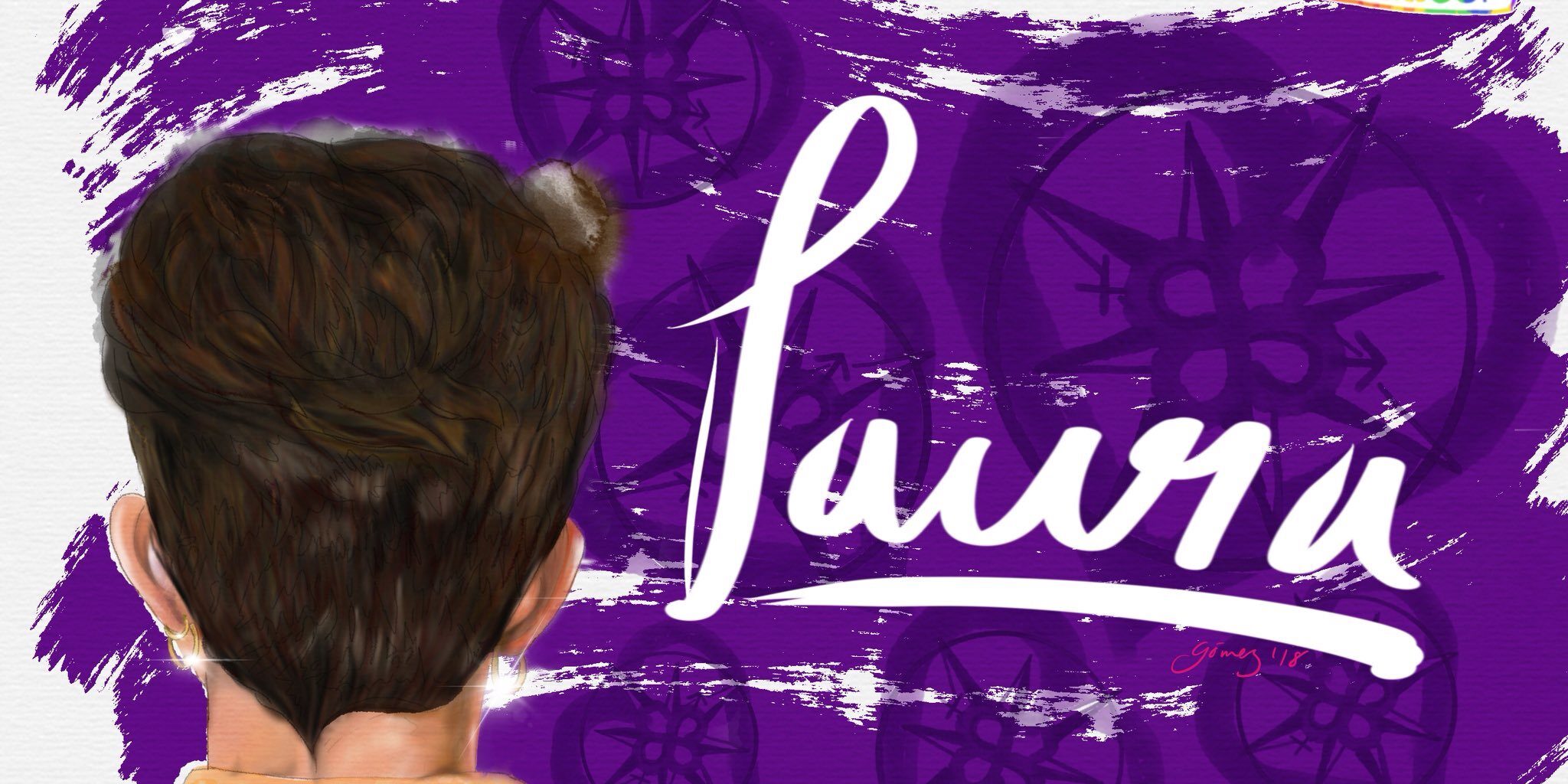
Over time, I founded a project to help other people who were born with bodies like mine, and finally, on October 27, 2013—the day after Intersex Awareness Day—the story of the Intersex Compass . It started as a Facebook page where I shared information that had helped me heal and some Spanish translations of important articles in English written by activists and intersex people.
Then it started to happen: people who identified with the experiences and information I shared began to reach out. I talked to them and offered them information and emotional support. I met many people like me, with equally difficult stories, who had lived through equally complex or even more difficult situations. I talked with them and supported them as best I could. Over time, I created a website where I shared the Spanish translations I did, videos, and my own personal story. I encouraged others to share their stories as well, and the project grew steadily with the support of many more people who joined along the way.
My life now has a purpose, and that is to help other intersex people and their families not feel as alone as I once did , and to stop the most basic human rights of intersex babies, children, and girls from being violated. So I created and maintained the Intersex Compass, which guided me to a more fulfilling life, so that it may also serve every person who feels lost and alone, so that they can find us, and thus find the strength to move forward and overcome adversity.
I know I can't change THE world, but I can make an effort to guide some people to change THEIR world , because change doesn't come from the outside in, but from the inside out. And I believe that the greatest well-being in life comes from what we, as individuals, contribute to the world, not from what we take from it. And that's what I try to do; I want to leave this world knowing that I did what I could to contribute my grain of sand. Possibly, if I hadn't lived through all of this, I would be leading a very different, much more ordinary life, but ordinary isn't always best.
*Mexican intersex activist. Founder of the Intersex Compass project. This is an adaptation of a text that earned her the first Raquel Berman Award for women's resilience in the face of adversity in 2019.
We are present
We are committed to journalism that delves into the territories and conducts thorough investigations, combined with new technologies and narrative formats. We want the protagonists, their stories, and their struggles to be present.
SUPPORT US

FOLLOW US
Related notes
We are present
This and other stories are not usually on the media agenda. Together we can bring them to light.