

Churches and sexual diversity: a relationship that “offers little hope”
Pope Francis says he supports civil unions for same-sex couples, but most Christian-oriented churches are far from open to LGBT+ people. An extensive survey shows this in Argentina.
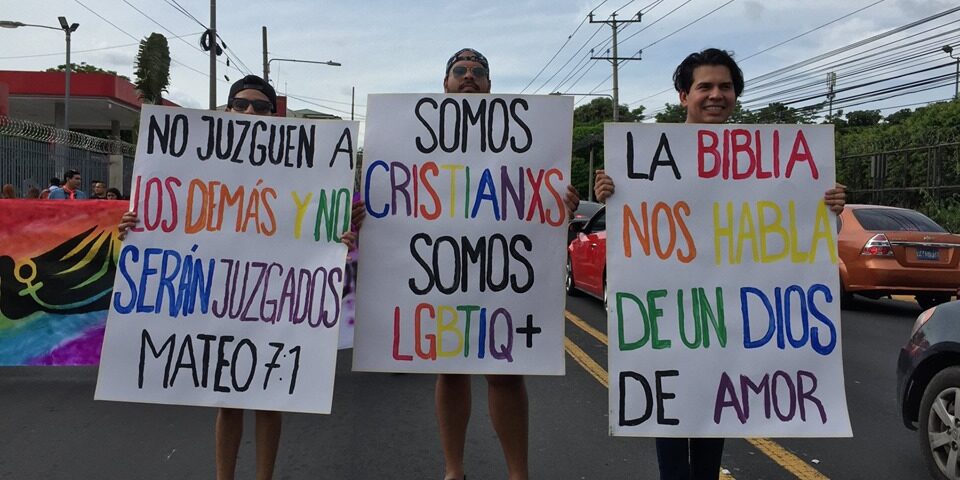

Share

By Alexis Oliva
Photo: Presentes Agency Archive
While a Catholic Pope has for the first time supported civil unions for same-sex couples , a questionnaire sent by the Argentine LGBT Federation to Christian churches in Argentina reveals a range of attitudes—from outright discrimination to a more de facto and marginal inclusion than an institutional one—towards diverse identities. Double standards, exclusion, and silence.
By Alexis Oliva
A Catholic archbishop considers homosexuality an “abomination now protected by law.” A doctor and pastor of the New Apostolic Church in Rosario rejects a plasma donor for indicating on the form that he has a gay partner. A Catholic priest is expelled for speaking out in favor of same-sex marriage. A crusade against Comprehensive Sexuality Education (CSE) is being launched by several Pentecostal churches with the slogan “Keep your hands off my children.”.
These are just a few of the countless acts and words that—in our country alone and in recent years—demonstrate the historical segregation exercised by the leadership of most churches against diverse sexual identities. This discrimination, increasingly visible and silent, generates discussions and, in many cases, conflicts between the rank and file and the hierarchy of religious institutions.
Currently, the debate is once again stirring within the Catholic Church, following the release of a statement by Pope Francis in favor of civil unions for same-sex couples , contained in the documentary "Francesco ," which premiered at the Rome Film Festival: "Homosexual people have the right to be in a family, they are children of God, they have the right to a family. Nobody should be thrown out of the family, or made to suffer because of it."
Based on a proposal from Protestants for Diversity (PpD) – an organization belonging to the Argentine LGBT Federation (FALGBT) – representatives from various churches and LGBTIQ+ activists agreed on a basic questionnaire during the 2019 National Diversity Meeting for the First Consultation with Christian Churches on Gender and Sexual Diversity in Argentina . The questions were directed to the authorities of the Argentine Roman Catholic Church (ICR), the Argentine Reformed Church (IRA), the Association of the Church of God (ALIDD), the United Evangelical Lutheran Church (IELU), the Waldensian Evangelical Church (IEV), and the Evangelical Church of the Río de la Plata (IERP).
The questionnaire, processed this year by the Secretariat of Religious Diversity of the FALGBT with the advice of the Multidisciplinary Studies Group on Religion and Public Impact (GEMRIP), included questions on the existence of ministries of sexual and gender diversity (1), ordination of LGBTIQ+ pastors or priests (2), marriage blessing for LGBTIQ+ people (3), use of inclusive language in the liturgy (4), renewal of baptism for transsexual people (5), inclusion of non-discrimination of LGBTIQ+ people in catechesis (6) and priestly ordination of women (7).
No. Sometimes. Soon. Maybe…
To question 1, the Catholic Church responded that initiatives for “working with homosexual people” include “reflection groups in various dioceses, and personal and group spiritual accompaniment.” Although these experiences “are not yet organized into a national structure,” authorities are confident that “such an organization will eventually be established.” Most evangelical churches answered the same question negatively, with the Evangelical Church clarifying that its approach is “holistic, not divided by ministries.”.
Regarding the ordination of LGBTQ+ people or women as priests or pastors (questions 2 and 7), the ICR indicated that it “only ordains heterosexual men”; in the IRA, “there are no ordained LGBTQ+ pastors, but the possibility is not excluded,” and women have been ordained “for many years”; ALIDD does not ordain LGBTQ+ pastors, but it does ordain women; the IELU “has ordained an openly gay pastor,” who “holds a position of high responsibility,” and women “since the early 1980s”; the IEV has ordained women since the 1960s, and regarding LGBTQ+ people, they reported: “The issue has not been debated. No applications have been submitted to date from LGBTQ+ people raising this issue.”.
Marriage and baptism, under tension
Regarding marriage (3), in Catholic circles it is only celebrated “between a man and a woman, according to the biblical text,” and they clarify: “We respect the freedom of individuals and the unions they establish between them, but (…) these unions do not constitute the Christian sacrament of marriage.” “There is no synodal decision on this matter, but our Church Order establishes the possibility of blessing couples whose union is recognized by law. (…) There are already communities where same-sex couples have received their marriage blessing,” was the response from the IRA, and from the ALIDD a laconic “we should.” The IELU responded that within the broader worldwide Lutheran Communion, the Argentine church is “one of the few churches in the Global South where several congregations—though not all—have celebrated and continue to celebrate marriage blessings for LGBTQ+ people without major tensions or risk of division.” The IEV has recognized LGBTQ+ marriage since 2010, by decision of its Synod.
Regarding the renewal of the sacrament of baptism for transgender people (5), the ICR understands that “when a baptized person changes their gender identity, they are not rebaptized because this fact does not change their status as a child of God.” For the IRA, it is “a complex issue” for which they have taken on “the challenge of working on it theologically,” and—speaking personally, the responding authority believes that “it could be.” As with marriage, ALIDD responded, “we should.” For the IELU, it is a topic under discussion because “Lutheran tradition has never rebaptized people,” considering that it would be “not recognizing the validity of the previous community” (however, they noted that a transgender person requested baptism and a “confirmation of baptism” was authorized). “This issue has not been debated. There have been no cases. The campaign for the Trans Law in Uruguay was supported,” responded the IEV.
From catechesis to inclusive language
“Yes, we are working hard to ensure that no person, especially LGBTQ+ people, is discriminated against because of their identity,” was the response of the Catholic Church of the Republic (CCR) when asked about the inclusion of non-discrimination against LGBTQ+ identities in catechesis (6). However, Catholicism does not incorporate inclusive language (4) because it understands that the masculine plural “includes all people.” In the Islamic Revolutionary Alliance (IRA), teaching “speaks of inclusion, respect for diversity, and acceptance of others,” and inclusive language is accepted “in general terms, although each community develops its own liturgy.”.
For its part, ALIDD includes non-discrimination in catechesis and, “very sparingly,” inclusive language. At IELU, there is “a strong tendency” toward “non-discrimination against LGBTIQ+ people”—even as part of Comprehensive Sexuality Education (CSE)—and toward “the use of inclusive language in liturgical celebrations.” “It’s a topic addressed in adolescent groups and in Bible schools with children from diverse family models,” because “it would be contradictory to the Gospel not to do so,” responded representatives from IEV. Similarly, “inclusive language is a policy of the Waldensian Synod for all churches.”.
A silence that expels
The Evangelical Church of the River Plate (IERP) reported that its policy is to respond only to inquiries from institutions with which it has a prior relationship, which is not the case “with either GEMRIP or the Argentine LGBT Federation.” They further stated: “The IERP is undergoing a comprehensive process toward greater inclusivity, but it is a complex and challenging process that is in no way reflected in the questionnaire as it is currently worded.”.
On the other hand, there was no response to the inquiry from the Christian Alliance of Evangelical Churches of the Argentine Republic (ACIERA) – which brings together the numerous Pentecostal temples throughout the country –, the Orthodox churches, the Methodist Church and the Argentine Evangelical Lutheran Church (IELA).
In one of the reflections accompanying the report, Nicolás Panotto, theologian, PhD in Social Sciences and director of GEMRIP, interprets: “The silence of many churches on these sensitive points shows the hardness, rejection and inability that exists, even, to address them, which leads us to think that the discourses and practices towards the LGBTIQ community within a certain evangelical spectrum continue to be discriminatory, exclusionary and resistant.”
“Don’t they consider us their neighbors when we address them in the form of a question?” asks Flavio Rapisardi, PhD in Communication, university professor, and member of Protestants for Diversity. He adds: “What good is ghetto solidarity? Doesn’t the fact that there are openly gay and lesbian pastors in churches, but that their institutions don’t take a stand in a dialogue initiated by organizations, reveal that diversity is merely decorative for those churches?”.
“Churches are part of the growth of the right wing”
“At best, they’re offering to leave traditional churches and create LGBT churches. Except for the Waldensian Church, all the others end up offering either a pen outside or silence inside. We don’t want to form other churches; we want to be included. Christ said that there should be no exceptions between people, and they’re doing it. That’s a sin,” Rapisardi explains to Presentes .
-Based on the results of the consultation and the concrete experience, where do the hopes for openness of the churches towards diverse identities lie?
We are living through a complex period that offers little hope. Churches are not immune to the conservative climate that has gripped Argentina and the region. The growth of evangelicalism is fueled by the segregation and denigration of others; Protestant churches are withering away due to their own conservatism and fear losing their followers and tithes; and the Catholic Church has a hierarchy that demonizes diversity. But even the progressive wing of liberation theology continues with its same old narrative: the oppressed subject is male, white, and poor, excluding poor women and trans people. Churches are complicit in this entire rise of the right wing in Latin America.
“They are trying to simulate a benevolent discourse”
In July 2010, the Argentine National Congress and society debated the reform of the Civil Code that legalized same-sex marriage. In that context, Father Nicolás Alessio, a priest from Córdoba, supported the initiative, going against the grain of a Catholic hierarchy that encouraged the "We Want a Dad and a Mom" marches. For this public commitment, he was subjected to a canonical trial and expelled in February 2013 by Pope Benedict XVI. Ten years later, Alessio continues his theological studies, popular catechesis, and social work from outside the Church.
Based on the responses to the consultation and other recent pronouncements, the former priest observes that “the Catholic Church tries by all means to disguise this 'heavy burden' on the bodies and lives of homosexuals without insisting that they awaken 'the wrath of God.' That is why it addresses them with a friendly, benevolent, affectionate discourse… They are treated as people who must be 'understood,' accompanied, and helped.”.
“This apparent new perspective is merely a confirmation of the initial position that warns homosexuality is a grave disorder,” Alessio points out. “They are ‘sick people at risk of mortal sin’ and ‘since we are understanding, we will accompany them.’ So bound to its own traditions, the Magisterium is a heavy burden for the homosexual community. A heavy burden without justification.”.
“To proclaim the grace of God without any discrimination”
In another reflection on the consultation, IELU pastor and PhD in theology Mercedes García Bachmann considers that “in traditional ecclesial discourses 'the Bible says so' is used not to proclaim the love of Christ, but to put barriers to women and the LGBTIQ+ community on various issues, such as marriage and ordination.”.
However, he notes: “Even so, churches that, after a thorough study of the Bible and their own traditions, conclude that it is God’s will to offer his blessing to any person, regardless of their sexual or gender identity, and that the celebration of marriage is one of the ways to invoke divine blessing, know that it is part of their prophetic calling to proclaim God’s grace without any discrimination, even if breakups occur.”.
We are present
We are committed to journalism that delves into the territories and conducts thorough investigations, combined with new technologies and narrative formats. We want the protagonists, their stories, and their struggles to be present.
SUPPORT US

FOLLOW US
Related notes



We are present
This and other stories are not usually on the media agenda. Together we can bring them to light.