

Conservative groups in Chile use television to spread anti-LGBT hate messages
Taking advantage of the television airtime provided by the State as part of the campaign for the plebiscite for a new Constitution, right-wing political parties and religious groups are engaging in anti-LGBT propaganda.

Share

By Airam Fernández, from Santiago, Chile
In late September, the televised electoral campaigns for the "Approve" and "Reject" options began airing in Chile for the historic constitutional plebiscite to be held on October 25. Some sectors of the "Reject" camp, linked to evangelical churches and the Independent Democratic Union (UDI)—a right-wing political party—are using this airtime to spread hate messages against sexual diversity, constructed from religious rhetoric, community symbols, and even testimonials from LGBTQ+ individuals.
According to the rules of the Chilean political propaganda system, this broadcast slot—which for the first time includes civil society—must air twice a day. Each slot lasts 15 minutes, with 7 minutes and 30 seconds divided equally between the parties and organizations of both sides. The fact that this slot is broadcast nationwide on free-to-air television channels belonging to the National Television Association is a source of concern for the LGBTI community, due to some of the content they are exposed for, particularly regarding the possibility of drafting a new Constitution.
Presentes analyzed them from the perspective of activists and experts in diversity, communication, and law. They also consulted the Pastoral Care for Sexual Diversity (PADIS), a community of lesbian, gay, and bisexual men and women who, along with their families, are linked to the Christian Life Community (CLC), an international lay association inspired by the spiritual life model of Ignatius of Loyola.
A flag of diversity and a burning church
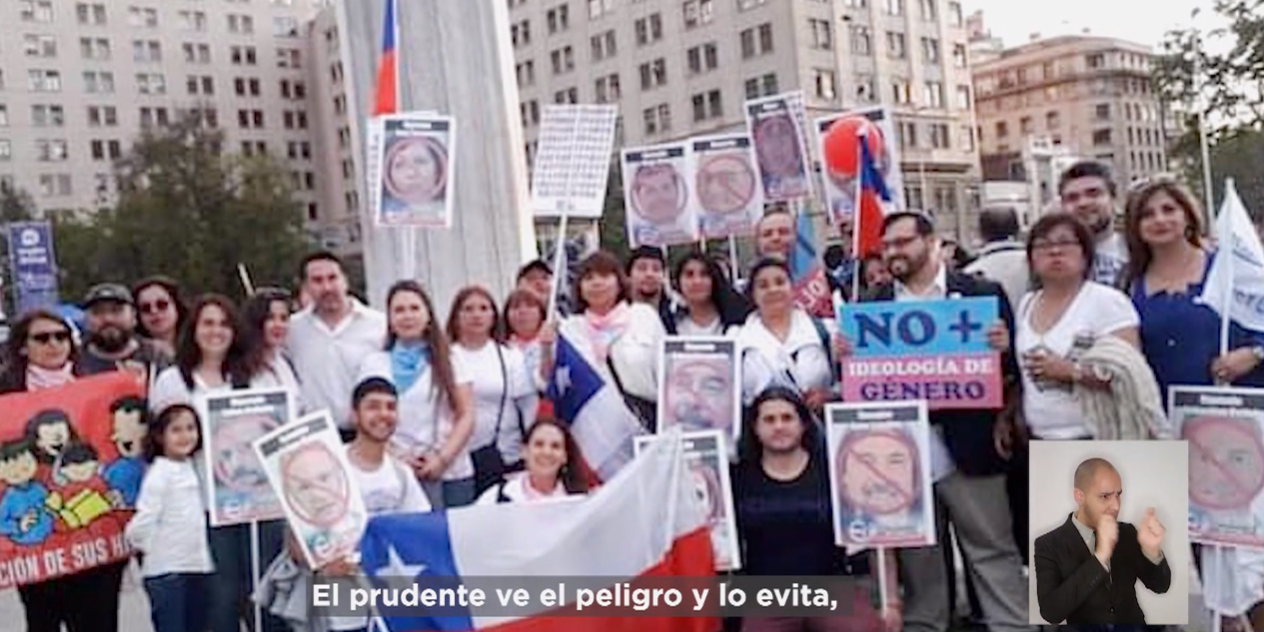
Through the El Samaritano Foundation, an evangelical group campaigning for the "Reject" option in the upcoming referendum, images of pro-abortion marches, the rainbow flag, and even a church engulfed in flames are used. These are interspersed with suspenseful background music and a voiceover that narrates: "The evangelical church has always been there to help those most in need, but today it is in danger, and we are going to defend it. The prudent see the danger and avoid it; the inexperienced press on and suffer the consequences."
There is a clear intention in the way that message is constructed, says Erika Montecinos, journalist and director of the Lesbian Group Breaking the Silence (RS): “They want to link diversity with destruction.”
Erich Mellado, a journalist and member of the organization Padis, sees it as part of the rise of extreme ideological populism that has emerged in several countries and promotes an agenda against sexual diversity. “Many of these political programs have been effective in constructing and spreading the concept of 'gender ideology,' which has been embraced by the Catholic and Christian world, especially among the more conservative elements. Thus, partisan politics has become intertwined with a certain religious fundamentalism that counts the demands of the LGBT+ community among its enemies,” he says.

For Constanza Valdés, a trans lawyer, legislative advisor, and co-director of the Chilean Association of Feminist Lawyers (Abofem), the actions of these religious groups are not only “lamentable and shameful,” but also, in her view, “imitate the most conservative groups in Jair Bolsonaro’s Brazil.” She adds , “They are not only trying to spread a campaign of terror, fueled by fear, prejudice, and unfounded homophobia, but it is also unacceptable. Since 1925, the Chilean state has been separate from the Church, and therefore, politics and state administration cannot be mixed with religion.”
Valdés says these are also very dangerous speeches that can fuel the growing climate of violence and anti-rights in the country. “They can incite people to act against us simply because they are promoted on national television and throughout Chile,” she warns.
"Voting 'approve' is voting for Satan."
Voting "Approve" is voting for Satan. That's the message implied by a group calling itself "Evangelicals for Rejection," which used its allotted airtime to spread a message that, at least for Valdés, is laughable. Kevin Valenzuela is the spokesperson in this case: "The Bible says that Satan came precisely to kill, steal, and destroy. This shows us who is behind this entire process of refounding Chile, and no child of God can approve of the fruitless works of darkness."
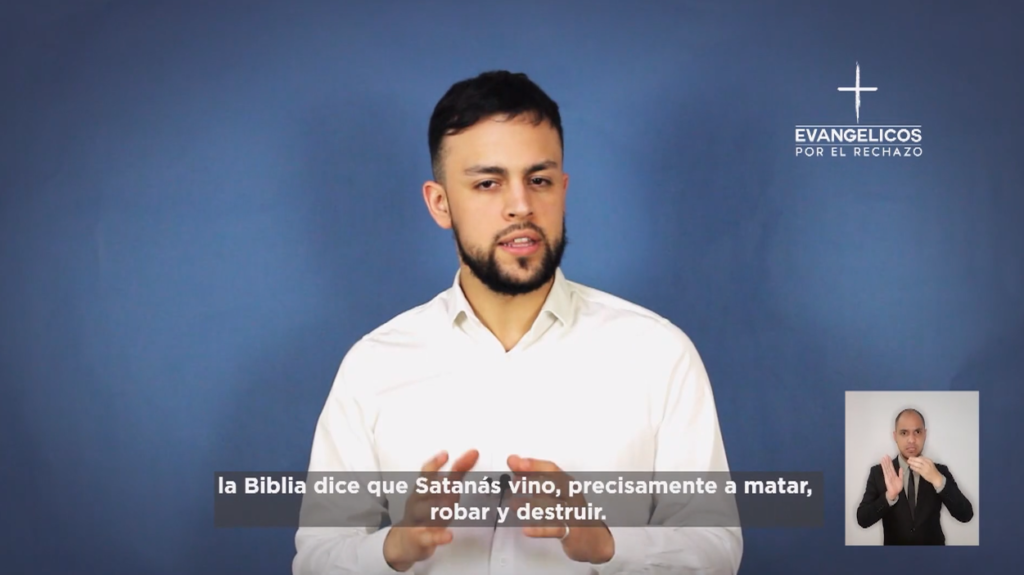
Valenzuela is a staunch defender of anti-rights movements like "Don't Mess With My Children." Both his appearance and the inclusion of the rainbow flag in this evangelical group's ad aim to "remind the more conservative public about the supposed dangers of opening the door to the rights of sexual minorities," Mellado observes.
He adds that, as a strategy, this group resorts to fear to point out, for example, “alleged links between sexual diversity and pedophilia, the lack of a clear image of father and mother roles for sons and daughters, and so many other disasters that voting for 'Approve' would entail.” He believes they do so based on a “bibliocentric” view: “Perhaps this is one of the differences that exists with the Catholic world, where there is a broader debate to understand the Bible.”
Mellado also emphasizes that this is happening within a context that has been developing for several years. Proof of this is the existence of an evangelical caucus in the Chilean Parliament, which emerged to "fight for 'Christian values'" but simultaneously opposes "any legislation that might contradict them," such as advances in the recognition of rights for sexual diversity.
“They are putting all our evidence and testimonies at risk.”
The appearance of a YouTuber known as “Facho Cola” also angered the community. In the “Reject” campaign ad, he claims he has never had a problem saying he is gay, but that the same cannot be said when he says he is gay and right-wing. Valdés questions the first assertion, especially in a country like Chile, which in 2019 registered a homophobic and transphobic attack every six days, according to data from the Movement for Homosexual Integration and Liberation (Movilh). “It’s a discourse that jeopardizes all our evidence, our testimonies,” he says.

For Montecinos, the intention behind that message is, first, to show that the right wing supports the community or has dissidents in its ranks. And he believes that, at the same time, it's an attempt to downplay the movement: “Everyone is free to be politically active wherever they want, but this is clearly an attempt to relativize everything, to say that it's all the same, as long as they 'support us,' as they suggest there.”
Mellado questions the use of a label like “facho cola” to describe a non-heterosexual person, especially given the negative connotations of that adjective. “It seems some people feel the need to portray diversity with these labels, as a caricature. Another questionable aspect is that he doesn't address the rights of LGBTQ+ people or the changes that voting for that option on the ballot could bring to the community,” he argues.
“They want to suppress and attack everything that is different from heteronormativity.”
In the segment, a social work student from the University of Chile recounts an episode of violence she experienced last year. She says that for political reasons, a group of hooded individuals, “about 15 people,” attacked her. And just as she says this, she is cut off from the frame, her voice fades to voice-over, and an image appears on screen that seems to be captured by a security camera, showing a group of people dressed in black, very close to a mural depicting emblematic figures of diversity in Chile: Pedro Lemebel, Hija de Perra, Gabriela Mistral, Mara Rita, and Nicole Saavedra, who was murdered in 2016.
Montecinos is concerned about this nod to diversity through the construction of such a message: “Clearly, there is an intention to erase and attack everything that differs from heteronormativity. They want to imply that everything related to diversity, to dissent, even to people who have suffered violence, represents a society in danger. It's a very low blow, because Nicole's face also appears in that mural, and surely those who created that campaign have no idea what she suffered simply for being a lesbian and a trans woman.”
Valdés explains that in this scenario there are no specific legal tools. There are not even special actions to take to punish hate speech, beyond the legal recourse of protection, such as the one Fundación Iguales filed with the Santiago Court of Appeals against the UDI party, given the clear discriminatory references.
The excuse of freedom of expression
But what both consider especially serious in all of this is that those who promote these discourses excuse themselves with freedom of expression. For Montecinos, these are nothing more than hate speeches that must be denounced publicly, through the media and social networks, given the lack of other tools. “If these are messages that threaten the freedoms of other people, or that are based on beliefs or ignorance regarding the existence of other people, they cannot be validated in a State that claims to protect all people,” she says, also criticizing the role of the Chilean Electoral Service (Servel), an institution that, in theory, has the oversight function in matters of electoral campaigns.
For Valdés, this is precisely why the advancement of a project like Comprehensive Sex Education, rejected last week in parliamentary debate, was so important. If approved, it would be a major contribution to an education that would allow for “combating hatred and ignorance” through information, discussion, and freedom regarding the right to experience sexuality free from prejudice.
We are present
We are committed to journalism that delves into the territories and conducts thorough investigations, combined with new technologies and narrative formats. We want the protagonists, their stories, and their struggles to be present.
SUPPORT US

FOLLOW US
Related notes
We are present
This and other stories are not usually on the media agenda. Together we can bring them to light.