

“Standing”: the Argentine publishing house that championed queer desire
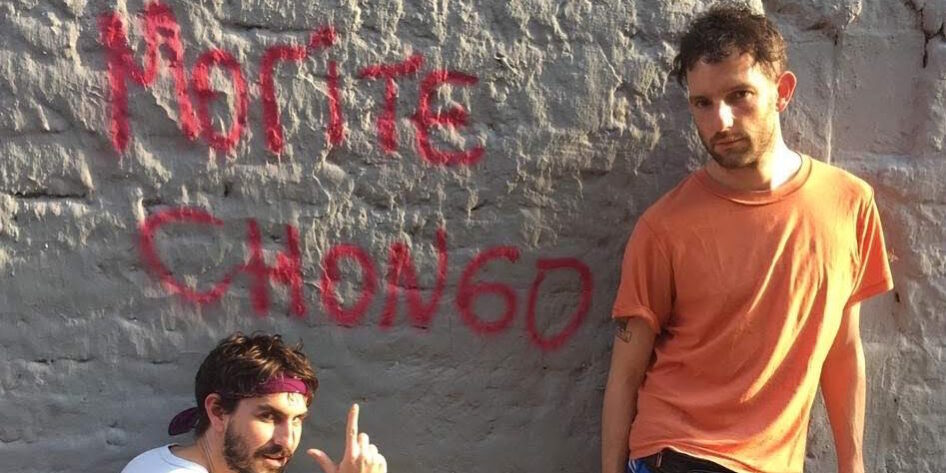
De Parado emerges as a novel publishing proposal in both an aesthetic and political sense. It is directed by the poet Mariano Blatt and Francisco Visconti.

Share

By Francisco Ocampo
Photo: Nacho Cañadell.
In the long history of Argentine literary publishing, the last twenty years have seen a healthy resurgence of the industry. Ventures like Iván Rosado, Belleza y Felicidad, Eloísa Cartonera, and Blatt y Ríos (to name just a few) have placed the independent publisher at the heart of Argentine literature. Self-managed spaces such as FLIA and the La Sensación book fair have fostered connections and bonds of friendship and camaraderie among publishers, authors, and the public.
However, the art of publishing books outside the patriarchal heteronormativity as an editorial criterion is a recent tradition. De Parado emerges as a novel publishing proposal in both an aesthetic and political sense.
Originally conceived eight years ago as a gay erotic publisher, today it expands its scope and deepens its search into an expanded palette.
From works like Gael Policano Rossi's *Gualicho* novella of hardcore porn) or Pablo Pérez's * Positivo (a book of biographical chronicles about HIV); to Diosas de estampita* (a book that blends pornography with science fiction) and Las tres carabelas Eros itself implies , as Roland Barthes pointed out.
We spoke with their editors Mariano Blatt and Francisco Visconti about the emergence of their joint work, the catalog and the new spectrum of possibilities opened up for their catalog in the context of the pandemic.
– How did De Parado come about?
– De Parado was founded in 2012 as an eBook publisher of gay erotic literature. Then, in 2015, we decided to revitalize the publishing house, bringing Fram on board as co-editor, publishing in print, and broadening our catalog to include texts that aren't necessarily erotic, but are still gay!
The publisher's first strategy was to have a digital catalog until the release of Gael's "Gualicho".
-What did the search for the paper format mean?
– We noticed that people weren't really getting into digital books, that they preferred paper and were missing out on a large part of our catalog. Gualicho came to us , we hadn't yet switched to print. It was a very well-crafted novel, a good story, in a genre that wasn't available in bookstores: there weren't any publishers that exclusively published queer content. It was entering new territory, taking the plunge. The cover image was of a naked guy on all fours—how were booksellers going to react? Luckily, bookstores responded very well, and we sold out the first print run.
–The catalog includes very different proposals. Do you feel there is a common thread in the treatment of the gay man's sexual subjectivity, which remains outside the literary genre, outside the authors?
– Initially, we wanted to focus on gay porn: we were looking for texts with explicit sex between people of the same gender. But as the publishing house grew, we thought it best to broaden our scope. So, what's the new criterion? A minimum number of sex scenes? Or that the main characters be gay? Where does queerness come in, in the story or in the characters? What does it mean to be queer? Do you have to be gay to be an author at De Parado? These were some of the questions we asked ourselves, and we still ask ourselves. Then we relaxed a bit, broadened our perspective. The texts have to have a nod to our community. We're two gay editors sharing a publishing house. What comes out of that is what's interesting, without so many labels.
What is the publishing process like at the publishing house? What criteria do they use to build their catalog, or how do they find out when new material/authors are selected?
"Well, that's an easy question. We both have to like it; it has to be a book we'd love to find in a bookstore, browsing the shelves. Imagine ourselves as teenagers, confused, wondering which book, out of all books, would have winked at us? Well, that one."
"We love it when our readers step outside the LGBTQ+ circuit."
–Do you think the circulation of the catalog (especially of new authors) transcends the LGBTQ+ public circuit? Is it possible, as a social and political intervention, to "queerize" the taste of the mass public, generating different, less heteronormative reading habits?
Yes, we love it when our readers venture beyond the LGBTQ+ sphere. It's a small victory. Of course, we'd love a future where gay literature no longer exists, where everything is so integrated that there are no closets left. But discrimination, segregation, and even murder based on sexual orientation still persist in Argentina. There's still a long way to go.
-What did it mean for the publishing house to publish a lost classic like Las tres carabelas ? How did the possibility of publishing it arise?
– A dream. Blas Matamoro published *Las tres carabelas* in the eighties, when he left the country. When we read it, we said, "That's perfect for De Parado." It's a coming-of-age novel (a subgenre we love) that touches on very contemporary themes, which is what attracted us most. The character's homosexuality was natural; he was in love with his best friend. On top of that, there's the historical backdrop of 20th-century Argentina, with the rise of Peronism, the military dictatorship, and so on. It was a masterpiece, so why was it so little known? The idea of reissuing lost books was always present in the publisher's future catalog. We emailed Blas, and he replied very enthusiastically. He barely remembered the novella, but he said that if we thought it would work, we should go for it. He was visiting for a tribute, so we rushed to have the book ready. We got together for dinner; he was happy about the reissue. He told us about the FLH, we talked about Proust and sealed a beautiful friendship with future books together to come.
The editor and the poet
In Mariano Blatt's case, not only do two distinct roles coexist—that of author (one of the most prominent figures in contemporary Argentine poetry) and editor—but he also juggles the dual role of editor. Besides being one of the founders of De Parado, he co-directs Blatt y Ríos, a publishing house that has been responsible for both rediscovering forgotten authors and works (such as the excellent edition of Bernardo Kordon's short stories, * Un poderoso camión de guerra* ), and publishing established contemporary authors (César Aira, Pablo Katchadjian, and Marina Yuszczuk, among others) . These roles, he explains, “coexist just as all the people I am, all that I do, coexist within me. No more, no less . And in publishing, it's like having two jobs. I leave one and go into the other. And sometimes when I'm in one, I do things related to the other, and when I'm in the other, I do things related to one. And sometimes I'm in both at the same time.”
– How do you see the development of sexuality and eroticism within the context of the pandemic and quarantine? How do you feel it changes the way you connect with others?
The lockdown was a push to start questioning our ways of relating sexually, with our own bodies and with those of others. Fortunately, there's no other option but experimentation. We wait.
–And regarding the book market and, specifically, the publisher's projects, how has the pandemic impacted things? Do you have any immediate publishing plans? Is it possible to envision a future for book production in this uncertain landscape?
We missed out on the Book Fair, and we had planned a couple of titles for those dates; now we'll have to stretch things out. Luckily, the book industry never stopped; bookstores opened with delivery. With so much free time, we found new readers thanks to booksellers who adapted to social media. All of this year's publishing plans changed. Life always changes.
–What universal classic do you feel could be included in De Parado's catalog? Would you like to add foreign authors to the catalog?
– Yes, we have many dream books that we'd love to republish. But a publisher never talks about what they want to publish until they actually publish it.
We are present
We are committed to journalism that delves into the territories and conducts thorough investigations, combined with new technologies and narrative formats. We want the protagonists, their stories, and their struggles to be present.
SUPPORT US

FOLLOW US
Related notes

We are present
This and other stories are not usually on the media agenda. Together we can bring them to light.