

The disappearance of two trans women in Jalisco has been reported to the UN.
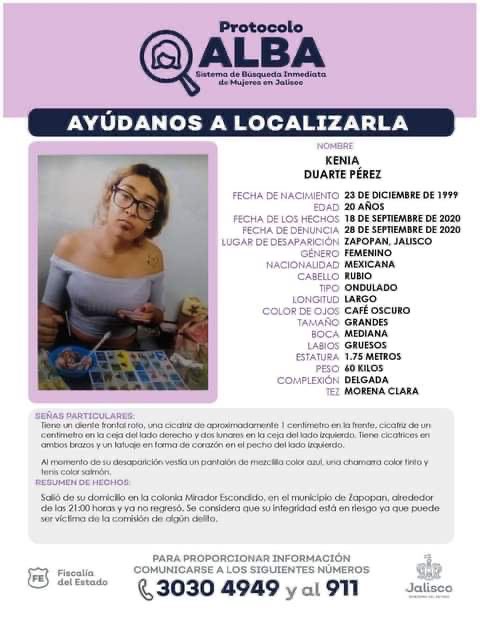
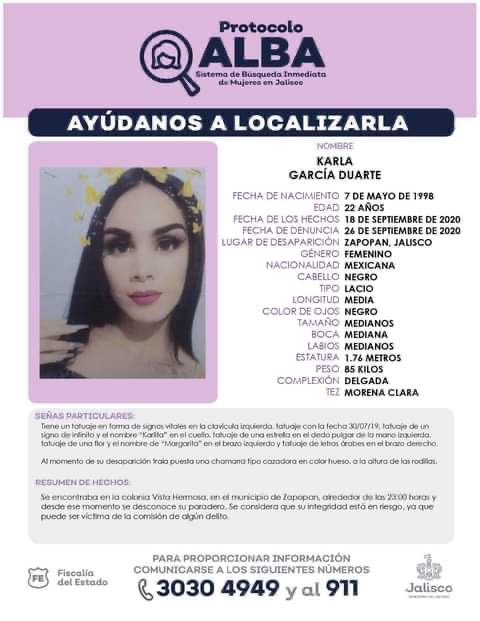
Karla García Duarte (22) and Kenia Duarte Pérez (20) are two trans women who have not been located since September 18.


Share

By Georgina González
Karla García Duarte (22) and Kenia Duarte Pérez (20) are two transgender women who have been missing since September 18. For the first time, organizations have requested the United Nations Committee against Enforced Disappearances (CED Committee) to urge the Mexican government to take urgent action to locate them.
Karla and Kenia are friends, and on September 18th they were heading to a party in the Mesa Colorada Oriente neighborhood in the municipality of Zapopan. That night they were last seen together.
“I want answers because I think the wait has gone on for too long. Whoever sees Kenia, please let me know. Her family is anxiously awaiting her return. We want them back alive, that’s how we want them,” says Kenia’s mother, Ana Lucía Duarte, in a video produced by the independent media outlet Zona Docs.
Need for a gender perspective
Due to their disappearances, the Alba Protocol was activated on October 1st. This is a mechanism involving all three levels of government for the search and location of missing girls and women in Mexico. This unprecedented action was achieved after public pressure from the organization Unión Diversa de Jalisco .
On October 2, the State Human Rights Commission (CEDHJ) initiated investigation file 623/2020/IV and issued precautionary measures to state authorities to ensure that investigations are conducted with a gender perspective. Furthermore, they requested adherence to the protocol for those administering justice in cases involving the sexual orientation and gender identity of victims, issued by the Supreme Court of Justice of the Nation.
“That the agent of the Public Ministry develop an inclusive perspective in his actions and value that the victims belong to a historically discriminated group and focus on possible lines of investigation tending to the execution of a hate crime against the LGBTTTIQ+ population,” stated .
Special prosecutor for missing persons Blanca Trujillo commented : “We have taken all immediate actions to locate them and to investigate the circumstances of their disappearance […] We are applying the protocols, including that of the Supreme Court of Justice of the Nation.”
Complaint to the UN
For the first time in history, a case was presented to the United Nations Committee against Enforced Disappearances (CED Committee) requesting urgent action from the Mexican State in the search and location of two trans women.
The organizations IDHEAS , Litigio Estratégico en Derechos Humanos AC and Unión Diversa de Jalisco (UDJ) requested the United Nations Committee against Enforced Disappearances (CED Committee) to issue “Urgent Actions for the Mexican State to take, urgently, all necessary measures to search for and locate two trans women who disappeared in the state of Jalisco.”
The organizations decided to go to the United Nations to denounce the cases and demand the prompt location of Karla and Kenia, "due to the time that has passed since the disappearance of the two young women and the lack of results in the processes of searching for the victims and investigating the crime," they stated in a press release .
They also warn the CED Committee about the widespread context of disappearances in the state of Jalisco, in which a total of 11,263 cases of missing persons are officially registered, making it the second federal entity in the country with the highest number of cases.
They also warned about the crisis of violence against the LGBT+ population in Mexico. “Particularly against trans women, who live in conditions of extreme stigmatization, precariousness, and marginalization as a consequence of gender violence and inequalities in economic and cultural structures.”
35 LGBT people missing in Mexico
In Mexico, 35 LGBT+ people have disappeared, 29 of whom are trans women, according to the registry of the Center for Support of Trans Identities ( CAIT ). The states with the highest number of disappearances are Sinaloa, Tamaulipas, Jalisco, and Mexico City.
These disappearances occur in states where organized violence is rife with squabbles over territory and where the army maintains a strong presence in the streets. Since 2006, when former President Felipe Calderón implemented a security strategy against drug trafficking, more than 73,000 people have disappeared in Mexico.
“There are many disappearance cases that go unseen. LGBT people also matter, and these search mechanisms should be created, exchanging missing persons reports with organizations that are not specifically LGBT-focused. What ultimately unites us is the call for the location of the disappeared,” Rocío Suárez, coordinator of CAIT, told Presentes.
We are present
We are committed to journalism that delves into the territories and conducts thorough investigations, combined with new technologies and narrative formats. We want the protagonists, their stories, and their struggles to be present.
SUPPORT US

FOLLOW US
Related notes



We are present
This and other stories are not usually on the media agenda. Together we can bring them to light.