

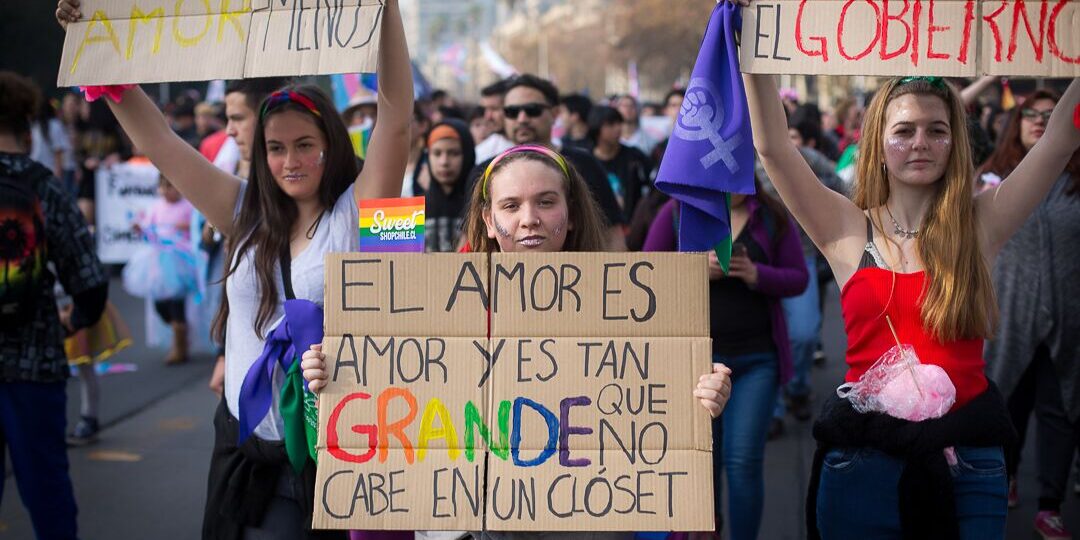
You come out of the closet when you can
"If there is a closet, it's because there is an environment that puts us in danger. But communication tends to speak only to the person in the closet, freeing society, a decisive factor in this construction, from responsibility."

Share

Photo: Josean Rivera /Presentes Archive
Every time we talk about closets, it all seems to boil down to a phrase on social media with its imperative of happiness: “Come out of the closet. Be yourself.” Often, the discussion is framed in a binary way that seems to recognize only two mutually exclusive spaces: “out of the closet” and “in the closet.” And in this outside/inside dichotomy, the idea that we are people in transition is lost. And that closets can be many, and have a different meaning, a need, and a different significance for each of us.
The loop of my coming out
My coming out became a continuous loop. I'm like a matryoshka doll, constantly popping out of one label and into another. First, I came out as gay. Then, this very Anglo-Saxon and decorative definition stopped resonating with me, so I came out as queer/faggot. After that, I had to face my HIV-positive diagnosis and decide how and why to make it public. Then came coming out as demisexual, understanding that not everyone experiences sexual attraction in the same way. And I'm sure there will be other coming outs.
That night, drinking the cheapest beers I could find at gas stations, when I sat my straight friends down to tell them I was gay, none of them were surprised. My declaration didn't change anything about how they felt about me either. I set the whole scene up with a "Choose Your Own Adventure" book that included options for drama, tears, and epic moments. But it wasn't necessary; they already saw it coming. They were just waiting for the right moment to share the news.
I don't pretend to be the "Marie Kondo" of our closets, nor do I intend to offer the ten infallible tips of the organization guru for creating our perfect outings on time. I still have many unfolded doubts, feelings still unresolved, and a huge number of ideas that I no longer use and must learn to let go of. I do believe, however, that sharing our insecurities, doubts, and processes collectively builds answers (and more questions).
If a closet exists, it's because there's an environment that puts us in danger.
I have no doubt: outing someone is violent. There's no "joke," no phrase adorned with unicorns, that justifies this. Disrespecting, forcing, or exposing someone—in any way—is violence.
Is it so hard to understand that for some people, the door to our closet can be opened little by little ? If, upon opening this door, we find ourselves confronted with violent families, states with anti-LGBT+ legislation, or homophobic work environments, our strategy will have to be more cautious and thoughtful. We need to see how things are out there. Close it, crack it open, open it a little more.
If a closet exists, it's because there's an environment that puts us at risk . Being inside means protecting ourselves from a threat. Communication tends to focus only on the person in the closet, absolving the entire society that is a decisive factor in this situation . Let's work so that, in addition to everyone being able to come out of the closet, the outside world stops being hostile.
imperative phrase , and not everyone can or should comply with it. I think it's essential to create supportive spaces so that, if someone comes out of the closet, they also find phrases like “we're here for you,” “there are laws that protect you,” “you took the right amount of time,” and “you're in good hands.”
Continuing to think that there are only two categories, closeted and out, is, among other things, violent. Nobody discovers their identity, the label that best defines them, their lived experience, overnight. These are constant processes. Imagine trying to figure out who you are and having someone next to you overstimulating you, yelling, “Come on! Accept it! This is who you are! Oh, don’t be a wimp!” while trying to propel you forward with glitter. It doesn’t help.
Just as some closets are very obvious, others go completely unnoticed. Seeing people out of the closet can serve as a clue, a point of reference for us to connect with and understand each other. In turn, our coming out can help others come out. And every coming out comes in its own time.
Because we are becomings. Or perhaps we don't even "are," at this moment we "are becoming." And in an ideal world, it would be best if these processes were as collective, nurturing, loving, and shared as possible. Understanding them in this way should also help to finally eliminate those imposed closets, those closets of survival because the outside world is hostile. And so that what remains are not closets but cocoons that embrace us, weave us, nurture us, and lovingly shelter us until our next mutation, ready to move on to the next one, the very next one.
We are present
We are committed to journalism that delves into the territories and conducts thorough investigations, combined with new technologies and narrative formats. We want the protagonists, their stories, and their struggles to be present.
SUPPORT US

FOLLOW US
Related notes



We are present
This and other stories are not usually on the media agenda. Together we can bring them to light.