

The Court of Cassation denies the transphobic murder of activist Diana Sacayán
The National Criminal and Correctional Court of Cassation of the Federal Capital upheld the conviction of Diana Sacayán's murderer but denied the aggravating circumstance of hatred based on gender identity.

Share

By María Eugenia Ludueña
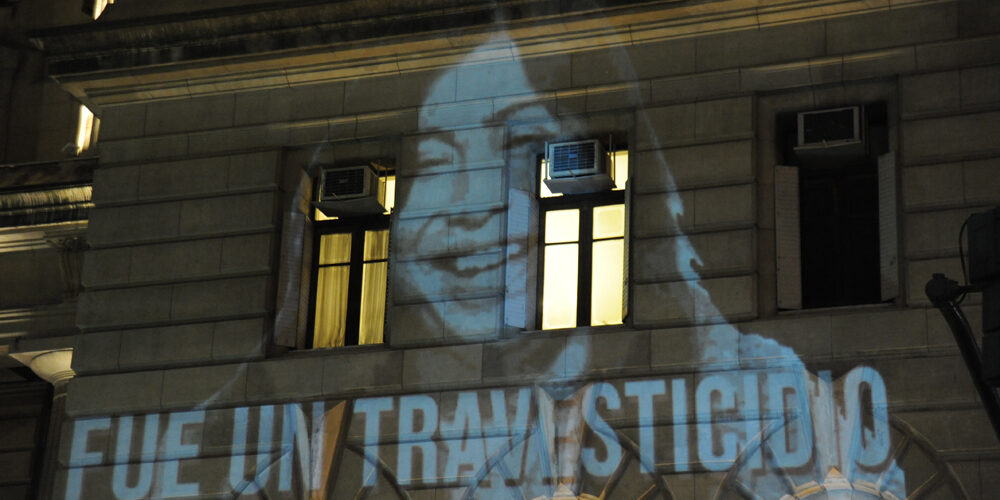
Photo: Ariel Gutraich/Presentes Archive
For the patriarchal justice system, the murder of Diana Sacayán, the human rights defender and trans activist whose assassination will mark its fifth anniversary in a few days, was not a transphobic hate crime. This was the decision of Chamber 1 of the National Court of Cassation in Criminal and Correctional Matters of the Federal Capital in response to the appeal filed by the defense of Gabriel David Marino.
The Oral Criminal Court No. 4 of the City of Buenos Aires (made up of judges Adolfo Calvete, Julio Báez and Ivana Bloch) sentenced Marino to life imprisonment as "co-author of the crime of homicide qualified by hatred of gender identity and by having gender violence intervened" in June 2018.
But yesterday it was revealed that Chamber 1 of the National Criminal and Correctional Court of Cassation responded to the appeal filed by Marino's defense, upholding the life sentence but rejecting the hate crime aggravating circumstance. In their reasoning, the three members of the Chamber argued that there was no evidence to prove that it was a hate crime.
"If they did this to Diana, what hope is there for us?"
That was one of the crucial features that made the sentence for the transvesticide of Diana Sacayán historic . It was the first time that the Justice system, after having heard the powerful testimonies of transvestites and trans people as victims of violence and exclusion of all kinds, spoke of hatred towards gender identity.
She gave it a name, she named it, and she condemned it as a transvesticide: a hate crime against a gender identity and also against a human rights defender, a driving force behind the transvestite and trans job quota that is now a national decree of 1% in the public sector. “If they did this to Diana, what hope is there for us?” the witnesses asked the Justice system in those unprecedented hearings at the Courts of the so-called Palace of Justice.
The ruling also recognized the transvestite and trans community as one of the most punished by structural violence, but also as one of the most criminalized in Latin America.
A strategic and team effort
The ruling was historic for these and other reasons. Among them was the fact that it was the result of a long-term, strategic effort by human rights and LGBTQ+ organizations, united in the Commission for Justice for Diana Sacayán , which managed to create spaces to influence the justice process. They also achieved a series of historic commitments enshrined in the 400-page ruling.
The appeal hearing was held via videoconference on September 29. Participants included Luciana Sánchez, the lawyer representing Say Sacayán – activist, brother of Diana, and coordinator of MAL – – the same lawyer who recently secured the acquittal of the young trans woman Luz Aimé Díaz ; and Juan Ricardo Kassargián, lawyer for the National Institute Against Discrimination, Xenophobia, and Racism (INADI), which was also a plaintiff in the case because Diana worked for that organization.
And on the prosecution side: prosecutors Ariel Yapur and Mariela Labozzetta of the UFEM –, representing the Public Prosecutor's Office and the Specialized Prosecutor's Unit for Violence against Women and LGBT* (another space that together with the family complaint was crucial to reach that sentence), Marino and his defense.
The court that made this decision to remove the aggravating circumstance for hate crime is made up of judges Jorge Luis Rimondi (presiding), Patricia M. Llerena and Gustavo A. Bruzzone.
The Public Prosecutor's Office informed Presentes that they will appeal the sentence before the Supreme Court of Justice of the Nation with an extraordinary federal appeal.
The organization MAL condemned the ruling in a statement on its social media .
We are present
We are committed to journalism that delves into the territories and conducts thorough investigations, combined with new technologies and narrative formats. We want the protagonists, their stories, and their struggles to be present.
SUPPORT US

FOLLOW US
Related notes

We are present
This and other stories are not usually on the media agenda. Together we can bring them to light.