

17th LGBTI March in Paraguay: the largest in the country's history
The pandemic did not prevent the 17th LGBTI march in Paraguay from taking to the streets of Asunción in homage to the 61st anniversary of the Letter of an Immoral Man.


Share

By Juliana Quintana from Asunción
Photos: Jess Insfrán
Covid-19 didn't stop Paraguay's 17th LGBTI march from taking to the streets of downtown Asunción yesterday, commemorating the 61st anniversary of a letter from an amoral person. This year, it transformed into a caravan of cars, buses, motorcycles, and bicycles decorated with balloons, flags, and colorful streamers. The 40-degree heat and the smoke made everyone sticky. Glittery eyes peeked out smiling from beneath face masks.

The LGBTI+ Coalition, which has organized the marches for the past 11 years, held a series of virtual cultural, academic, and entertainment activities during the month of the 108 memories , culminating in the caravan on Wednesday, September 30. It began at 5:30 p.m. at the Recoleta Cemetery and ended at Plaza de la Democracia. Artistic interventions took place at emblematic points along the route, such as the Buen Pastor women's prison, the Antequera Steps, and Plaza Uruguaya.

“We never imagined we would be marching in a context like the Covid pandemic in 2020. But even so, we found a way to be present,” said Ana Goetz, a lesbian activist with Somos Pytyvohára . “There is an absent state that doesn't govern for sexual and gender diversity, that denies and violates LGBTQ+ rights. At Somos Pytyvohára, we fight for comprehensive sexuality education for children, youth, and adolescents. I think it's important to be physically present in every process that arises.”


I am trans. I am bisexual. I am a sex worker. I am gay. I am a lesbian. I am 108. I am revolution. Forever dirty. I am pansexual. I am a dyke. I am gay. I am other things. I am a whore. I am crazy. I am non-binary. The slogans were projected yesterday onto the National Development Bank building. There was a special mention of Sucia-Inmunda-de-la-basura (Dirty-Filthy-of-the-Garbage), a trans artist much loved by the community who was found dead on the 29th in Campo Grande, Brazil .


The LGBTI+ coalition reported that approximately 1,500 people attended the march. Some arrived by car, others by bicycle. Trans people gathered on the steps, and many followed the live stream. According to the organizers, it was also the largest and most enthusiastic caravan in the country's history .

The anti-discrimination law remains conspicuously absent in a year in which lockdowns exacerbated domestic violence against LGBT people , marines in Alto Paraná tortured 35 people—including 3 trans women —and there were repeated attempts at transfemicide . People of diverse sexual orientations and gender identities lack legal recognition in Paraguay. They also lack guarantees and laws to protect them.
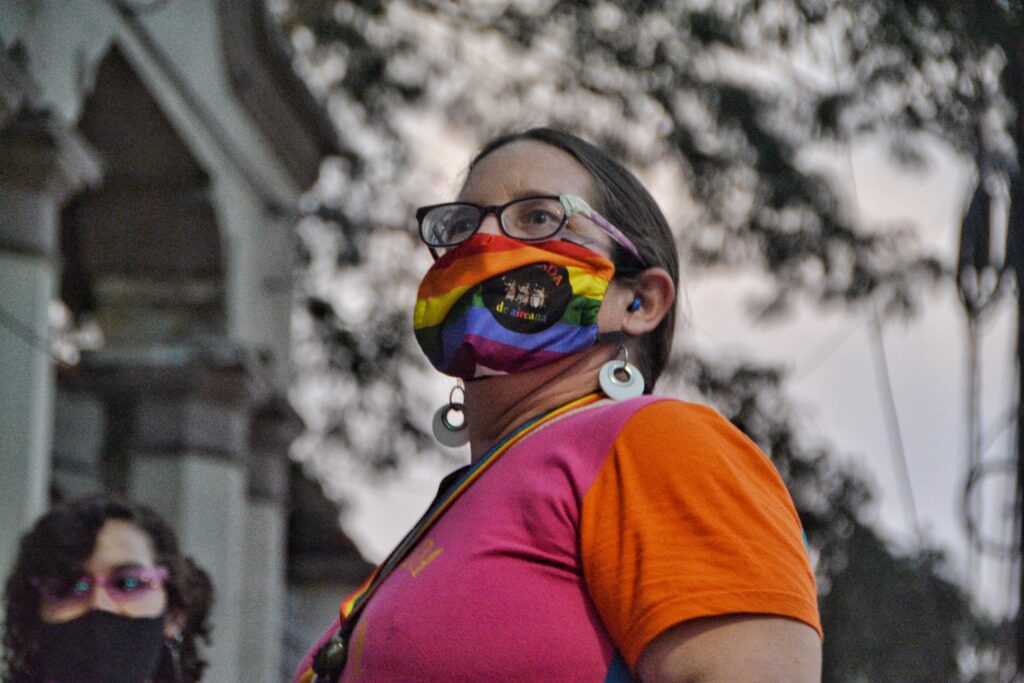
Sol Gómez is a musician and bisexual. "I'm marching today because I want to feel safe walking down the street. Fifteen years ago, there probably wouldn't have been this many people. If I'm here today, it's because others came before me," she told Presentes. For her, the historical legacy is very important for those who build LGBT memory.
"I march for bisexual visibility. Because it's still not fully understood that we're neither lesbians nor straight, we're bi full-time. The letter from an amoral person to me was written by a group of people and it was groundbreaking. It deserves to be remembered every year," Andrea told Presentes.


Letter to an amoral person
September 30 marked the 61st anniversary of the “Letter to an Immoral Person” published in the Paraguayan newspaper El País, which was aligned with the dictatorship. It was a response to a previous edition of the same newspaper that ran the headline “108 People of Dubious Moral Conduct Are Being Interrogated. Intense Police Action. Results Expected.”

It was the first time the number 108 appeared in connection with homosexuality, according to the archives, newspaper clippings, and documents that make up the research conducted by lawyer Erwing Augsten. "Letter from an Amoral Man" was a political manifesto that sparked public discussion and activism for sexual diversity.

“We follow a vocation that is as old as humanity itself, and in this century of the consecration of all human rights, no one can deny us the right to do with ourselves, with our physical continent, what we want, without inconveniencing others who do not want to do the same,” says the letter, which was published anonymously.
"The 108 and one burn victim are part of a struggle that is no longer just historical but belongs to everyone. Our presence here today is a message that we will never again be forgotten," said lesbian activist Giovana Soria.

Symbolic act on the Antequera Steps
In addition to commemorating a significant date in the history of the LGBTI movement in Paraguay, a symbolic event was held at the Antequera Steps. Located in the historic center of Asunción, the steps represent the struggle of sex workers, transvestites, and transgender people during the dictatorship of Alfredo Stroessner (1954-1989).
The event was held in conjunction with Transitar, Escalando, and Casa Diversa. These organizations decided to draft a manifesto addressing the needs of transgender people. Their main demands included: a gender identity law, a law against all forms of discrimination, a law guaranteeing labor inclusion, inclusion in housing, health, and education, and justice for transfemicides .
Panambi, an organization that promotes and defends the rights of transgender people in Ecuador, has withdrawn from the 17th LGBTI Pride March. They announced their decision in a statement on Facebook on September 30th. According to Panambi's director, Viki Acosta, the organization decided not to participate or have a strong, large presence at the march this year. “I believe we cannot talk about diversity if we exclude our colleagues from the Association of Women Sex Workers United in Hope (UNES), who have been actively participating in the march for over 11 years. We are not withdrawing from the coalition, but we did see a need to demonstrate that some things are not working,” Acosta stated, adding that this decision was made in support of UNES.
So far in 2020, three sex workers affiliated with UNES have been murdered. Their crimes remain unpunished and uninvestigated. The organization's manifesto denounced these hate crimes and demanded investigation, punishment, and reparations.
Mariana Sepúlveda, also an activist with Panambí, explained: “Many of our colleagues don't have a vehicle to travel behind a caravan. Very few of us have access to employment. So, in order to keep going, we decided to organize a symbolic event at the Antequera Steps, which is where sex work used to take place. We created a WhatsApp group to plan our route, and the idea arose that only trans women would participate at the Steps.”
October 15: Trans Visibility Day in Paraguay
Viki Acosta announced that on October 15th, Panambí will launch Trans Visibility Day to commemorate the 62 unsolved transfemicides. This date marks the anniversary of Romina Vargas's murder by Blas Amarilla, who did not receive first aid. "It's a sad and emotional day for us because it's the day homophobia and transphobia killed Romina," she said.
“We went to Congress to request a Trans Visibility Day in Paraguay. At the time, the Speaker of the House was Beto Ovelar, who supported us, but the request was shelved,” says Viki. “Just like in all of Latin America and the Caribbean, Paraguay will also have a Trans Visibility Day .”
We are present
We are committed to journalism that delves into the territories and conducts thorough investigations, combined with new technologies and narrative formats. We want the protagonists, their stories, and their struggles to be present.
SUPPORT US

FOLLOW US
Related notes


We are present
This and other stories are not usually on the media agenda. Together we can bring them to light.