

Polyamory, identity and capitalism: a conversation between Brigitte Vasallo and Violeta Alegre
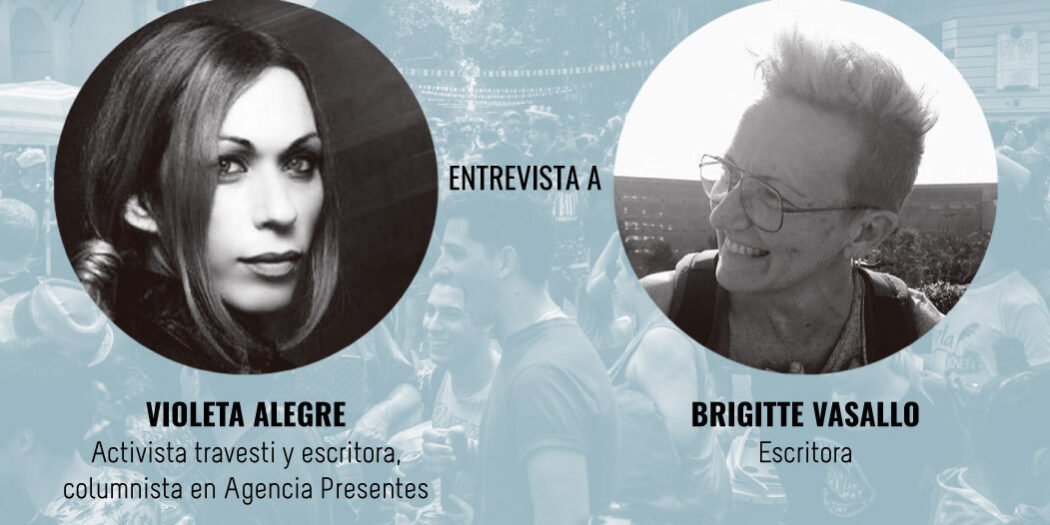
As part of the "Other Possible Worlds" series organized by Presentes, trans activist Violeta Alegre spoke live with Catalan writer Brigitte Vasallo to explore some alternatives to these questions.


Share

Why do we struggle so much with relationships? What does it mean for us to be deconstructed if it's not something that will benefit us as a community? Are there other possible worlds beyond cisheteronormative monogamy? As part of the "Other Possible Worlds" series organized by Presentes, trans activist Violeta Alegre spoke live with Catalan writer Brigitte Vasallo to explore some alternatives to these questions.
“The self-referential proposal of the deconstructed self as a kind of activism about being a good person bores me .” This is how Brigitte Vasallo opened her talk. She recently presented her book , 'Monogamous Thought, Polyamorous Terror,' , where she analyzes the monogamous system and how the proposed alternative, polyamory, can be more of the same if we are only interested in the number of people involved in the relationship. “I prefer more grounded proposals, ones that involve diverse people, where there are people I don't like, but with shared strategic, time-bound, and concrete objectives.”
According to the Catalan writer, both monogamy and polyamory can be capitalist or anti-capitalist practices. What matters is the dynamic of the relationships, not the number of people involved. “If we create genuine social and emotional networks, new ways of loving and relating to each other beyond family ties, beyond the couple and blood, we would be much better protected against destructive capitalism.” One possible proposal: to de-hierarchize monogamous love from the place it is given in relation to other forms of affection.
"LGBTI categories also limit our desires"
For her part, Violeta Alegre emphasized that thinking in terms of relational hierarchy remains difficult for trans and travesti people who are not yet integrated into an emotional and affective framework. “Our relationships are highly commodified and commercialized in certain contexts. From a personal and collective perspective, I think we are breaking down some structures of our own desires, opening up a cultural field that allows us to relate to others without being conceived through regulation, without the constant imposition of a pedagogy of sexuality.”
For the trans activist, it is essential to consider the possibility of including trans and transvestite identities in an affective agenda that stops labeling them as criminalized, pathologized, and commodified identities. “ In this sense, I think that LGBTI categories also regulate or limit our desires, even though they are constantly evolving categories, because gay men connect with other gay men, transvestites connect with other transvestites, so how can we broaden our erotic and affective horizons as dissidents of the heterocis system?”
Monogamy and affective capitalism
Throughout the talk, Vasallo emphasized the importance of revisiting Gayatri Spivak's postcolonial theory, which proposes the notion of "strategic identities" as opposed to essential identities, those that must fulfill a set of guaranteed, universal and general aspects in order to be narrated and visible within a system.
“If we use identities to articulate ourselves, to connect, to name ourselves, I am interested in them being strategic and not essential because it is when we make them essential that we become trapped and cannot move forward. Within the acronym LGBTI there are multiple, fluid experiences that cannot be reduced to homonormative gay capitalism.”
Furthermore, the writer added that when discussing the relationship between capitalism and monogamy, the discourse often falls into the trap of framing sexual exclusivity as the possession of bodies. However, she clarified that the issue is far more complex. “There’s a point where the way we construct a closed identity or a group identity for couples is linked to the identity proposed by nation-states and the discourse defending that identity . We’ve seen this very clearly with the pandemic. Governments talk about the well-being of Spaniards, of Portuguese people—what about, for example, the well-being of Argentinians in Spain? They’re not even mentioned in the discourse.”
For the Argentinian trans activist, monogamy also functions as a (cis)theme that necessarily involves certain pre-established monogamous and cisheteronormative practices that extend beyond individual relationships. “Here, we have to think about being outsiders, about the notion of invasion. In that discourse, we trans women and transvestites always occupy the position of threat. If we reduce monogamy to an individual bond with another person, we fall short.” For Alegre, a valid alternative to break with this (cis)theme is to generate new networks of solidarity and affection. “Welcome to entering into erotic friendships and being able to generate new horizons from there.”
Relational resistance in times of pandemic
“The solution adopted by governments to lock us down, although I understand it stems from a sense of urgency, has brought to light the normalizing and naturalizing assumptions of a defined way of life behind the decision to confine us. These assumptions are based on the idea that everyone has a home and can happily stay in that home,” Vasallo continued.
“Now, this doesn’t take into account the countless people who fall outside of these categories, such as transnational families or informal workers. What lies behind these measures is the idea that the family is the place of safety. For dissidents, who have experienced being expelled from their families, that idea is very far removed from our reality.”
For the Catalan woman, this discourse brought with it a long-standing dispute about which lives deserve to be lived and saved. “The system organizes reality based on interests that don't necessarily have to do with our well-being . Experiences and lives that aren't placed at the center of the system are left on the margins: sex workers, trans people, neurodiverse people , people whose bodies aren't deemed suitable for reproduction. That's what we have to keep in mind all the time, and that's what we have to critique in order to break free from its regulatory frameworks.”
Along similar lines, Violeta Alegre clarified that, in Argentina, the pandemic brought to light the inequalities affecting trans and travesti people and the precarious situation in which they live, since many only have informal access to housing and work. “In our country, many trans and travesti people are sex workers, and we had to build networks to compensate for the lack of economic and emotional support that the State fails to provide. What the (cis) establishment did to us is genocide. But as Marlene says, we continue to exist because we continue to be born.”
Share
We are present
We are committed to journalism that delves into the territories and conducts thorough investigations, combined with new technologies and narrative formats. We want the protagonists, their stories, and their struggles to be present.
SUPPORT US

FOLLOW US
Related notes

We are present
This and other stories are not usually on the media agenda. Together we can bring them to light.