

Tomas against gender violence in Mexico: “We are still strong here”
The takeover of the National Human Rights Commission (CNDH) by mothers of victims and feminist groups has marked a milestone.

Share

Photos and text: Lizbeth Hernández

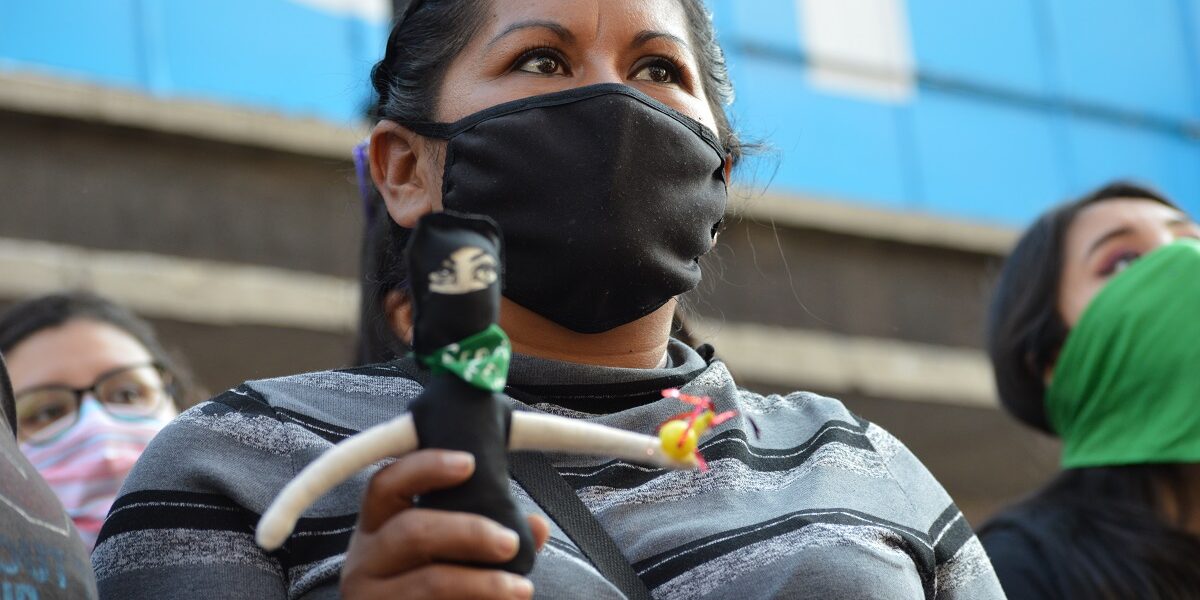
Inside the building located at number 60 on República de Cuba Street, the atmosphere is calm. Some young women are painting murals, others are chatting. There isn't much noise. In a corner of the building, Érika Martínez, the mother of a girl who was sexually abused at age 7, answers a few questions about what has happened in the more than two weeks since various feminist collectives and mothers of victims of other forms of gender-based violence occupied this place, the headquarters of the National Human Rights Commission (CNDH) in downtown Mexico City.
“The meaning of this occupation is that we are fed up with the government not taking us into account, with the State not guaranteeing our rights ,” says Martínez, one of the women who led this action on September 4, and which had as its immediate antecedent, two days earlier, the occupation of one of the rooms of this Commission by relatives of disappeared persons and Marcela Alemán, mother of a girl who also suffered sexual abuse.
Since September 4th, Erika has become a more public figure, as has Yesenia Zamudio, mother of Marichuy, a young woman murdered in 2016 and a member of the organization Frente Nacional Ni Una Menos México (National Front Not One Less Mexico). The Front “provided the necessary legal support to draft a petition that would allow us to occupy the facilities,” as reported on September 16th in a statement by the Bloque Negro (Black Bloc), another of the groups that carried out the occupation when various disagreements became public. At that time, Zamudio withdrew from the CNDH (National Human Rights Commission), which was briefly renamed “Ocupa Casa de Refugio Ni Una Menos México” (Occupy Shelter House Not One Less Mexico). Today it is known as “Okupa” (Squatter).
—How have these past two weeks been since the takeover? How do you assess what has happened?—
"We started with a lot of force in this occupation, and we've already been taken as an example. In other states (of the country) they've already occupied some CNDH headquarters, and right now, after the separation with Ms. Yesenia (Zamudio), it's brought us conflict with people out there. Here inside there hasn't been any conflict, but there is doubt from the people out there who are questioning what's happening with the feminist movement and the families of victims and the feminists. I do want to clarify that we are still strong here," Erika responds.
Erika says that she "already had many feminist ideas" because in her past she suffered "a lot of violence" but it was only after the abuse of her daughter that she fully embraced feminism.
“It wasn’t until this happened to my daughter and I met feminist groups that I began to understand the feminist struggle […] . I believe that every woman should be fighting for her rights and leaving behind sexism, the sexist school of thought of the past, to change this world, or at least this country. That the authorities begin to change and start being led by women who are truly committed to other women.”

The occupation took place in 2020, a year in which, despite the Covid-19 pandemic, demands to end femicides and other forms of violence against women have not ceased. Even before the pandemic, these actions had reached unprecedented levels, such as the massive march on March 8th (
#8M
Between #MeToo and 10 femicides per day
If we go back a little further, we have all the mobilizations and actions of Mexican women that in 2019 brought about the beginning of a turning point when #MeToo exploded (in different areas from writers, journalists, photographers), the strikes in different schools and faculties of the National Autonomous University of Mexico (UNAM) to reject the sexual harassment against students by professors, students and workers of the institution and the protests against police violence towards women under the HT #NoMeCuidanMeViolan, mobilizations that marked a change by incorporating more direct actions (graffiti, burnings, incursion into institutions such as the Prosecutor's Office of Mexico City or the intervention at the door of the National Palace, seat of the Mexican Executive Power).
As pointed out , "young feminists have shaken the government of Mexican President Andrés Manuel López Obrador by demonstrating belligerently against the increase in femicides and murders of women—which average 10 cases per day —disappearances, sexist violence, and by placing the issue on the media agenda."

This doesn't mean that women were silent about gender-based violence before. The feminist movement in Mexico has a longer, broader, and more complex history. It's worth noting that starting in 2016, with the so-called Violet Spring —an awakening that echoed Argentina's #NiUnaMenos—feminist and women's actions (we can't forget the marches and search efforts by mothers of victims of enforced disappearance, for example) gained greater strength in the streets of various parts of the country and on social media.

"I think we've finally woken up."
It's important not to forget that in order to understand this moment of the events. "I think we've already woken up, that we're waking up little by little, but we have to keep fighting so that this doesn't fall apart," Erika shares with me.
Capucha, one of the members of the Black Bloc who prefers to be identified as such, shares a similar opinion. For her, the occupation “is proving to be a watershed moment, helping women overcome their fear. I think they feel protected, and I'm not just speaking for ourselves, but in general. After the confinement we experienced (due to the pandemic), this awakening and the fact that so many women want to be a part of it is really beautiful.”
Capucha is a young woman from the State of Mexico, which borders Mexico City, and has become one of the most violent and dangerous states for women in the country. “I think it still hasn’t sunk in (an expression used to express that the full magnitude of something hasn’t yet been grasped), or at least it hasn’t for me. I haven’t been able to sit down and process all of this (the occupation). For me, it hasn’t been two weeks; it feels like two months, because we’ve done so many things that aren’t being talked about out there…”
For Capucha, these days it has been important to share with other women. “…trust is fundamental, knowing that the companion you are with will not abandon you, that she will support you, being sure that (we will be together) through whatever we face (as far as necessary).

Awaiting a concrete response from the government
During these past two weeks, the government, through the Ministry of the Interior, has held two meetings with the women occupying the building. Despite this, “we still haven't made any progress regarding why we're here . I'm here because of my fight for justice and truth for my daughter, and I haven't received any response. As a collective, we've already submitted two petitions, but the first one was addressed. It was to meet with all the victims and give them a voice. And well, we're still waiting for a response from the government. In my case, I'm also still waiting because at the first meeting with the government, I was given a voice, but at the second one, they wouldn't even let me in. And that's how we get responses from our institutions; we're still stuck in bureaucracy,” Erika shares.
The squatters are poised to enter a new phase after the separation from Yesenia Zamudio, following the " Antigrita ," a protest held on September 15th in opposition to the Grito de Independencia (Cry of Independence). "We are going to continue the occupation and we are going to start structuring some workshops. Yes, we need people's support to teach them and to attend them as well [...] without you (those of you outside) we won't be able to do it. We continue to require your support, both moral and financial, as well as donations, because this work has to be for everyone," says Erika.
Women's actions against gender-based violence in Mexico continue unabated and will not cease. On the contrary, they are constantly evolving, taking on new forms, reaching unexpected places, and increasingly challenging the institutions that should be providing answers. These are not isolated incidents, nor are they recent events. We see mothers, sisters, and young women among them. The rage of Mexican women resonates throughout Latin America.
We are present
We are committed to journalism that delves into the territories and conducts thorough investigations, combined with new technologies and narrative formats. We want the protagonists, their stories, and their struggles to be present.
SUPPORT US

FOLLOW US
Related notes



We are present
This and other stories are not usually on the media agenda. Together we can bring them to light.