

Who are TERFs and why do we want them far away from feminism?
TERF forms a word that combines the initials of the English Trans Exclusionary Radical Feminist.


Share

By Violeta Alegre
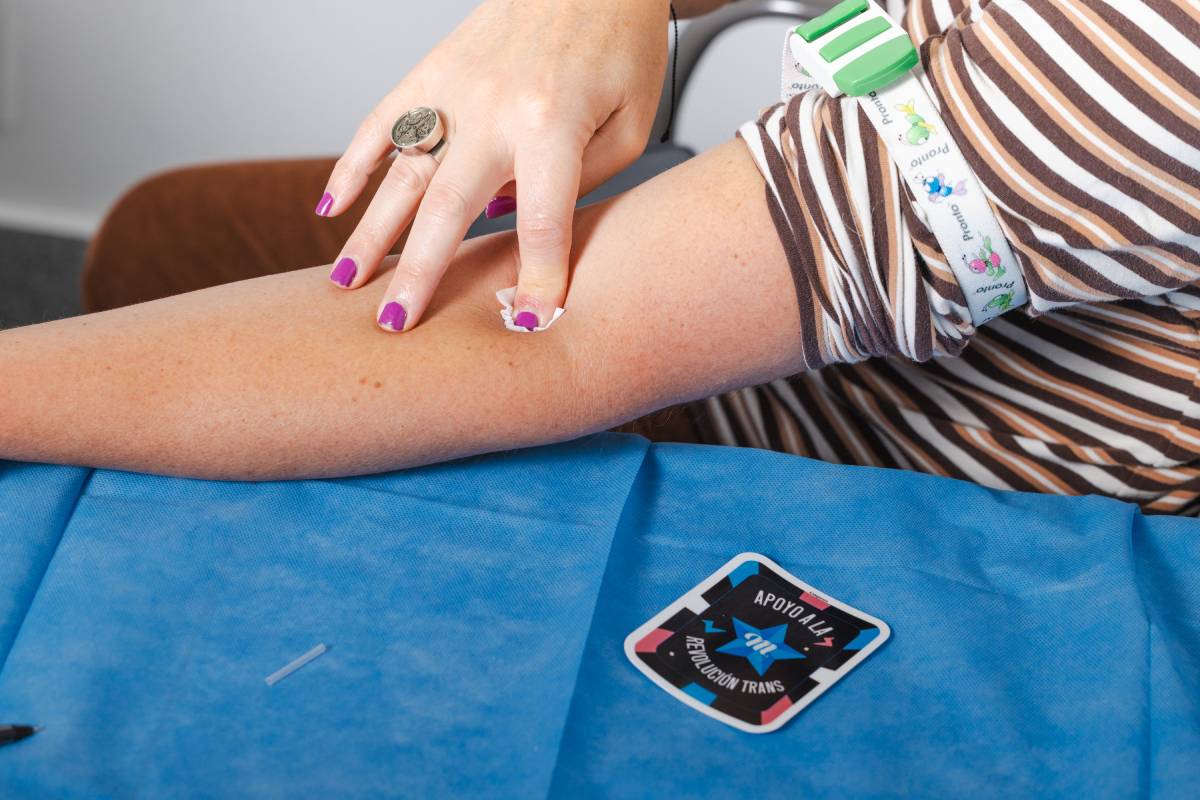
Photo: Luli Leiras/Present Archive
In recent days, media transphobia—and thankfully its condemnation—has once again become a trending topic on social media. The reason? A new chapter in Harry Potter author J.K. Rowling's contempt for the trans community.
After posting a tweet mocking the expression "people who menstruate," where she reiterated her defense of biological determinism, we learned last week that her latest novel, published under a pseudonym, is about a serial killer who dresses as a woman to prey on his victims. The novel, not yet published in Spanish, is titled " Troubled Blood" and can be interpreted as a literary campaign against trans identity. These recent actions have revived the support of TERF feminists, who see Rowling as a spokesperson for self-proclaimed "born women."
TERF is an acronym for Trans Exclusionary Radical Feminist. They are a group of feminists whose theoretical framework leads to the exclusion of trans women and men, and by exclusion I mean violation, stigmatization, criminalization, pathologization, and denial of our identities and life stories.
But where do TERFs come from?
Radical feminism was born in the United States in the late 1960s. It is a movement that sought the root of the domination and oppression suffered only by cis women (that is, those who correspond to the assignment of the medico-legal system: penis/male and vulva/woman).
One of the foundations is based on the production-reproduction relationship and the inequalities that arise from this binomial pair: public and private world, masters and slaves, dominators and dominated.
Within this Western, binary, and dichotomous framework, radical feminisms perpetuated heterosexual models of production and reproduction. As a result, many women's entry into feminism stemmed from an understanding of the oppression and violence suffered by cisgender men.
In this binary, artificial, and biologistic relationship, where being born with certain genitalia and organs obligates you to be a certain way, radical feminists fail to recognize the artificiality of their own gender. At the same time, they fail to acknowledge the violence they reproduce and perpetrate as a hegemonic systemic counterpart against the trans community.
In the face of debates surrounding the productivity and reproduction of the body, such as debates on the right to abortion, biological discourses resurface, finding their foundations while reproducing the anatomical difference of this systemic pair as the only way to challenge, unsettle, claim rights, and engage in politics.
Transvestite as a non-binary identity
In contrast to the victim figure within these feminist perspectives, we find the survivor, as articulated by trans activist Marlene Wayar. Unlike the victim, the survivor possesses political power because defining ourselves as such allows us to fight to prevent further violence. This further collectivizes and intersects our struggles.
Furthermore, Wayar mentions that these hegemonic labels are full of meanings and trying to resignify, define or expand them is a struggle that will take us years, and for some, a lifetime.
That's why it's important to share with our brothers and sisters in other parts of the world the creative power of our South American and Indigenous trans migrants, to give them—or rather, throw at them—a label laden with biological determinism, inequality, and limitations, and to begin calling ourselves transvestites. Neither men nor women. We are transvestites.
In both Europe and the United States, trans people are reclaiming the words and expressions imposed upon them by oppressive powers: Tranny-Shemale ( Trans-she-male ), which originates from the pornography industry. But also "transsexual" or "trans woman," which can provoke a reaction from TERFs. Thus, the term "travesti" (transvestite) is moving away from that context.
The dangers of staging "cross-dressing"
The documentary Disclosure references the historical representation of trans people in film and shows how the first technology of gender (clothing) was used by those who "didn't belong" to it to embody murderous, treacherous, and untrustworthy characters (particularly for cisgender women). Could Rowling have been inspired by this history of transphobia?
The terms "transvestite" or "transvestism" were first used in European theater during the 16th century, as women were excluded from the stage and female roles were played by men. These roles were then filled by upper-middle-class prostitutes who were transvestites. They provided the world with the first discourse on what a transvestite means from a cisgender perspective: "people who occasionally dress and act according to the 'codes' of the opposite sex/gender, even though in their social and daily lives they 'identify' with the gender they were assigned at birth.".
Let's keep in mind, as I mentioned earlier, that the first technology of gender is clothing. At that time, gender technologies that emerged in the 20th century, such as surgeries, didn't exist, so clothing was seen as a sporadic instrument (as if identity ended when we took our clothes off). This fostered an assumption of the artificiality of identity that persists to this day, not only among transvestites but among all trans people. This is where TERF discourse also takes hold, highlighting biological differences (which no one denies) to justify the oppression (which is also not denied) of cisgender women, but which has nothing to do with "natural" matters.
TERFs are gaining ground and attracting followers. Many of them are young women who are aware of patriarchal violence, but they don't question the oppressive regimes to which they are "affiliated." They don't usually say "we hate trans people" and justify their actions with phrases (like Rowling's) such as: "I have trans friends. How can they say I hate them?"
This is how they distort the message and lose sight of the symbolic messages they send to societies. We can no longer say they are few, we can no longer minimize them . We can no longer allow other feminists, supposedly trans-inclusive, to ask us to "not give them importance."
Because of medical biologism, they mutilate and kill us. We are not trapped in the wrong bodies; there is no such thing as the right body . For many years, we have suffered stigma, segregation, and death because of this kind of discourse. It offends us that it comes from the "feminist" camp. We will no longer allow it; we want TERFs far, far away.
We are present
We are committed to journalism that delves into the territories and conducts thorough investigations, combined with new technologies and narrative formats. We want the protagonists, their stories, and their struggles to be present.
SUPPORT US

FOLLOW US
Related notes
We are present
This and other stories are not usually on the media agenda. Together we can bring them to light.