

Estefanía Cámera Da Boa Morte, non-binary and Afro-Indigenous activist: “Our origins are everything”
Estefanía Cámera Da Boa Morte is an Afro-Indigenous, migrant, non-binary, lesbian, and anti-speciesist activist who has been fighting for at least twenty years.


Share

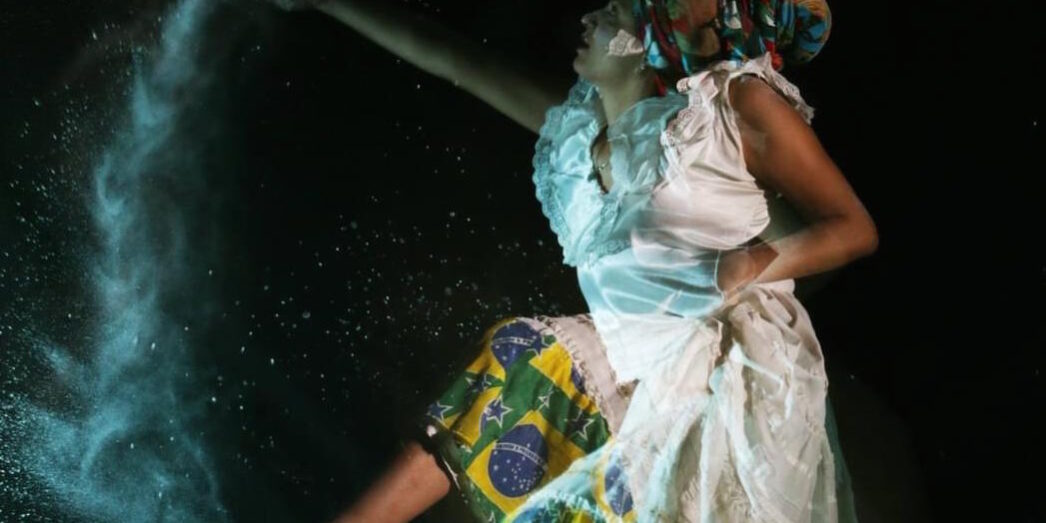
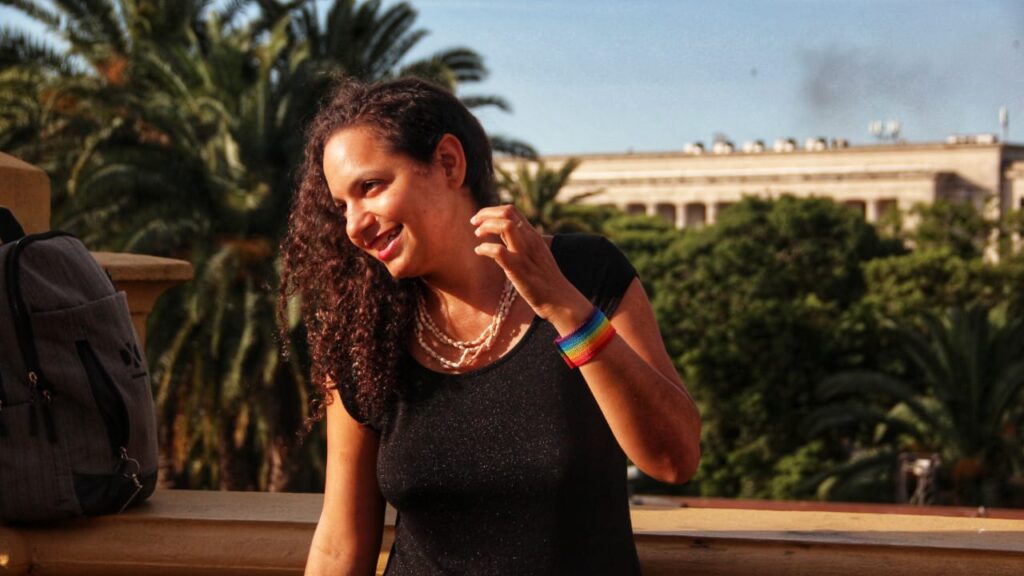
Photos: Paula Jimena and Florencia Mendilarzo
In addition to being the year of the pandemic, 2020 was also the year of renewed anti-racist protests. Racist violence took center stage, entering media debates and becoming a central issue within human rights and feminist movements. This was evident in the United States with the Black Lives Matter protests and in Latin America with denunciations of institutional violence and discrimination against Indigenous and racialized people.
Estefanía Cámera Da Boa Morte is an Afro-Indigenous, migrant, non-binary, lesbian, and anti-speciesist activist who has been fighting for at least twenty years in each of her identities. Born in Uruguay, she has lived in Argentina for 29 years. Her mother's side of the family is of African descent, specifically from the slave trade that brought people from Portugal to Brazil, and her paternal mother's side is of Charrúa descent. She currently serves as a board member of the Argentine-Brazilian Cultural Association A Turma Da Bahiana and is active in various organizations, including the National Campaign for Legal, Safe, and Free Abortion and the Black, Indigenous, Racialized, Lesbian, Bisexual, Trans, Transvestite, Non-Binary, and Fat Collective, among others. In this context, she spoke with Presentes about activism, racism within progressive movements, and why the struggle must be intersectional.
– Why is the recognition of different identities important?
– Identity is everything. Our origins are everything. If you don't know your origins and can't identify with others, you're not a being, you're an empty vessel . It's very important because historically, it's what was taken from us, and from then on, we were forced into submission. It was the first thing they did: give us a name that didn't represent us, take away our rights, and take away our identity. Once you know where you come from, it's a weight lifted from your shoulders, and you feel and recognize yourself in others. That otherness begins to be part of you, so you don't perceive it as such, or you learn to understand it from a different perspective.
– In your case, you've been an activist for many years.
– I became Black out of a need to recognize myself because I couldn't see myself, despite always being involved in active circles. In a way, the racism I suffered—I even dropped out of high school because of it—made me want to stop being Black and renounce my skin color when I was much younger . But luckily, getting involved in activism made me completely deconstruct my taste, my pleasure. In it, I found sisters, brothers, security, acceptance, a lot of love. Also discord and pride, empowerment. I was able to look into the eyes of others, see that their gaze reflected back to me what that person had gone through, and realize that you're not the only one these things happen to.
– You also fight for all your identities.
– Intersectionality is absolutely necessary and mandatory: it's about seeing how many forms of oppression affect us all. How can someone be so hypocritical as to say they fight for rights and not understand the needs within the Black community or the LGBTQNB collective? You can't think that because you're part of the LGBT+ community you're not racist, fatphobic, or lack empathy for poverty. If you don't see intersectionality, you're not understanding the struggle itself.
– How do you see LGBT+ and feminist activism in relation to the anti-racist struggle?
– In LGBT+ activism, I've experienced racist situations where I'm not recognized. What's more, they've tried to somehow exclude me from the Pride March Organizing Committee. Feminism is also very hypocritical in the sense that, yes, it represents and empowers women, but it doesn't talk about Black women and continues to leave them on the margins of poverty . There's an openness, and at the same time, a constant obstruction of Afro and Indigenous communities, especially in events like the March 8th assemblies, the assemblies against violence, and the Plurinational Gatherings. Feminism as an idea isn't bad, it's fantastic—I'm an Afro-feminist—but there's a lot of hypocrisy and double standards.
– How can someone who is not racialized be part of the anti-racist struggle?
– I believe that first, one must learn to listen actively and consciously. After doing this, after recognizing their own privileges and detaching themselves from them by giving space and voice to those who don't have them, then they will be able to get involved and be an activist, not an appropriator of voices and cultures. A true deconstruction is necessary: to begin problematizing racist, homophobic, or any other practices one may have, and to resolve them through acquired knowledge. If knowledge hasn't been acquired, there is an obligation to seek that information. Historical reparations shouldn't be solely the responsibility of the State, but of everyone. Each person has the capacity to learn history, to make it visible, and to reclaim it. It's not an obligation only for racialized people: we didn't come here to educate, we came here to fight for our rights.
We are present
We are committed to journalism that delves into the territories and conducts thorough investigations, combined with new technologies and narrative formats. We want the protagonists, their stories, and their struggles to be present.
SUPPORT US

FOLLOW US
Related notes


We are present
This and other stories are not usually on the media agenda. Together we can bring them to light.