

She was a trans survivor from Lima and was murdered in her home: "Gabriela suffered daily violence"
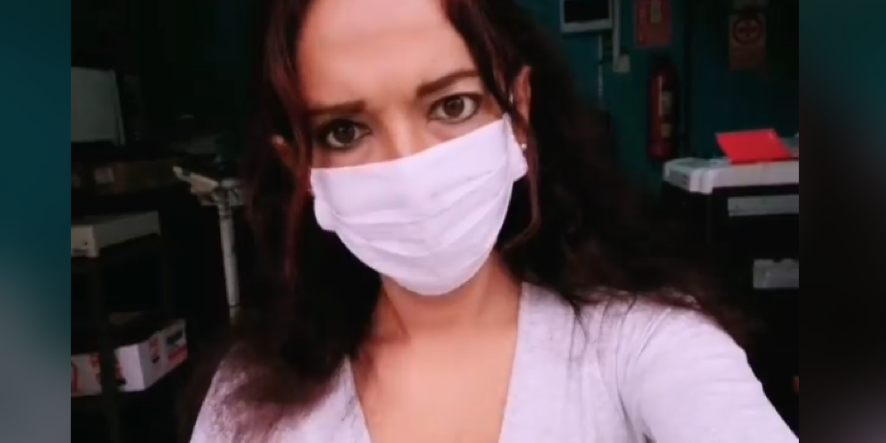
Gabriela Cruz Pimentel was murdered on Friday in her bedroom. She was strangled and bound.

Share

By Verónica Ferrari
On September 4, in the early morning, Gabriela Cruz Pimentel, a 46-year-old trans woman who worked as a photocopier operator in a shop near the University of San Marcos and sold cosmetics in her free time, was murdered in Lima.
She lived alone in a room in the San Miguel district and maintained regular contact with her two sisters. When she was absent from work, one of her sisters went to her apartment. Despite the building manager's refusal, she was allowed to go up to her room. With the help of a neighbor, they were able to open the door and found her body. Gabriela was lying down with her wrists tied behind her back with a cable and a cloth stuffed in her mouth. Forensic experts indicate that she died of mechanical asphyxiation by hanging.
Presentes spoke with Sandra, Gabriela's sister, who said that she was a responsible and hardworking person, but that she experienced a lot of violence in her daily life: "She received a lot of ridicule, a lot of discrimination from men, women got jealous, they looked at her badly," as often happens with trans women due to the prejudices and stereotypes of society.
After removing the body from the morgue the next day and holding the wake, with all the difficulties that the pandemic context implies at this time, where funeral homes are overwhelmed and charge high prices to attend to the bereaved, the sisters have been waiting at the San Miguel police station, so that the main suspect is arrested and gives his statements: Marty Alan Cerna Abregu.
The investigation is being led by Prosecutor Ríos of the Tenth Prosecutor's Office, who will be required to act ex officio. The Ministry of Women and Vulnerable Populations is also aware of the case.

Hate crimes in Peru
We spoke with Leyla Huerta, director of Féminas, and a friend of Gabriela for more than 20 years, who was at the National Directorate of Criminal Investigation (Dirincri) accompanying the family to clarify the transfeminicide.
She pointed out the role of the press when reporting on the murders of trans women: “When the press reports the news and treats them as if they were men, it makes society not understand that the murders of trans women are femicides; that possibility is lost.”
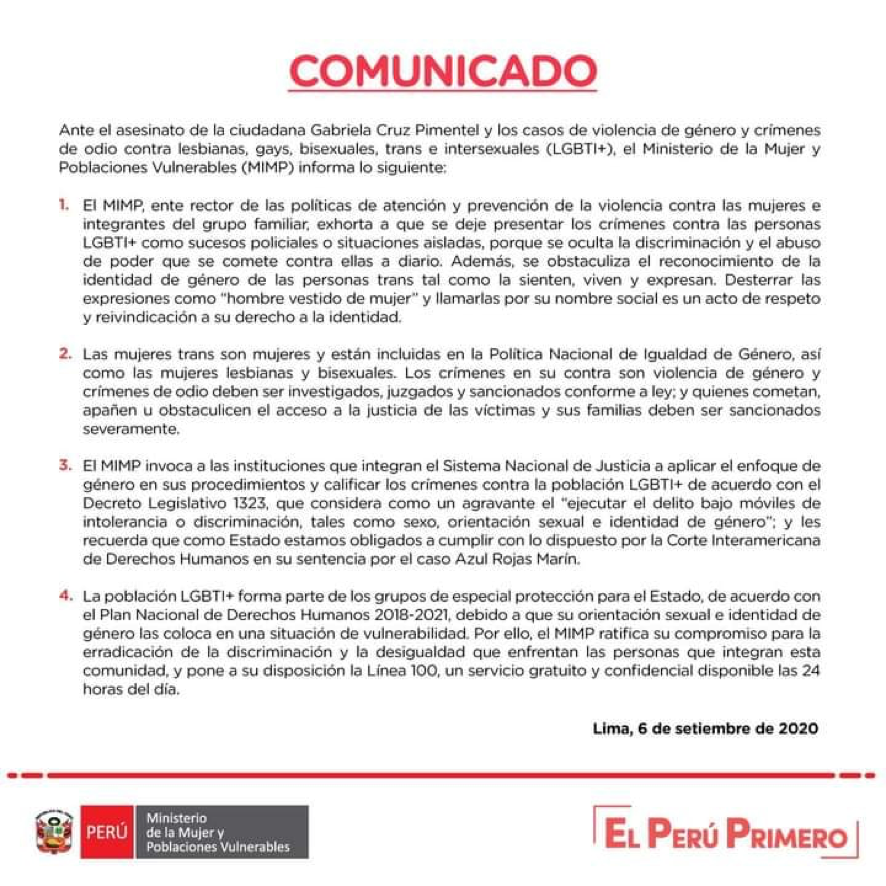
Therefore, the Ministry of Women issued a statement on September 6th urging the press “ to stop presenting crimes against LGBTQ+ people as police incidents or isolated events, because this obscures the discrimination and abuse of power committed against them daily . Furthermore, it hinders the recognition of the gender identity of trans people as they feel, live, and express it. Eliminating expressions like 'man dressed as a woman' and calling them by their chosen name is an act of respect and a vindication of their right to identity.”
Huerta also emphasizes the need to analyze the contexts in which trans women are murdered : “Other femicides must be studied because they involve extortion, blackmail and/or violent sexist relationships that end up affecting the vulnerability of trans women and their high risk of being murdered.”
The LGBT Human Rights Observatory recorded 20 hate crimes against people based on sexual orientation and gender identity in Peru in 2019, four of these crimes against trans women. This figure remains constant year after year, in a context where trans people do not have a law that recognizes their identity, so they are doubly vulnerable: by society and by the Peruvian State.
In 2020, four transfeminicides were recorded, considered hate crimes due to the brutal nature of the death, which involved planning, torture, and attempted disappearance of the victim because of their sexual orientation/gender identity/expression. They were also classified as femicides because they highlight the structural violence suffered by women, and as transfeminicides due to the triple vulnerability experienced by trans women in transphobic societies that deny them their rights.
The victims were Angie Mimbela del Águila (28), who was found with her throat slit on February 9 while walking through the streets of the Villa El Salvador district (Lima), her crime has not been solved; Cristal Romero Mattos (52), who was beaten and stabbed on July 11 in the city of El Porvenir (Trujillo); and Brenda Venegas Ayquipa (52), who was hanged on August 1 in the San Juan de Lurigancho district (Lima) by Ivan Alexander Timaná Ángel (23), who was her partner and extorted her; and the last one, Gabriela Cruz.
We are present
We are committed to journalism that delves into the territories and conducts thorough investigations, combined with new technologies and narrative formats. We want the protagonists, their stories, and their struggles to be present.
SUPPORT US

FOLLOW US
Related notes

We are present
This and other stories are not usually on the media agenda. Together we can bring them to light.