

Argentina decrees a 1% transvestite and transgender employment quota for the public sector
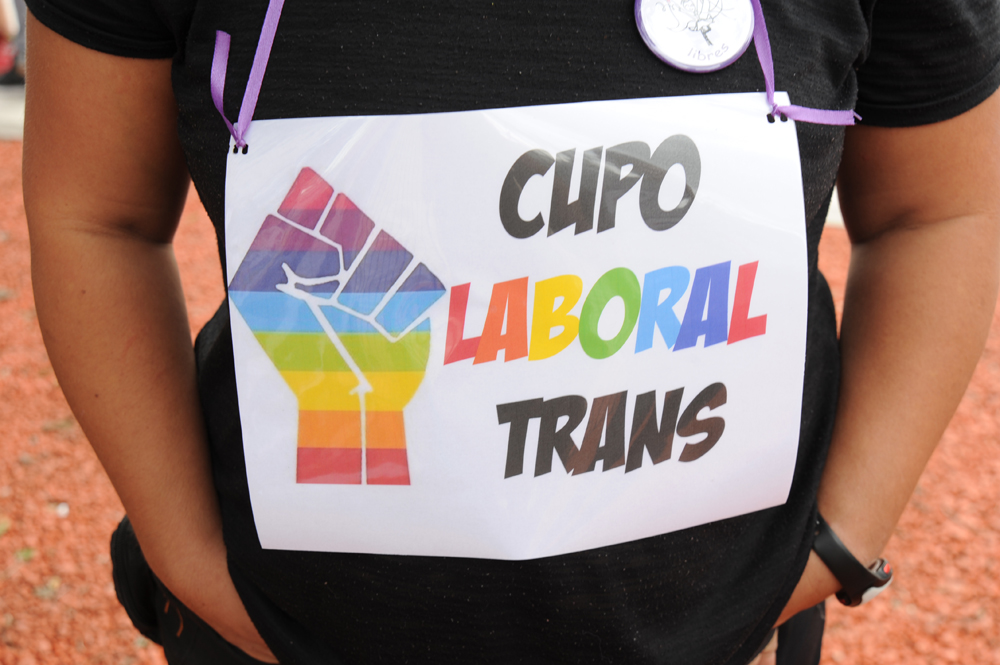
In a historic decision, the Government of Argentina decreed to allocate a quota of 1% in the positions of the National Public Sector personnel "for transvestite, transsexual and transgender people who meet the conditions of suitability for the position.".


Share

Photos: Presentes Archive/Illustration: National Campaign for Quotas and Labor Inclusion for Transvestites and Transgender People.
In a historic decision, the Argentine government has decreed that at least 1% of positions within the National Public Sector will be reserved for transgender, transsexual, and gender-diverse individuals who meet the qualifications for the position. The decree stipulates that this percentage must be allocated to these individuals through any of the existing employment modalities. Decree 721, published today in the Official Gazette, authorizes the Ministry of Women, Gender, and Diversity, in conjunction with the Secretariat of Public Management and Employment of the Chief of the Cabinet of Ministers, to issue the implementing and supplementary regulations.
What are the main points of the decree?
-The possibility of accessing the quota will be for all trans, transvestite and transgender people, "whether or not they have carried out the registration rectification of sex and the change of first name and image referred to in article 3 of Law No. 26,743", as stated in article 2 of the decree.
-There will be a registry of applicants , a voluntary registration process for transvestite, transgender, and transsexual individuals who wish to enter the public sector. Its creation is outlined in Article 6, and it will be managed by the Ministry of Women, Gender, and Diversity.
-In its third article it speaks of "Non-discrimination": "Every transvestite, transsexual or transgender person has the right to decent and productive work, to equitable and satisfactory working conditions and to protection against unemployment, without discrimination on the grounds of gender identity or its expression, therefore, no employability requirements may be established that obstruct the exercise of these rights.
It states that “to guarantee true equality of opportunity, the requirement of educational attainment cannot be an obstacle to entry and retention ” (Article 4). “If applicants for jobs have not completed their education, as defined in Article 16 of National Education Law No. 26,206, they will be allowed entry on the condition that they complete the missing educational level(s).” The Coordination Unit “must take the necessary steps to guarantee the mandatory education and training of transgender, transsexual, and gender-diverse individuals in order to align their situation with the formal requirements for the job in question.”
-Article 5 refers to the training of authorities and staff of the Executive Branch so that inclusion is carried out in a respectful manner : "The MINISTRY OF WOMEN, GENDERS AND DIVERSITY in conjunction with the NATIONAL INSTITUTE OF PUBLIC ADMINISTRATION will train the authorities and staff of the National Executive Branch to ensure that inclusion in the jobs of the National Public Sector is carried out under conditions of respect for the gender identity and expression of people."
-An Interministerial Coordination Unit is created within the Ministry of Women, Gender and Diversity , which will have the following functions: to develop the Quota Implementation Plan, to guarantee the mechanisms and procedures of inter-institutional coordination necessary for its fulfillment, to guarantee the necessary educational spaces for transvestite, transsexual and/or transgender people who require to complete compulsory studies, to guarantee spaces for employment training and labor training required by transvestite, transsexual and/or transgender people.
-It recognizes the reparative and complementary nature of the measure, which will be followed by others. “This decree establishes affirmative action measures with the objective of beginning to redress the violations that have been historically committed against transvestite, transsexual, and transgender people in our country , including promoting the application of Law No. 25,164 in a way that respects the human rights of this group.”
-According to the decree, "the permanent legal service of the MINISTRY OF WOMEN, GENDERS AND DIVERSITY has taken the corresponding intervention.".
In line with human rights organizations
Among its arguments and justifications, the decree cites “Advisory Opinion No. 24 of November 24, 2017, from the Inter-American Court of Human Rights, which affirmed that ‘sexual orientation and gender identity, as well as gender expression, are categories protected by the Convention’ and that ‘consequently, their recognition by the State is of vital importance to guarantee the full enjoyment of the human rights of transgender people.’ It also cites the Inter-American Commission on Human Rights, which in 2018 recommended that States develop ‘coordinated, intersectoral strategies, articulating issues based on multiple factors, such as education, work and social security, food, housing, and health, aimed at guaranteeing the democratic participation and empowerment of LGBTI people.’”.
It also includes the report on the situation in Argentina prepared by the United Nations Independent Expert on Sexual Orientation and Gender Identity in 2017.
The decree cites the national importance of the Gender Identity Law but acknowledges that "even with the regulatory advances in this area, transvestite, transsexual and transgender people continue to have difficulties in enjoying the effective exercise of the right to health, education, decent housing, equitable and satisfactory working conditions, as well as protection against unemployment, without any discrimination.".
We are present
We are committed to journalism that delves into the territories and conducts thorough investigations, combined with new technologies and narrative formats. We want the protagonists, their stories, and their struggles to be present.
SUPPORT US

FOLLOW US
Related notes


We are present
This and other stories are not usually on the media agenda. Together we can bring them to light.