

Indigenous women unite to denounce “chineo”: racist rapes of girls
“The word 'chineo' has a colonial connotation and speaks of a racist, patriarchal, and genocidal act. We shout it to say enough is enough.”

Share

By Elena Corvalán
Photo: Leandro Rodríguez
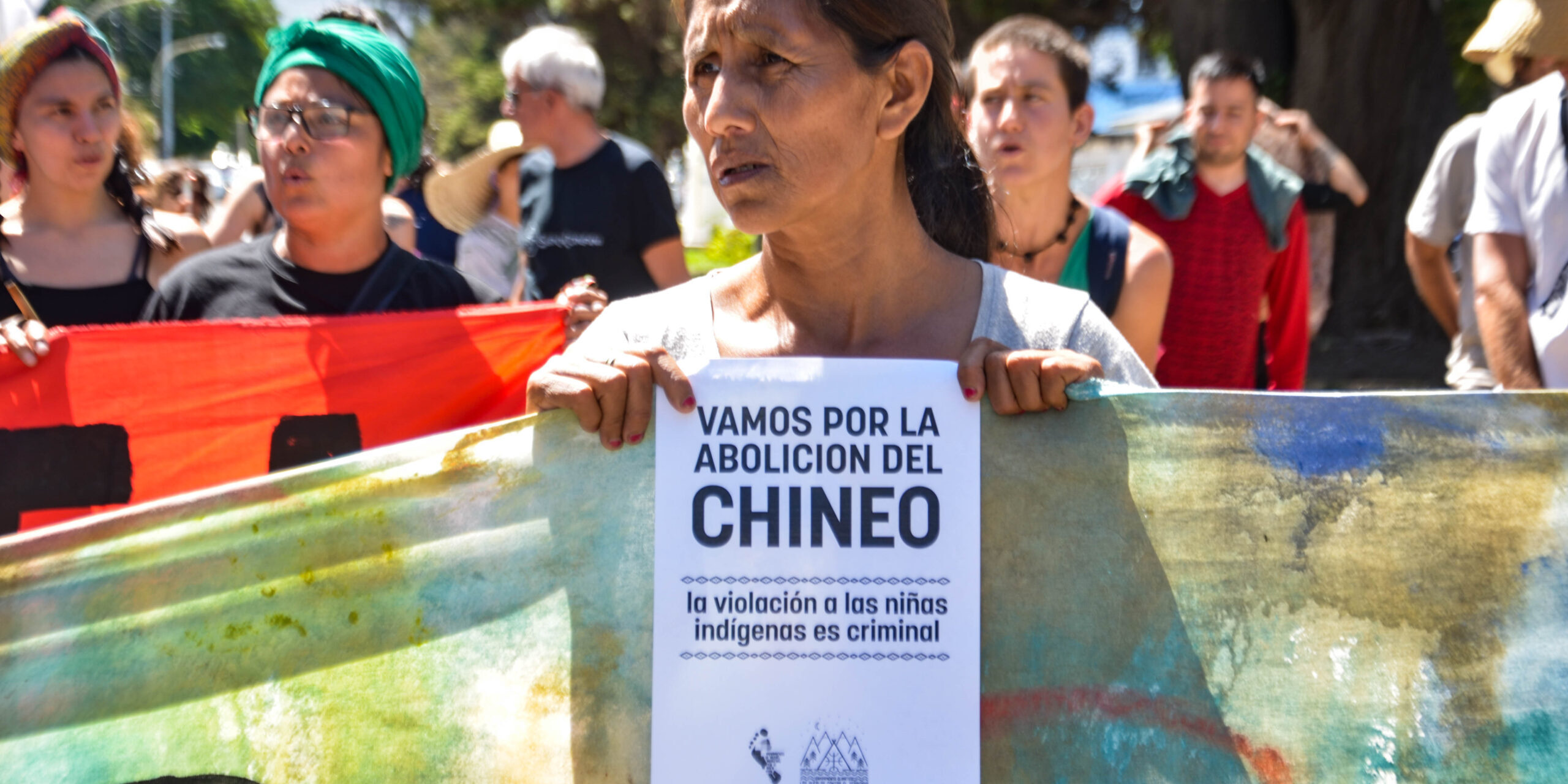
The Indigenous Women's Movement for Good Living denounces in a campaign the persistence of "chineo": the rape of Indigenous girls, boys, and women by non-Indigenous men.
"Did you know that in Argentina, even today, non-Indigenous men rape, torture, and kill Indigenous women and girls?" asks one of the campaign posters, which is being shared on social media with the hashtag #StopChineo.
The video, part of the visibility initiative, includes testimonies from women who have suffered "chineo".
The voices of those who suffered "chineo"
“My daughter had barely turned 15 when they took away her happiness and innocence,” the woman recounts from Salta, emphasizing that since that experience, her daughter “has always been afraid, like she’ll never, ever be at peace again.” The teenager disappeared on her birthday. “They kidnapped her from the community and took her to Rivadavia Banda Sur. Then to Tartagal, and they were going to send her to Formosa and then to Jujuy to force her into prostitution. But I thank God infinitely that, thanks to prayers, one of their accomplices let her go. And today she’s with us, but she still has this problem of fear.” The woman called on older people to “protect the children (…). Together we can say enough is enough, that this, which is, let’s say, from the devil, has to end. Because that’s what our ancestors said, ‘ahatay’ is the devil,’ which is what the Creoles are.”
“My little girl, Irupé, only 7 years old, used to play doctor, she dreamed of singing. Suddenly her smile vanished, and in her eyes she hid a great pain. A pain caused by three people, from a good family, or so they said. Two white men raped her, and a woman was an accomplice, threatening her that if she spoke, she would kill her family. And she threatened her, made her feel like nothing, told her she deserved it because she was just like her mother. Enough of this abuse. No more smiles erased from the faces of girls and boys. No more dreams shattered because of white people. Enough of this abuse,” another woman recounts and protests.
“Today we take the hands of our wounded, humiliated ancestors” to demand justice, the campaign states. One of the women speaks about her ancestor: “My grandmother always had stomach aches. And she was always overly protective of me, until one day she told me that she was raped when she was 9 years old. A group of white men raped her. She was a victim of 'chineo' (child molestation). It is a racist and patriarchal crime that continues in these territories to this day.”
“I hold my mother’s hands and the hands of the voices that were always silenced but were surely also victims of ‘chineo’,” says another Indigenous woman. She recounts that her mother “was raised in different houses, with different people and different families, from a very young age.” And although “she was protected by some of her siblings,” because of “the way she behaved and told us that white people were always harmful, I always thought she was a victim of ‘chineo,’ even though she never said so. Now that I’m older, I realize that in her care and in everything she told us—to take care of ourselves, to be careful with this and that—she was protecting us from this, from the coercion, as she always called it, which is how she used the word ‘chineo.’”
“I was coming home from school with my cousin,” a young woman recounts. When they were almost home, her cousin managed to escape, but she didn't: “They forced me into a car. They were white men, and they raped me. Today I don't want that to happen to any of my daughters, that's why I say enough is enough with 'child abuse'.”
This year, in mid-June, a Wichí teenager was raped in Rivadavia Banda Sur by four Creole men, according to information confirmed by the Public Prosecutor's Office of Salta and another source.
What is chineo?
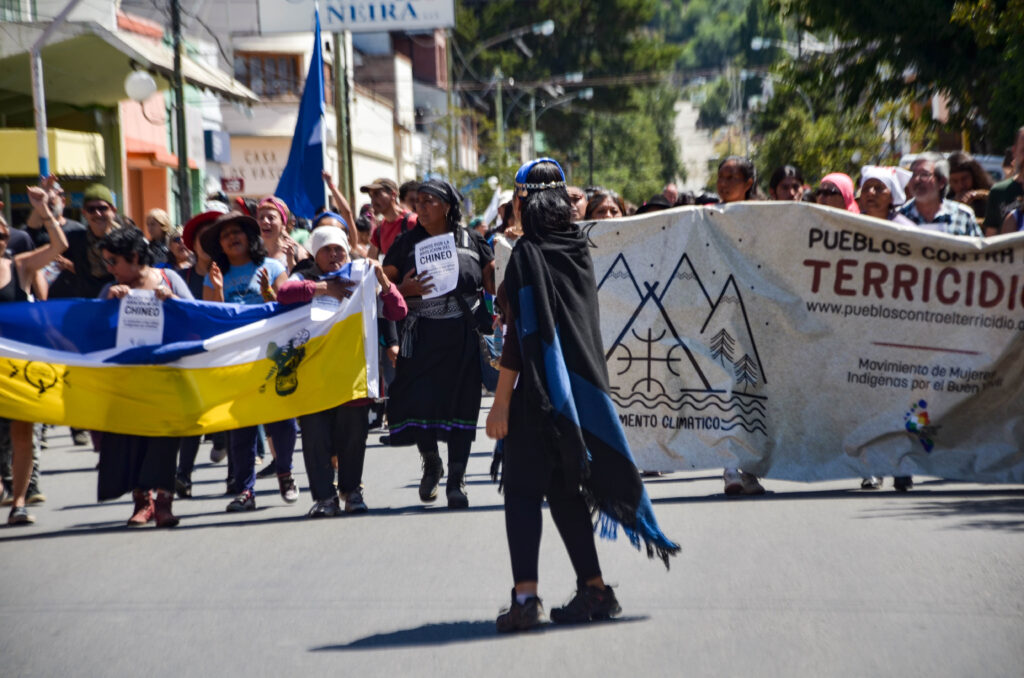
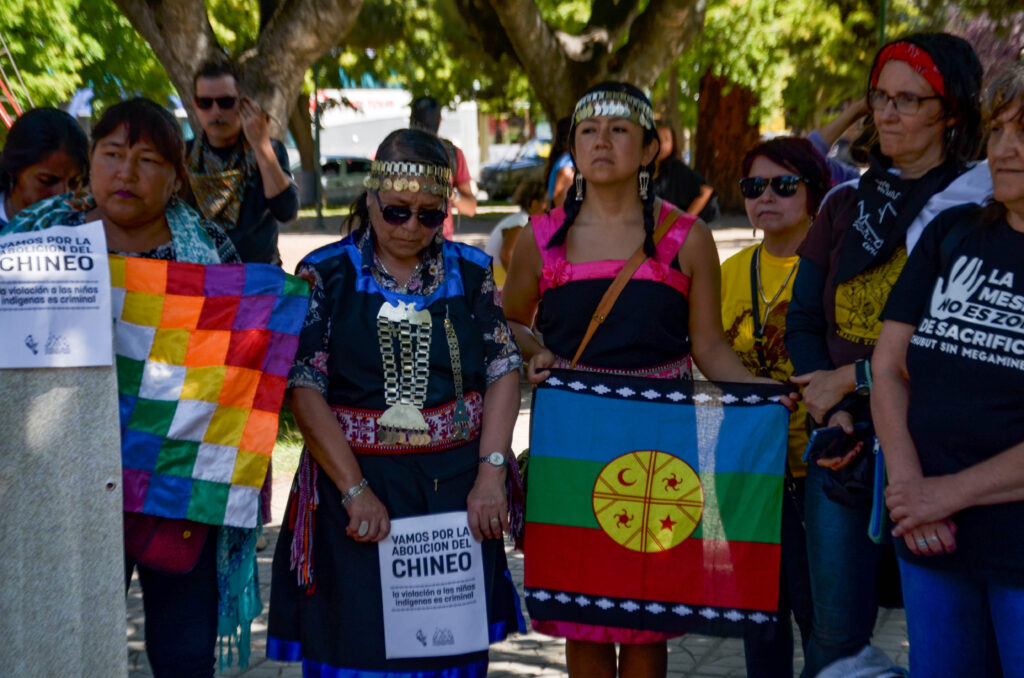
“Chineo arrived with colonization and the oppression of our bodies—our territories. It is infanticide.” “The word 'chineo' carries a colonial weight and speaks of a racist, patriarchal, and genocidal act. We shout it to say enough is enough.” “We demand the abolition of chineo and justice for our ancestors, ourselves, and our girls.” The posters inform and demand. One of them asks for help to “break the sexist, racist, and colonial pact.” These are some of the key messages of the campaign, which began in October 2019 during the peaceful occupation of the Ministry of the Interior, which brought together women from different communities.
“That’s where the women expressed what they were going through. So when we met in February for the Climate Camp, we launched the campaign,” Noelia Chumbita, from the Kakán Diaguita Los Chumbichas Indigenous Community, located in the province of La Rioja, told Presentes. As a member of the Indigenous Women’s Movement, Chumbita is one of the campaign’s spokespeople. “This has always been happening; it’s just that now the women have raised their voices,” she emphasized.
Last February, in the Pillán Mahuiza community, a territory now known as the province of Chubut, during the Climate Camp: Peoples Against Terricide, the campaign was launched and a document denouncing the "chineo" was read during a march that took place.
The claims of the campaign against child pornography
The campaign demands:
– “Justice for all the sisters who are going through these crimes”
"That 'chineo' be declared a hate crime." In other words, she is asking for an aggravated penalty in cases of gang rapes committed by non-Indigenous people against Indigenous children and women, "because it is being done under discrimination, under a racism that exists against our sisters," due to "the racist undertones of the act," the spokesperson explained.
-It is also demanded that these crimes be declared imprescriptible.
"The campaign is also being done so that 'it is no longer said to be a cultural practice and so that it is known that it is a systematic colonial policy,'" Chumbita explained.
-They demand sanctions for companies operating in Indigenous territory whose employees commit these crimes. Chumbita said there are testimonies from women reporting gang rapes committed by members of “companies working in the territory,” both in the south and the north of the country. Therefore, another demand is that in these cases, “the company be barred from working in the territory.”
The debts of Justice
The peaceful occupation of the Ministry of the Interior in 2019 involved women from the Guaraní people who inhabit the territory that is now the province of Salta, one of the places in the country where this criminal practice of group rapes by criollos against indigenous girls and women is still in force, especially in the Salta Chaco.
“We, Indigenous Women of the 36 Nations organized in the Indigenous Women's Movement for Good Living, have decided to speak out, denounce, and raise awareness about this very delicate issue,” says one of the campaign messages.
The Chineo began to gain more visibility in 2015, when the rape of a girl from the Wichí People perpetrated by eight Creole men in Alto La Sierra, a place on the border with Bolivia and Paraguay, in the jurisdiction of the municipality of Santa Victoria Este, Rivadavia department, came to light.
The girl was 12 years old and has a mental and physical disability. She was given the pseudonym Juana for the purposes of publicizing the case, which feminist movements have taken as an example of other cases that go unreported.
The sentence was handed down in February of last year. The First Chamber of the Tartagal Trial Court sentenced six men of mixed European and Indigenous ancestry to 17 years in prison for the crime of aggravated sexual assault, due to the number of participants, the victim's incapacity, and the involvement of underage perpetrators. In their ruling, Judges Anastasio Vázquez Sgardelis, Osvaldo Chehda, and Ricardo Martoccia took into account the elements of gender-based violence and the racism of the Chaco region toward Indigenous people. The term "Chaqueños" refers to the people of mixed European and Indigenous ancestry from the Salta Chaco region, an area of 64,000 square kilometers encompassing the departments of Orán, San Martín, and Rivadavia, one of the areas with the highest rates of unmet basic needs.
"These types of violations have always happened."
“To the entire context of ethnic and racial discrimination, we must also add the inherent machismo of the Creole man from the Salta Chaco region. He sees women as objects—means to satisfy his position in the social environment in which he lives—objectifying them and considering them as his property. These characteristics are imposed upon him by the culture, which is specific to the geographical area where they live,” the judges stated. They added: “The idiosyncrasy of the man from the Salta Chaco region is that of the 'macho' who compares himself to others. He is only concerned with his own satisfaction, with what he considers his 'manliness,' regardless of the humiliation of women, since he sees and feels her as a means to achieve something.”
“These kinds of rapes have always happened in this community, but since nobody knew anything, and nobody ever went to the city, nobody dared to report it,” said Julio Díaz, a bilingual teacher and community leader in Alto La Sierra, after the sentencing. Even before this incident, other members of the Wichí people, such as Francisco Pérez, coordinator of the Lhaka Honhat Association of Indigenous Communities, had raised concerns. In 2011, he publicly denounced the threats and pressure received by the family of a 14-year-old girl from Santa Victoria Este, who had reported her daughter's rape by adult non-Indigenous men.
Pérez also denounced the persistent and systematic rape of girls and women from the Wichí community. He noted that a sister of this teenager had also been raped previously. The coordinator said that this case was never solved, and the young woman ultimately died because someone forced her to drink beer laced with broken glass, apparently to silence her.
In 2010, Pérez's granddaughter, who lives in Misión La Paz, a town near Santa Victoria Este, separated from Paraguay only by the Pilcomayo River, was raped. The Indigenous leader recounted that the accused was detained but later released, and they believe he was never convicted. Pérez recalled another rape of a young girl, committed in 2007 or 2008. He stated that "none" of these cases "saw justice," and that in all instances the accused were non-Indigenous men. Pérez spoke of a "custom" of raping Wichí girls. He said there are many known cases in the communities and many more that never come to light because "Wichí girls generally don't speak out."
“The word #chineo does not originate from ancestral Indigenous thought; the word chineo belongs to the oppressor, the invader, the Creole #rapist. The word chineo reveals how our bodies have been racialized and our lives devalued, and we will continue to use it to demonstrate that we do not forget, we do not forgive, and we demand justice.” This is the message from the Indigenous Women’s Movement for Good Living campaign, which asks people to share and help raise awareness and “break the #machista, #racist, and #colonial pact.”
The content can be found at:
⚠AC: Audio with stories. #Chineo #Infanticide #Rape #Racism #Colonization #Genocide From the Movement of...
Published by Indigenous Women's Movement for Good Living in Thursday, August 20, 2020
We are present
We are committed to journalism that delves into the territories and conducts thorough investigations, combined with new technologies and narrative formats. We want the protagonists, their stories, and their struggles to be present.
SUPPORT US

FOLLOW US
Related notes


We are present
This and other stories are not usually on the media agenda. Together we can bring them to light.