

Trans women gain access to their first decent housing thanks to the initiative of a nun
Neuquén, in southern Argentina, became the first city in the world to have a trans "neighborhood".


Share

By Laura Loncopan Berti *
Photos: Diario de Río Negro/Provincial Government
Neuquén, in southern Argentina, has become the first city in the world to have a trans "neighborhood." It's a complex of studio apartments for the exclusive use of twelve older trans women who were able to escape marginalization thanks to the support of Sister Mónica Astorga. Astorga, of the Discalced Carmelite order, took on this project ten years ago and secured support from the provincial government and the Church.
“From the very first moment, she started helping us in every way. I had been living in a boarding house for 15 years. Obviously, I'm not ungrateful, but the place wasn't decent to live in,” Érica Díaz tells Presentes. She continues: “When you go to ask for a rental, they tell you 10,000 pesos, and then when they see your face, they say 25,000. That's the first thing that happens; discrimination has always been there.” On Monday, August 10, she became one of the trans women to move into the Costa del Limay housing complex, designed to guarantee access to housing for this historically excluded population.
Díaz lives in the city of Neuquén, but is originally from Cutral Co, the town that in 1996 established the picket line as a form of social protest against the devastation caused by unemployment after the privatization of YPF. A decade ago, he met Sister Astorga.
“We were never able to live decently in a nice house; we always end up in the worst places. We all live poorly in that sense because it's always so much more expensive. Then Sister Monica said, 'Let's start a project.' The project took ten years, and thank God, now I'm in my own home, watching my dogs play in the yard,” she says.
Erica is a sex worker and is 40 years old. The average life expectancy for the trans community is around 35.
“Since I arrived here, I’ve been getting up at 6 to make the place look nice,” he says.
Sister Monica receives the photos that everyone sends her: “one of them told me: “the bathroom in the house is bigger than the room where I rented.”
Sister Monica's project
“I started working with trans people 14 years ago. What impacted me the most was that when I asked them what their dream was, they told me that what they wanted was a bed to die in. For me, that was very moving,” Astorga told Presentes.
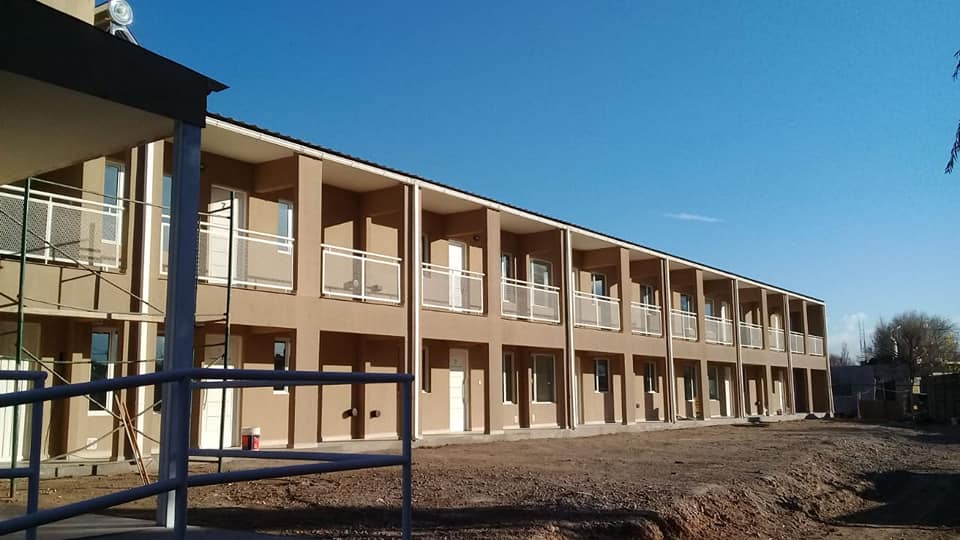
The complex of 12 studio apartments is located in the Confluencia neighborhood. The project required an investment of 27.6 million pesos. The Discalced Carmelite monastery, to which the nun belongs, manages the facility, which is exclusively for vulnerable adult transgender women. It has six apartments on the ground floor and six on the upper floor, along with a multipurpose room.
The project involved not only the provincial government—whose construction was overseen by the Housing Institute—but also the city of San Miguel de Allende, which ceded the land to the monastery in 2017. Those present at the inauguration included the beneficiaries, the nun, Governor Omar Gutiérrez, and Mayor Mariano Gaido.
The complex, Astorga explains, is “registered in the monastery’s name. This allowed us to resolve the entire process, because if we had given it to an organization, there was a risk that it would later dissolve, leaving only one or two people with the place. The monastery manages it, but we can’t use the place for any other purpose. They were given a loan agreement. They don’t pay rent and can live there until they die, or if they want to leave and vacate the place, another trans person will occupy it.”
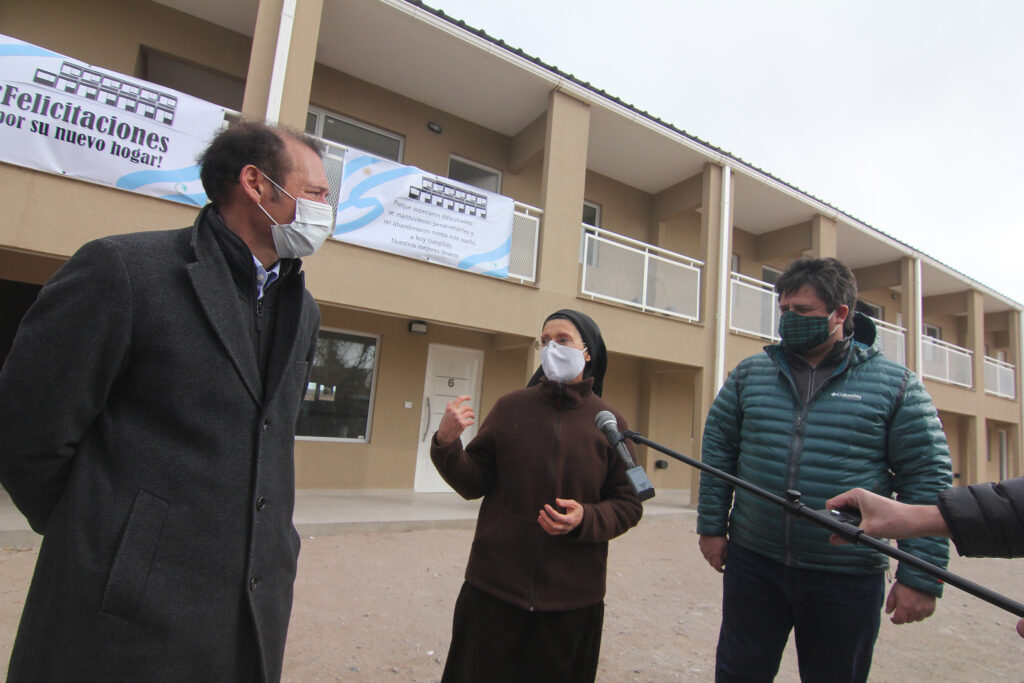
For Astorga, the first form of exclusion this population experiences comes from their own families. “Most of the trans people I work with were expelled from their homes between the ages of 8 and 15, and some never had any further contact with their families. They continue to be killed to this day in Argentina. From January to the present, we have had 58 deaths, with an average age of 35. The last one killed was in Tucumán (Vanesa Solórzano),” she points out.
The family isn't the only institution resistant to transgender people. The Catholic Church, to which the sister belongs, is also resistant. "Yes, I've had disagreements with several people, but I have the Pope's main support, and he accompanies me," she says.
She has known Jorge Bergoglio since he was a Jesuit at the Colegio del Salvador in Buenos Aires. She says he sent her photos of the inauguration. “He sends me messages like ‘greetings to your girls,’ not photos of those men dressed as women, those sick people,” the sister adds.
She is a role model for priests and nuns across the country who assist transgender people. “It’s like making dough; this work is done with a minimal amount of yeast, and it ferments. Very slowly. That’s why, from within the Church, I let the closed-minded conservatives say whatever they want, those who go out shouting and boasting that they fight for both lives, but are letting this other group, who also deserve to live, die. A path is being forged with this little bit of yeast,” she points out.
Discrimination, economic motives and overpricing
In 2018, the first survey of the trans population of Río Negro and Neuquén was presented by the National University of Comahue in collaboration with LGBTIQ+ organizations, with contributions from the Human Rights and Diversity departments of both provinces. The report provides a detailed socio-demographic characterization of the population, based on a sample of five localities, and includes information on housing conditions.
According to the published data, 45% of trans people in both provinces “had difficulties renting, which are related to: the discrimination suffered by the interviewees due to their identity (more than 60% in both provinces), economic reasons (around 15% in both Río Negro and Neuquén), and overprices (15% in Río Negro and 7% in Neuquén).”
The study mentions that “although the instrument does not include a question specifically about rental agreements, during its development some respondents revealed that they had never signed one. This implies that variations in rental conditions are recurrent, which impacts the rental value, which in turn produces enormous instability in the possibility of exercising the right to housing.”
Regarding property acquisition, the survey indicates that "68% in Neuquén and 63% in Rio Negro have never tried to buy a home."
“I’m going to teach him how to treat a trans woman.”
For Adrián Urrutia, provincial director of Diversity who was present at the inauguration, the possibility of having a home “compensates for years of persecution.” “ Until 2011, in Neuquén, there were codes of conduct that criminalized transgender people and homosexuality. We repealed them on August 24 at 3 a.m. in the Legislature with pressure from organizations. That same State that criminalized us is now providing a home,” he maintains.
The management provided vans for the move. That's how Paola Guerrero, 46, moved her furniture.
“I used to live with some friends who rented me a room. Always in small apartments. The other women who have houses have inherited them or joined together, because otherwise it’s very difficult for a trans woman to have her own home,” she says.
And she recalls: “I was going to rent, and at one point when I told them, ‘Look, I’m trans,’ that’s when they started: ‘Oh, no, because my husband doesn’t want me to,’ ‘Oh, no, because what will my neighbors say?’ There’s always a prejudice, a ‘but.’ Or they think we’re all troublemakers, that we’re going to ruin the place. At first, you come across as the little monster that’s arrived in the neighborhood. I think for a long time, minds are very closed, and we’re going to stay that way.”
Paola was one of the first activists in Conciencia Vihda, Vidas Escondidas, and ATTTA in the region. It was in this context that she met the sister. “She said to me: ‘Paolita, do you want to have your own house?’ And you know how I started crying!” she recounts.
She transitioned at age 15 and studied gerontology at the Macelino Champagnat Center for Specialized Workforce (CeMOE).
“I was one of the first trans women to enter a religious school with Luján, the first two we opened. On the first day, I didn't challenge him, but I educated the principal of Champagnat, because he addressed us using male pronouns, and I told him: "Look, we're here in a school; I'm going to teach you how to treat a trans woman."
Luján is Luján Acuña, who is 53 years old, a nurse and a role model for older adult trans women.
“These are years of struggle, years of dreams. When we first met Sister Monica, we wondered: “What can this nun do for us?” We discovered it over the years,” Luján emphasizes.
She affirms: “We are the ones responsible for changing this modern, contemporary history. People will talk about us long after our deaths, because we were the first trans women to forge such a strong bond within the Catholic Church, a bond that today we are fortunate to see replicated in several provinces of our beloved Argentina . This gives us the certainty that the Church must recognize transsexuality as part of this society and that the world must give us the place that is rightfully ours: first-class citizens. With all the benefits and obligations that entails.”
*Gender editor at the Río Negro newspaper
All our content is freely accessible. To continue producing independent, inclusive, and rigorous journalism, we need your help. You can contribute here .
We are present
We are committed to journalism that delves into the territories and conducts thorough investigations, combined with new technologies and narrative formats. We want the protagonists, their stories, and their struggles to be present.
SUPPORT US

FOLLOW US
Related notes

We are present
This and other stories are not usually on the media agenda. Together we can bring them to light.