

Why is it necessary to talk about trans children?
Transvestite activist Violeta Alegre interviewed Gabriela Mansilla, mother of Luana, the first trans girl in Argentina to have obtained her new identity document.

Share

By Violeta Alegre
Photos: Archive/Presentes Agency
Trans people are always imagined as adults. We are also imagined in certain times and places: the night, the street, the so-called “red-light districts.” We appear in the police sections of the media, in news stories with stigmatizing headlines, or as buffoons on television. In the libidinal realm where we have been placed (as sewer-bound identities) [1] , the world interprets our lives by registering our bodies, our performativity, which still provokes abjection and moral panic, without any kind of record of our lived experiences.
Behind all these performances, does anyone wonder if they want to be standing on the road? If they could do other work, would they still be there? Who are their families? Are they happy? Who has ever looked at one of us and wondered: How old is she? What was her childhood like?
I could describe my childhood as "happy" because I had family acceptance. Initially, my desires were simply shaping new ways of feeling. When I was just five years old, I liked a classmate in kindergarten and felt very ashamed about it. I'm talking about desire, about liking someone, and not about sexual orientation because I didn't even have a grasp of my own sexuality. The shame and crossing that boy out of photos at that young age were clear signs that something outside of me was telling me that "that" was wrong.
As the years went by, I began to express other desires. I started to grow my hair long, to wear clothes that were traditionally considered feminine. And I began to express this within my family.
“We will always love you, no matter what you decide,” were my parents’ words, which gave me great relief and allowed me to continue believing that my differences wouldn’t be obstacles to achieving what I wanted in life. But that was within my home, and I must say, more so on my mother’s side than my father’s. At that time, I didn’t feel the need to change the name I was given at birth, even though it didn’t match my appearance.
My father had a shop in Grand Bourg (Buenos Aires province) where he sold pet supplies, and I worked there for a few hours. One day, a customer told him, "Your son is so cute, he looks like a little girl." After that comment—which embarrassed me—my father said to me, "What are you going to do with your life? Be whatever you want to be, but make up your mind."
At the time, I didn't quite understand the message; now, as an adult, I can understand that he needed me to conform to a binary, that he wanted me to be "a teenager" or "a teenager," not that "in-between" thing I was being. I felt relieved because I still understood "acceptance," but from that moment on, I began to explore femininity, to desire the feminine, understanding that the only way to be feminine was to be a woman. I didn't have many references from other transvestite or trans people, and my life began to take on a different color: Violet.
The Argentine singer, poet and transvestite activist or “South American trans artivist” (as she likes to be called) Susy Shock, has written and spoken a lot about this hetero-cis-sexual binary system that forces us to “decide”, as my father asked me back then.
“Heterosexuality as a political regime has constructed everything: the laws, the institutions, the symbols, and it cannot stop constructing heterosexuality and cannot, or does not want to, acknowledge that other possibilities exist. So, a teacher stands in a classroom to teach mathematics assuming they are facing heterosexuals, and that in itself is a failure, beyond the violence; it is a failure as a pedagogical system. In most cases, this same thing is reproduced within the family, which ends up being the most violent territory, the space where we wage all our battles because we have nothing at hand that allows us to transcend compulsory heterosexuality,” Susy tells me, who in recent years has dedicated herself to studying childhood in depth.
In 2018, she published “Crianzas” (Upbringing), where she recounts what it's like to be a trans aunt and has supported the struggle of parents of trans children. “We have to start thinking from the perspective of transvestite-trans theory and pedagogy, because we have a practice. In my case, I am a mother and an aunt. I don't know if we have all the theoretical frameworks, because our very evolution, our very impoverished circumstances, don't offer us 'that space of peace,' as Marlene Wayar [2] , to think about ourselves concretely. But we keep doing and implementing in the urgency,” she adds.
What is it like to be the mother of a trans daughter?
Turning these thoughts around, today I also wonder: What is it like to be a mother or father of a trans child? How many questions will run through their minds? How many fears? How much information will they need to avoid repressing or abusing them? How much love?
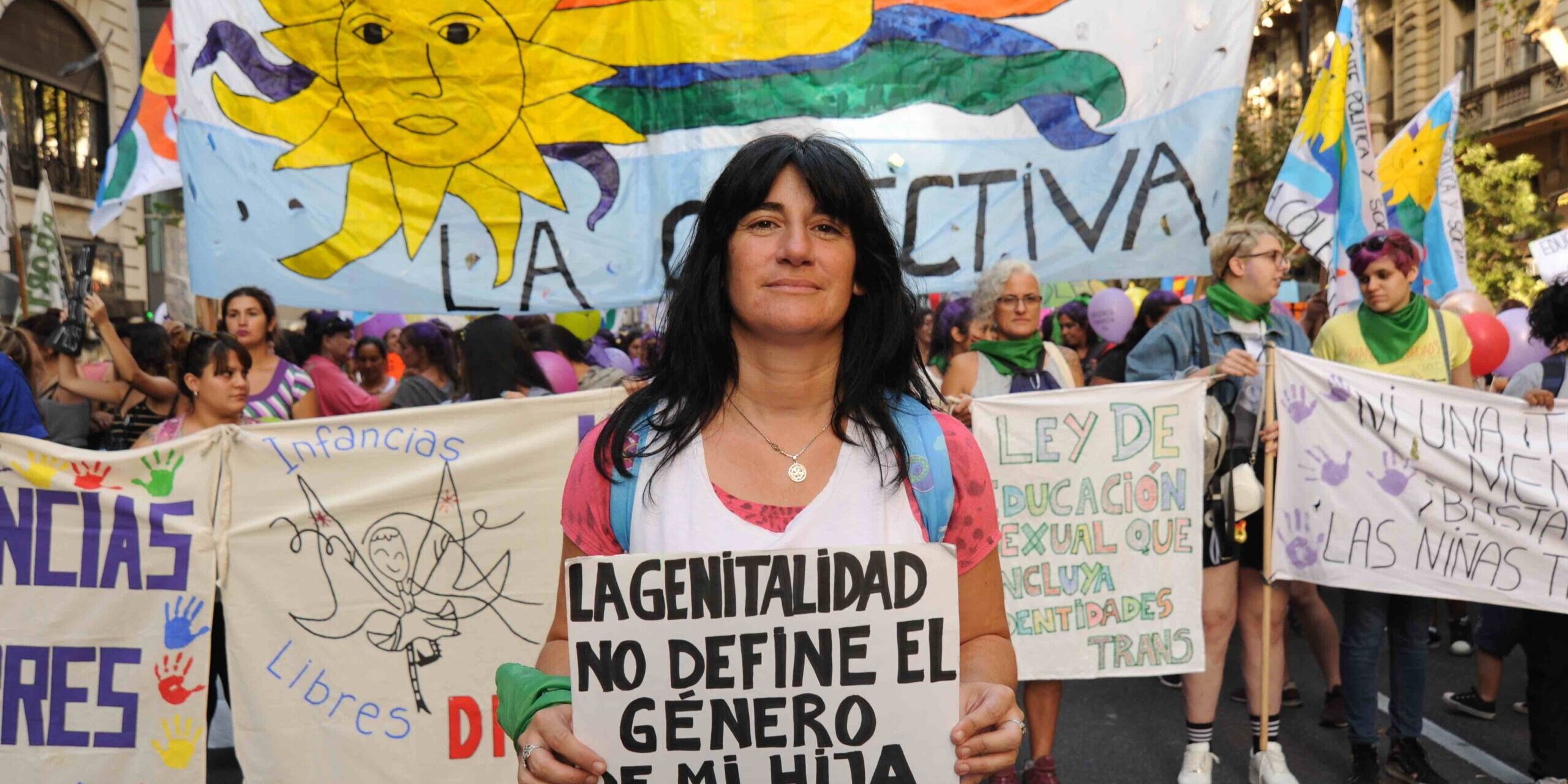
With these questions in mind, I interviewed Gabriela Mansilla. Gabriela is the mother of Luana, the first trans girl in the world to obtain a National Identity Document when the Argentine Gender Identity Law was enacted in 2012. Luana was only 6 years old.
Gabriela became a leading figure in the fight for trans children, wrote the book "Yo nena, yo princesa" (Me a girl, me a princess), documenting her daughter's transition, and founded the Civil Association "Infancias Libres" (Free Childhoods), which defends the rights of trans children and creates a space for support and socialization for their families.
Today Luana is about to turn 13 and Gabriela continues to be an activist like the first day, convinced of the importance of making these childhoods and adolescences visible.
– Why is it important to talk about trans children?
– Starting to talk now about trans children and adolescents will change the 35-year life expectancy of trans people in Latin America; it will put this issue on the political agenda. A different kind of education will begin to take place. We need to talk to change the culture, to lower the level of violence that exists against the trans community. Once it's understood that the path forward is to embrace, understand, support, and respect, then there's the whole other aspect: the outside world. We have to go to school, walk down the street, and so we not only have to work with children so they love themselves, but we also have to work with other children and adolescents so they can socialize with a trans person without rejecting or discriminating against them, dispelling the prejudices that other children or adolescents may have about other trans children. If we don't do that, the violence will continue. We have to start removing the negative stigma and realize: they are children like any other and they need exactly the same things.
-Do you see changes in recent years in the way trans children are addressed?
– Yes, although I don't see major changes. I see changes when we take action, when we demand change, because this arises from other people's will. I'm still fighting to get my daughter respected at school. There are changes, but on a larger scale, they don't even know about the gender identity law and they don't care to learn about it. There's no willingness to delve into the issue. They wait for it to happen, and then, with the pressure mounting, the need to know what to do begins. Having a law helps with all of that. The mothers of this new generation will be eternally grateful to the collective that campaigned for it; it's a tool to exert pressure through the law. There are many cases of private schools with legal advisors who deny rights. We have a letter from Abosex [3] for any situation. We've had to send it to many schools.
– What role do families play in the fight for rights?
– There are a lot of changes we've driven from within families, because the adult trans community has so many urgent needs to address in the here and now. Because they're being killed, they're fighting for labor rights, health rights, housing rights, so they can't be busy going to a kindergarten to talk about trans children. In my case, it wasn't until a year after the publication of the book "Yo nena, yo princesa" (Me, a girl, me, a princess) that other families started to come forward. These so-called "test cases" were needed. Someone who would say, "My child is happy, we survived." The idea isn't for these to be isolated cases, but to talk about free childhoods in general. Because the trans community was never heard in childhood. Nine years have passed, and there are more organizations with families from other areas. Changes are happening, although our children can't yet enjoy them because they're very slow: 7 out of 10 schools in Argentina don't know the gender identity law, and therefore don't know how to address these issues. Apply that to the health system, to going out on the street, to gender violence.

– What are the main difficulties families face today?
The issue is: who listens to a trans child? There's a stigma attached to trans people being prostitutes, and nobody wants a trans person in their home. That's why I say in my talks: "Bring trans people into your home, let them be part of your family, let them be your child's girlfriend." They'll always prefer them to live across the street. There's still a long way to go for true acceptance. People think, "It will never happen to me," and when it does, they're devastated. You have to deconstruct your own biases first to be able to support your child. That's when the violence, the sexism, and how patriarchy permeates everything come to the surface. Mothers have started to awaken and empower themselves, and that creates distance with their husbands. We've also had cases where it's the other way around. Many families have broken up because they have a trans child.
– What myths do you think need to be debunked?
– Biological determinism: the idea that having a penis makes you a man, or having a vulva makes you a woman, and that's that. The law requires us to call people by their gender identity, but many people still think you're something else. The most difficult aspect is cultural, deeply ingrained, and already established. Because the law compels you, but people don't engage their conscience. We're at a point where things are being done, but there's no internal change. For example, for my daughter not to want to hurt or hide her penis, I had to love it first, and that was the genuine feeling she intuited, and that's what's real. It's not just about rhetoric, because the rejection is felt, no matter how much you try to hide it. You realize it when people see you on the street and either like you or reject you.
-What challenges does a trans teenager who transitioned in childhood face?
"I wondered about that for a long time. I think the first thing they face is themselves. I see it in Luana, who has a very positive experience thanks to memories, hugs, and always being at home. But when puberty arrives, I think teenagers face themselves, those physical changes, and that's where the biggest crises tend to arise. For example, in trans masculinities, when breasts start to grow. If you don't have a whole foundation of love beforehand, you just don't fit in. Even if you love yourself, everything's fine inside the house, but when you have to go out into the world, the 'don't let it show' mentality starts. Add to that the lack of maturity to face what an adult faces, that adolescence that is painful and, on top of that, trans. Luana is now in that stage of childhood where she wants to keep playing but also wants a boyfriend, and the opinions of others weigh more heavily. And then relationships with other people begin to emerge, love, the need to be loved for who you are."
– What do you think are the main dangers?
– It's a very dangerous stage; they face the streets, they face society. Social media, abuse, encountering situations involving sexual relationships, having to satisfy someone else's sexual appetite so they'll be loved. Or going to play soccer as a trans man and going through the locker room or showers. Or staying overnight at someone's house, leaving a club with someone, being subjected to interrogations. I tell Luana that I want this to always be her home. That if
If she faces a difficult situation outside, she should come back home. Here she has her mother, her warm bed, the hugs of her aunts and uncles, her grandmother, and her brother. But I can't help but think, who doesn't have that? Do they survive? Families that offer that security are still few and far between. If you see the reality, you're terrified and don't want your children to leave the house. Today, I'm at peace knowing my daughter is trans, she loves herself, and she has no conflict with her body. But tomorrow, if she wants to erase her pubertal characteristics and decides to alter her body with surgery, hormones, or whatever she wants, I will support her. And I know that will come more from external pressures. I'm fighting for something I don't know if my daughter will ever experience, but at least we'll leave a message for future generations: that they have jobs, education, and that someone truly loves them. Having an ID card still doesn't save them from anything, that's why we need a cultural change.
Gabriela's words resonate with me, taking me on a journey through my own story. I began to love my body because it was loved, desired, and accepted. And not by a man, but by the first institution that should embrace us: family. In my case, my mother was the one who, until her last hours, stroked my hair and, looking at me, said, "You look so beautiful." Thanks to those moments, I was able to keep living. Thanks to those moments, I love myself, I love others, and I allow others to do the same.
The future is genderless when they stop killing us.
As Gabriela tells us, we are undergoing this cultural and emotional shift within our community. And at the same time, every trans and travesti activist, some more visible, others hidden, is present in neighborhoods and various spaces. Sometimes they're delivering a bag of groceries to another, because they know what deprivation is, or working in a community kitchen preparing milk for those who don't have any. These are actions that pave the way. They open, among other things, the possibility for others to see you, to know that you are committed to the struggle against lovelessness and denial. And to working so that this doesn't continue to happen to new generations. Even as we engage in educational work about our existence, because our activism transcends personal "benefits," we are shouting to a world to let us live with dignity. To not break the wings of our young. To take responsibility for what is so often reduced to a mere biological act that brings another being into this world. Let them know: they don't deserve the violence we perpetuate through action or inaction. It doesn't take much more than shedding the affective pedagogy with which we were raised and creating new ways where "the engine of change," as Lohana Berkins would say, which is love, prevails.
Violeta Alegre is a trans activist, researcher, and columnist for Agencia Presentes. She has consulted for the World Bank and the United Nations Development Programme (UNDP), along with the Ministry of Labor (Argentina). She has published in the Soy supplement (Página/12) and in academic journals. A graduate in Gender, Politics, and Participation (National University of General Sarmiento), she teaches in that program. She coordinates workshops on the topic, has been invited to participate in talks and courses in Latin America and Europe, and is in charge of the Gender Identity and Sexual Orientation Office of the Justice Observatory of the City of Buenos Aires. She is a co-founder, with Susy Shock and Marlene Wayar, of the organization La Colectiva Lohana Berkins.
[1] Term used by the transvestite activist and leader Lohana Berkins to refer to the fact that all the shit is placed on us: therefore, all violence is justified.
[2] Marlene Wayar is an activist and a leading figure in the transvestite and trans community in Argentina.
[3] Abosex is a network of legal activists for the rights of gender and sexual diversity.
All our content is freely accessible. To continue producing independent, inclusive, and rigorous journalism, we need your help. You can contribute here .
We are present
We are committed to journalism that delves into the territories and conducts thorough investigations, combined with new technologies and narrative formats. We want the protagonists, their stories, and their struggles to be present.
SUPPORT US

FOLLOW US
Related notes


We are present
This and other stories are not usually on the media agenda. Together we can bring them to light.