

Emma Barrandéguy: a taboo novel about lesbian love
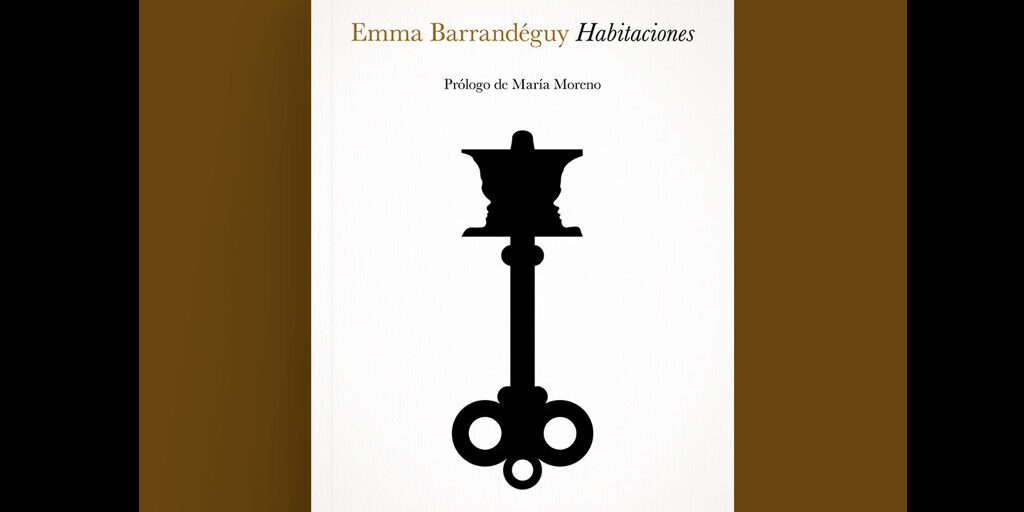
Opening a book is like opening a door to desire. This is the invitation Emma Barrandéguy extends to us in Habitaciones, a lesbian fiction novel written in epistolary form, reissued by La Parte Maldita.


Share

Written at the end of the 20th century and rescued fifty years later by María Moreno, this work by Emma Barrandéguy (Gualeguay, Entre Ríos) anticipates the decade of demands for sexual liberation and theories about sexual minorities. “Memoiristic, autobiographical, utopian, enlightened, perverse, and anti-establishment. All of that is Habitaciones (Rooms ) and, because of its very radicalism, much more. It is an unprecedented experience in the context of Argentine literature of that time,” Moreno recounts in the prologue, who would talk with Barrandéguy on enough occasions for the latter to confess that “growing old isn’t sad because you always have your clitoris.”
The book remained unpublished for almost half a century. “In the 90s, when María Moreno discovered it, lesbian visibility was nonexistent, and many of the themes this novel explores were taboo,” Gabriela Borrelli, a journalist, poet, and lesbian-feminist reader, tells Presentes. Written within the context of the Latin American Boom, an exclusively male journalistic and literary movement, the irreverence of its words condemned it to obscurity. And when it was finally published in 2002, it was a limited edition, impossible to find, and read only through borrowed copies passed from hand to hand.

To this day, in Entre Ríos, Emma's name barely resonates. The members of the transfeminist group Hermanes de Villaguay had never heard of her. “I think we don't know her because she's from Entre Ríos, because she's a woman, because she might have had a reputation for being a lesbian. I don't want to sound angry with this town, but sometimes it's so narrow-minded,” Vito (30 years old) tells Presentes. “Growing up in Villaguay meant growing up without knowing that I could be a dissident. When I was in high school, we had no role models or education about diversity, and there was no support in schools.”
“I read the novel in PDF format because it was impossible to find; it was completely out of print. That's why I insisted so much on its re-publication,” explains Mauricio Koch, editor at La Parte Maldita. “It's not just about correcting an injustice, but about valuing and circulating ideas and aesthetic proposals that move us .”
It is for this reason that Koch, along with Santiago Kahn and Alejandro Pisera (editors of La Parte Maldita), conceived a collection made up of women writers from the mid-20th century. “Most of them were contemporary authors of the boom , with interesting and complex works that, simply because of their gender, were relegated and forgotten or poorly or little read at the time,” Koch explains.
Lesbian love
For Borrelli, Habitaciones tells a universal story that was and continues to be very daring for addressing topics that are taboo within lesbianism. “One example is the issue of age difference within a couple, something we have discussed a lot in cisheteronormative terms. But we haven't explored it as much in lesbianism. It remains a taboo subject.”
“It’s a novel that anticipates the imagery of her later poetry collections: love in old age and sex before and after adulthood,” the poet explains. “The turning point is when the protagonist of Rooms discovers her early love for a pre-adolescent girl.” Added to this are lovers, travels, jealousy, and an epistolary exchange overflowing with passion. “My dear, not only a refuge but an island where I immerse myself and breathe, relieved of all my tensions (…)”.
According to the editor of *La Parte Maldita*, these were the same reasons why the book remained in obscurity for so many years. “It is a work written by a woman who lived almost her entire life in a small town in Entre Ríos, far from the big cities. And yet she did not succumb to picturesque regionalism and created a lasting, honest, and unsettling body of literature .”
It was Koch who brought the proposal for a reissue to the publishing house. Like Barrandéguy, he too spent part of his childhood and adolescence in a town in Entre Ríos. “In Emma’s case, her ideas were too revolutionary for her time and didn’t have access to major publishing houses. Her texts circulated in small, local editions, and in other cases, they weren’t published at all.”
Injustice and falsehood
Vito believes it's urgent to learn about Emma Barrandéguy and read literature about life in the provinces. She recalls, “When I was in high school, we had no role models, no education on diversity, and no support in schools.” “I wanted to go to a technical school, but I ended up in a convent school where they made us kneel to see if our jumpers reached the floor. We didn't have much room to develop our desires. It's very important to understand how the dissident groups that grew up in the provinces felt historically, to awaken new perspectives and move beyond the established norms.”
This is possible because, according to Borrelli, it is "a novel that finds in a structure as classic as the epistolary one a very fresh form of development, which is why it always seems new."
Koch says that while the work narrates a lesbian romance, “it is also a fierce critique of the conservative shallowness of towns (“Injustice and falsehood are, for me, provincial life and falsehood” ), from which the narrator can escape when she goes to the library to read a series of obscene books that an old librarian was in charge of including in the catalog.”
For the editor, the text's relevance makes it an essential book for our time. “There's a formal freedom, a boldness, a complete lack of solemnity that is sorely needed in our current literature, always on the verge of stagnation. Emma's work was written in solitude, far removed from trends, market concerns, and lobbying for positioning. She wrote a novel for our time that narrates a love between women before sexual minorities were even theorized about. Before words—the words we use today—even existed to name their desires.”
We are present
We are committed to journalism that delves into the territories and conducts thorough investigations, combined with new technologies and narrative formats. We want the protagonists, their stories, and their struggles to be present.
SUPPORT US

FOLLOW US
Related notes
We are present
This and other stories are not usually on the media agenda. Together we can bring them to light.