

The Salta court sentenced Mirna Di Marzo's transphobic murderer to life imprisonment.
The Salta Justice system sentenced José Gustavo Gareca to life imprisonment for the "aggravated homicide due to gender violence" committed against Mirna Antonella di Marzo.


Share

By Elena Corvalán, from Salta
Judge Roberto Faustino Lezcano, of the Fourth Chamber of the Salta Trial Court, today sentenced José Gustavo Gareca to life imprisonment, finding him guilty of aggravated homicide due to gender-based violence in the murder of transgender woman Mirna Antonella Di Marzo.
The crime occurred in the city of General Güemes, about 50 kilometers south of the city of Salta. Gareca attacked Di Marzo with punches and kicks on October 21, 2018, near the Caribe Disco nightclub, where they had apparently met. The victim was left unconscious and remained in that state until January 27, 2019, the day she died.
The now-convicted man was identified by witnesses and security camera footage from nearby businesses.
It was not considered a hate crime
The sentence was exactly as requested by prosecutor Ramiro Ramos Ossorio, who maintained the charge of aggravated homicide due to gender-based violence, based on the fact that "Argentine law and the state recognized Mirna's gender identity" and that this recognition had been formalized by granting her an official identity document that recognized her as a woman. "She was Mirna Antonella Di Marzo," he emphasized.
And while he acknowledged that there may have been an attempted sexual assault, and that there may have been a hate crime element—in fact, he pointed out that the blows were to the victim's face—he considered all of these factors to be subsumed under "the ultimate expression of gender violence," which is murder.
Regarding the accused, for whom he requested a life sentence, he maintained that the accused has "a life history marked by violence" against women. He stated that the accused committed sexual offenses and crimes against life linked to sexual offenses. He affirmed that although the accused refused a psychological evaluation, it is known, through the analysis of his phone, that he consumed videos of men committing violence against women and that he filmed women he was stalking.
The legal team representing Mirna's family had requested the same sentence, but they argued that the State and the Salta justice system had to recognize the crime of transfemicide or travesticide in the ruling, thus acknowledging the victim's self-perceived gender identity. "
I want to focus on the aggravating circumstances," because their application "also contributes to the justice that this party considers necessary," stated lawyer José Lazarte, representing the legal team formed by Mirna's father, Oscar Daniel Di Marzo, on behalf of his entire family.
The lawyer argued that Gareca acted with premeditation, because he waited until Mirna was unsuspecting and defenseless, and then attacked her "treacherously." He asserted that there was gender-based violence, but differed from the prosecutor in that while the latter classified the act as an isolated homicide (an isolated attack), the plaintiffs argued that "it is a non-related transfemicide." "This term, which may seem new, is not new at all," because Mirna "identified as a trans person," and that must be recognized by the court, Lazarte insisted, adding that the attack expressed "hatred of gender identity." He further stated that "Mr. José Gustavo Gareca's motive" was "a motive of hatred. To take her life for being a transvestite, for being trans. The motive was gender-based violence."
The plaintiff's lawyer also argued that "profound changes are needed in different institutional spheres" to stop reproducing structural violence that manifests itself in various ways, such as referring to the victim as if they were male. He maintained that "the justice system is not exempt from this violence," nor are any of the other branches of government.
"It should be called transfemicide"
“Antonella Di Marzo’s life was the self-perceived life of a trans woman,” she emphasized before concluding: “Taking her voice, because she is not present here today, this side believes that Mr. José Gustavo Gareca should be sentenced to life imprisonment for the crime of aggravated homicide, due to gender-based violence and hatred based on gender identity, to the detriment of Mirna Antonella Di Marzo, and that this homicide should be classified as a transvesticide or transfemicide.”
Gareca’s defense attorney, Walter Clark, argued, however, that the trial had failed to establish certainty regarding his client’s involvement in Mirna’s murder and requested his acquittal based on reasonable doubt.
To support his request, he pointed out, among other things, that the images captured by the security cameras did not show his face, and he also maintained that the Investigations Brigade was at fault because it had an interest in protecting the police officers working extra shifts at the nightclub who had allegedly been warned about the attack and did not intervene. The defense attorney also argued for the dismissal of the testimonies of two women related to the nightclub owner, claiming that they lied to avoid a civil lawsuit against the company for failing to assist the victim.
The judge rejected the dismissal, as well as the request for acquittal, and instead opted for a conviction, as requested by Prosecutor Ramos Ossorio. In the operative part of the ruling, he made no mention of the prosecution's arguments.
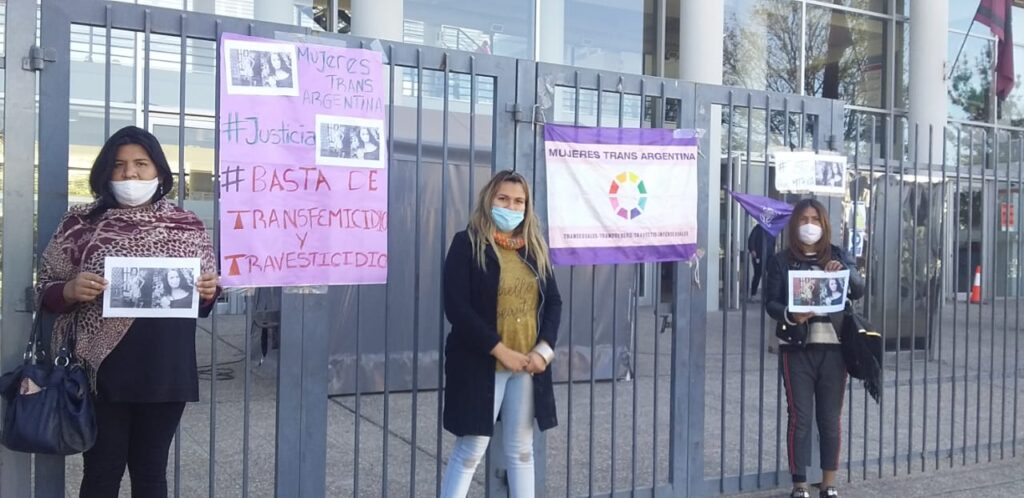
The hearing was held behind closed doors, as was the entire trial, due to pandemic restrictions. However, this time the arguments and the verdict were broadcast on the Salta Judiciary's press office YouTube channel. Despite the restrictions on movement, a small group of members of the LGBTIQ+ community gathered mid-morning at the entrance to the courthouse, holding signs demanding justice for Mirna Di Marzo and insisting that the crime be recognized as a transfemicide or travesticide.
The request from the plaintiffs and the LGBTIQ+ community had received the support of the Observatory of Violence Against Women (OVcM), which presented itself as amicus curiae (friend of the court). “This Observatory considered it appropriate to collaborate technically in this process, understanding that the ruling in this case affects the public interest and encompasses the human rights of people of diverse sexual orientations and gender identities residing in the province of Salta,” explained one of the directors of this organization, Ana Pérez Declercq, who participated in the final hearing of the trial.
The OVcM stated that it understood that “the ruling in this case, which judged the transfemicide of Antonella Mirna Eva di Marzo, should assign the facts a legal classification that captures the specific violence experienced by the trans community and that corresponds to the expression of the systematic violation of the human rights of people in this community.”
Attack and social complicity
Mirna was 31 years old when she died. She lived with her family in a working-class house in General Güemes. She had worked as a prostitute at some point, but since March 2018 she had resumed her secondary school studies and was determined to turn her life around. She took care of the housework, and she and Janet made homemade sweets to sell.
According to testimonies detailed by the prosecutor in the indictment, the attack lasted approximately 20 minutes. The attack was witnessed from a distance by at least three people who did not intervene. Two young women excused themselves by saying they feared being attacked as well or didn't want any trouble. The third witness was a taxi driver who, by illuminating the scene with his car, caused Gareca to flee. Mirna was left unconscious at the scene, on 20 de Febrero Street, and never recovered.
“She was a cheerful girl, a good daughter. She had her issues because she was trans and she was discriminated against. I want justice to be done because my daughter deserves it. They abandoned her to her fate,” said her mother, Cristina Salas, during the first day of the videoconference hearing.
We are present
We are committed to journalism that delves into the territories and conducts thorough investigations, combined with new technologies and narrative formats. We want the protagonists, their stories, and their struggles to be present.
SUPPORT US

FOLLOW US
Related notes


We are present
This and other stories are not usually on the media agenda. Together we can bring them to light.